

Whales Accumulate Bitcoin While Liquidations Drop Sharply
Friday, August 14, 2026
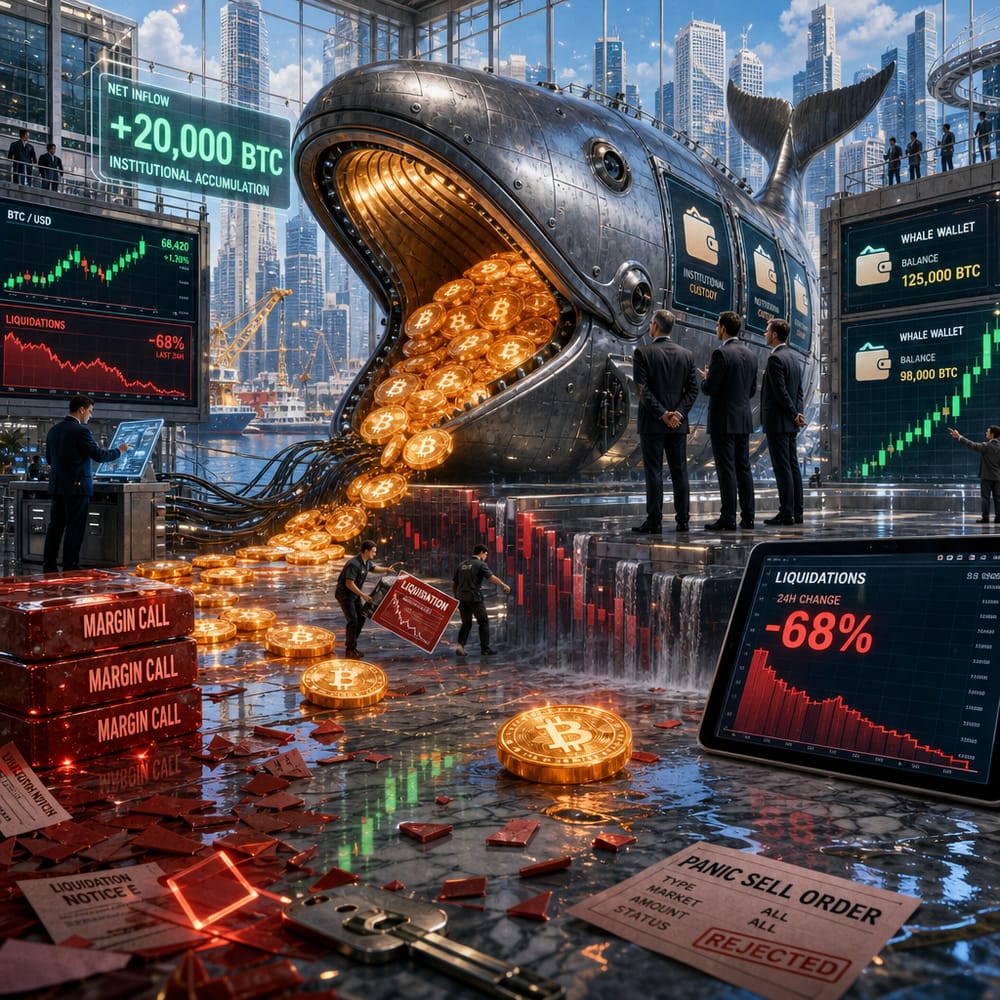
WHALES ON A BITCOIN SHOPPING SPREE: WHAT IT MEANS FOR THE MARKET
If it feels like the world of Bitcoin has been a bit more sedate lately, that's because it has. In the wild west of cryptocurrency, where volatility usually reigns supreme, recent data shows that large Bitcoin holders—affectionately known as "whales"—have quietly been on a buying spree. Since late July, they've scooped up over 20,000 BTC. Meanwhile, liquidations on the Bitcoin market have nosedived by 68%. What gives, and more importantly, what does it mean for you?
WHALES ON THE MOVE
Let's start with our oceanic friends—the whales. These are the big players in the Bitcoin pool, the ones whose moves can send ripples across the market. When these leviathans start accumulating Bitcoin, it signals a shift in sentiment. They aren't just hoarding digital gold for kicks; they likely see potential for brighter days ahead in Bitcoin City. It's as if these whales have suddenly decided Bitcoin is on sale and are stocking up before the price tag gets hefty again.
This behavior hints at a broader confidence in Bitcoin's long-term value, despite the choppy waters of short-term price fluctuations. When the heavyweights are buying, it's a pretty solid vote of confidence in the crypto's future.
LIQUIDATIONS: FALLEN AND CAN'T GET UP
Now, let’s talk liquidations. In the crypto world, liquidations often occur when leveraged traders—those betting more than they can afford to lose—get wiped out because they couldn't meet margin calls (essentially: "Hey, pay up or lose what you staked!"). With liquidations down by a hefty 68%, this suggests a more stable market environment. Lower liquidations mean less forced selling, which reduces downward pressure on prices.
So, with fewer fire sales, Bitcoin's price may stabilize further, giving it room to grow without being tripped up by a sudden avalanche of sell-offs. This healthier market dynamic is a win for investors who prefer a slightly less turbulent ride.
UNDERLYING FORCES AT PLAY
But wait, there's more. Are there any external forces nudging these trends along? Let's peer outside the crypto bubble for a second. Over in traditional finance, the 10-year U.S. Treasury yield is barely budging, which tells us investors aren't exactly dancing in the streets over economic growth prospects. Meanwhile, the Federal Reserve's short-term interest rates are adjusting only gradually. This creates a backdrop where traditional investment returns are flat, which can make Bitcoin's potential returns look a tad more appealing. It's akin to trying out the new spicy dish on the menu when the usual fare just isn't doing it for you anymore.
Geopolitical tensions, like those simmering between Japan and Russia or in the Middle East, can also divert attention to alternative assets like Bitcoin. When the global political landscape looks about as stable as a Jenga tower in a hurricane, some investors start eyeing Bitcoin as a safe haven.
THE TAKEAWAY FOR YOU
So, what does all this mean for you, the retail investor keeping an eye on your phone for the next big thing? If the whales are in a buying mood and the market is seeing fewer forced sell-offs, Bitcoin could be gearing up for its next big chapter. While nothing is ever certain in the crypto world (or anywhere, for that matter), these trends point to a potentially more stable and promising future for Bitcoin prices.
But, as always, tread carefully. The crypto seas are as unpredictable as ever, and while the whales may be giving you the nod, it's crucial to do your homework and make sure diving into Bitcoin suits your risk appetite and financial goals.
In the end, whether you're just dipping your toes in the crypto pool or are already swimming with the whales, understanding these shifts can help you navigate the waters more smoothly. So, keep your eyes peeled and your wits sharp—Bitcoin’s journey is as captivating as ever, and you won't want to miss the next wave.
This article is for informational purposes only and is not investment advice. Always do your own research or consult a licensed financial professional before making investment decisions.
© Copyright 2024. All Rights Reserved.
© Copyright 2024. All Rights Reserved.