

Wendy's Plunges on Activist Angles
Saturday, August 29, 2026
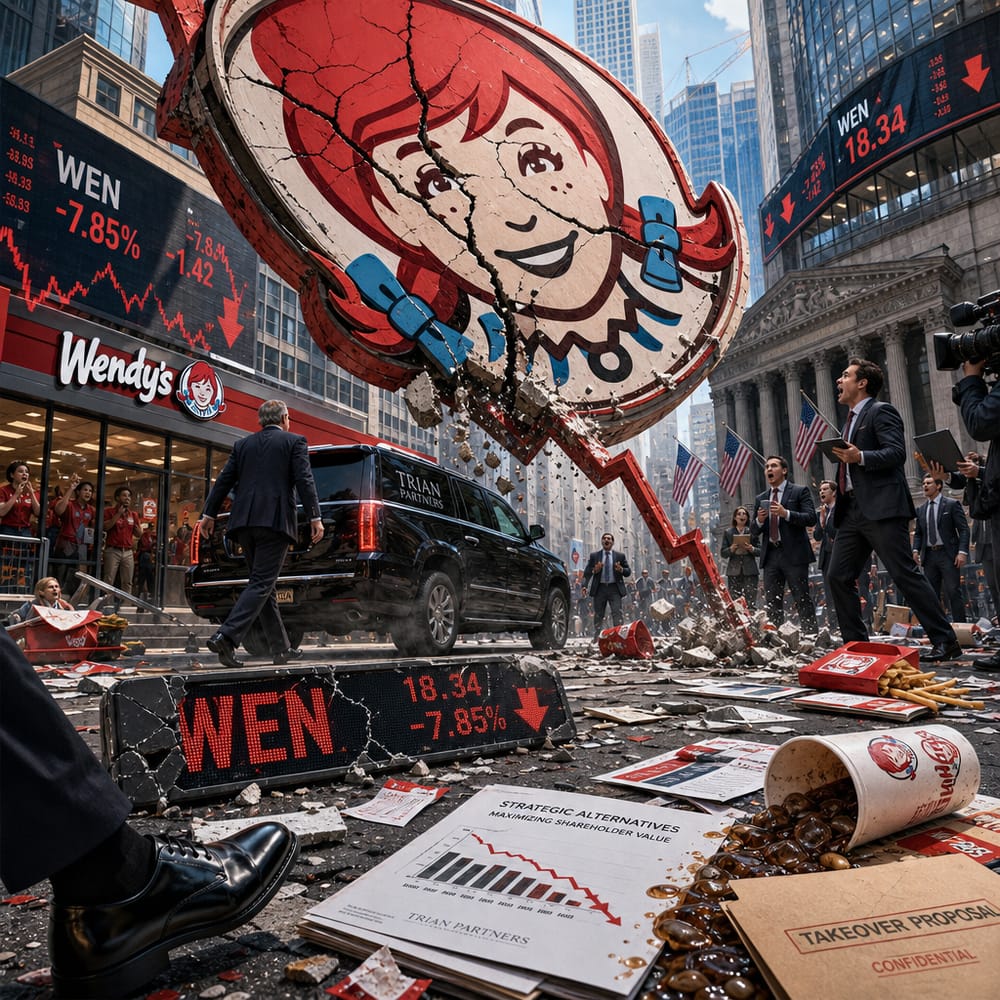
Wendy's Shares Get Grilled as Trian Fund Sizzles Out
When it comes to Wendy's, we might just have a case of "Where's the beef?"—or more accurately, "Where's the buyout?" The burger chain’s stock took a dive faster than fries in hot oil after reports emerged that Trian Fund Management, the activist investor with a penchant for shaking up boardrooms, decided to take a rain check on its takeover ambitions. The result? Investors basking in the afterglow of a potential deal were left nursing their wounds as Wendy’s shares plunged in response.
WHAT CAUSED TRIAN FUND’S ABOUT-FACE?
So, what’s behind Trian's sudden cold feet? Picture this: You're eyeing the last slice of pizza at a party, but as you reach for it, you realize you're not as hungry as you thought. That slice? It's Wendy's. Trian Fund, led by the savvy Nelson Peltz, has been flirting with the idea of taking Wendy's home, but it seems they've decided to leave it on the table for now.
The murmurs suggest that concerns about the financial appetite and strategic fit of such a move may have tempered Trian's enthusiasm. With the fast-food sector sizzling with competition and economic uncertainties, it's possible that Trian has decided to refocus its energies elsewhere, leaving Wendy’s to flip its own patties for the time being.
HOW MIGHT WENDY'S RESPOND?
Now, don’t count Wendy’s out just yet. Picture the iconic square patty, resilient and unapologetically different. Wendy's has been here before. With or without Trian’s backing, the chain still has its menu of strategies to grill.
CEO Todd Penegor and the executive team might take this as a cue to bolster internal strategies and prove they can stand tall without an activist investor’s guiding hand. They’ve got the tools—innovation in menu items, digital expansion, and global growth plans. The challenge now is to convince investors that Wendy’s can super-size its potential without Trian super-sizing the deal.
LONG-TERM IMPACT ON WENDY'S STOCK
With Trian's sidestep, Wendy's stock is currently feeling the heat. But let’s not forget, stocks are like weather—they're subject to change. The volatility doesn't necessarily spell doom. Instead, it presents an opportunity for Wendy’s to forge its path.
In the long run, the absence of a takeover bid might just push Wendy's to double down on its growth strategies, seeking new ways to woo investors and customers alike. Marketing revamps, menu innovation, and international expansion could be their secret sauce to bouncing back.
Investors will undoubtedly keep a close eye on Wendy's to see if the chain can navigate the competitive fast-food landscape on its own, or if it will need to court new suitors in the boardroom.
WHAT'S ON THE MENU FOR INVESTORS?
For retail investors, Wendy's current predicament is a tasty reminder of the role activist investors play in the stock market. Peltz and his crew have shown their influence, but their exit strategy also highlights the inherent risks tied to such maneuvers. Activist investors can push up stock prices on whispers of change, but their withdrawal can send those prices tumbling just as quickly.
If you're holding onto Wendy’s shares, you’ll want to keep that seatbelt fastened and stay tuned to the company’s next moves. This might be a time to look beyond the immediate noise and pay attention to the fundamentals—are they flipping burgers, or are they frying up something bigger?
At the end of the day, Wendy’s situation is a masterclass in market dynamics, one where investor sentiment can morph as quickly as a frosty melts on a summer day. So, the next time you're digging into a Baconator, remember that behind those crispy layers lies a world of strategic decisions, boardroom dramas, and the ever-evolving market game. Keep your eyes peeled, and your portfolio diversified, because in the world of investing, as in fast food, variety is truly the spice of life.
This article is for informational purposes only and is not investment advice. Always do your own research or consult a licensed financial professional before making investment decisions.
© Copyright 2024. All Rights Reserved.
© Copyright 2024. All Rights Reserved.