

Weak Jobs Report Influences Fed Rate Hike Expectations
Wednesday, August 19, 2026
WHEN THE JOBS REPORT DINGS, THE FED LISTENS
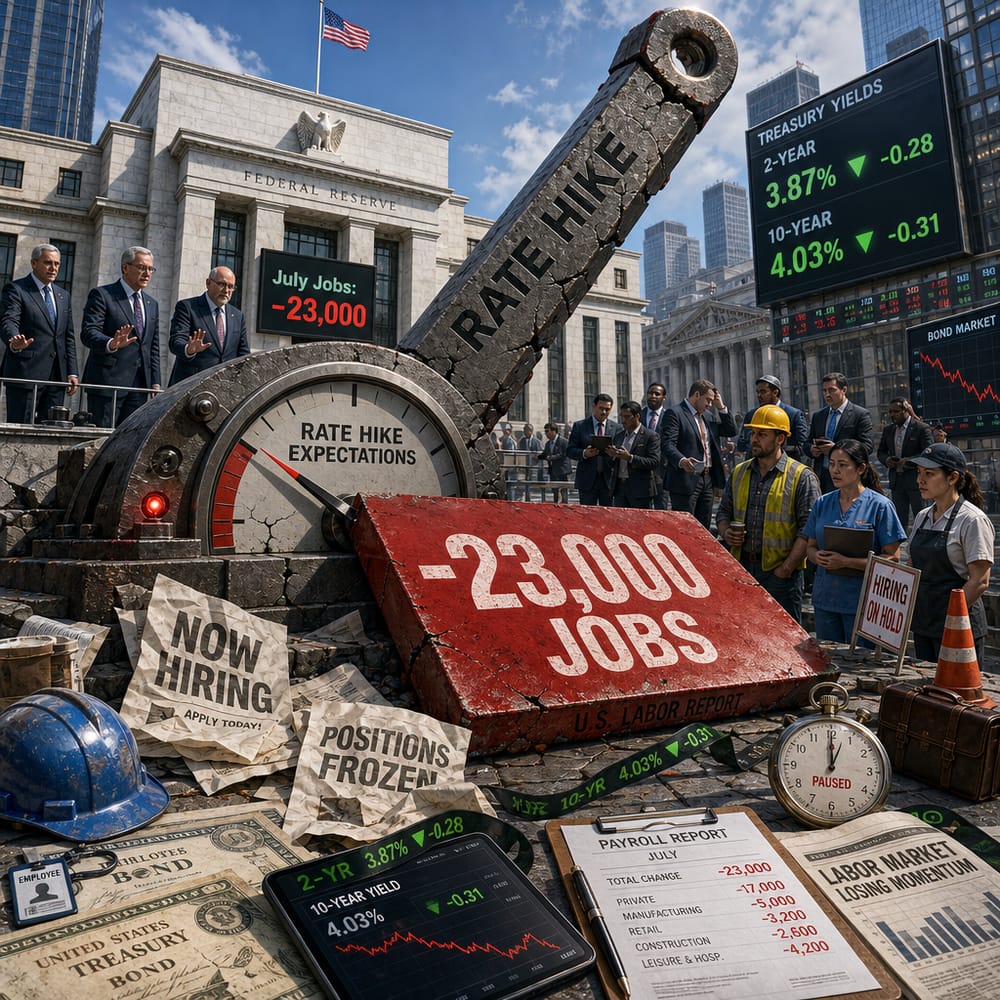
If the American workforce had a resume, July's jobs report would have a glaring typo. With a surprising loss of 23,000 jobs last month, it was like the economy hit the snooze button when everyone was expecting it to be wide awake. This latest blip in employment figures sent ripples through the markets and made even the Federal Reserve sit up straighter in its chair.
Now, why should you care if the Fed's morning coffee got interrupted by this lackluster jobs report? Here’s the scoop: The Federal Reserve, the not-so-silent puppeteer of interest rates, keeps its gaze firmly fixed on employment numbers to decide whether to hike, hold, or slash interest rates. Think of the Fed as your cautious friend who only orders dessert if everyone else at the table seems sure they want it too. And right now, they're eyeing that dessert menu with a new level of uncertainty.
The jobs report, an economic barometer of sorts, has thrown a curveball at the Fed's plans for upcoming interest rate hikes. Until July, the narrative was all about inflation and reining it in with aggressive rate hikes. But with fewer Americans clocking in last month, the Fed might start reconsidering if now's really the time to hammer down on borrowing costs.
Here's why this matters. When interest rates go up, borrowing money gets more expensive, whether it's for a car, a house, or that dream business venture. The Fed's rate-setting decisions ripple through the economy, affecting everything from how much you pay on your mortgage to how your retirement accounts perform. If they decide to hold off on more rate hikes, it could mean a sigh of relief for borrowers and investors alike.
Now, what's happening in the Treasury yields world, you ask? Picture a group of investors at a party, and the announcement of a weak jobs report is like a sudden rainstorm—everyone's making a dash for umbrellas, or in this case, safer investments. The retreat in Treasury yields is the equivalent of investors cozying up to the warmth of government bonds until the economic weather clears up a bit.
The relationship between yields and prices can be a little counterintuitive. When Treasury yields drop, bond prices rise, making them more attractive to safety-seeking investors. In the fixed-income market, which deals with securities like bonds, this interplay with interest rates is key. If the Fed decides to hold off on rates, diminishing yields could continue, influencing everything from pension funds to your friendly neighborhood bank.
So, how does a dent in the labor market influence the Fed's decision-making process? When job losses occur, it signals a potential cooling in the economy. The Fed, which has been on a rate-hiking spree lately to curb inflation, might ease off the gas pedal. If job growth isn't strong enough to carry the weight of higher borrowing costs, it might just push the Fed into adopting a more dovish—or cautious—stance.
The implications for fixed-income markets are notable. A softer Fed stance could mean bond investors will see less volatility in yields, and maybe even a more attractive bond market. For those invested in bonds, stable or falling yields may offer some predictability in returns, albeit at the cost of lower yields than in a high-rate environment.
In summary, the latest jobs report has everyone—from Wall Street to Main Street—re-evaluating their playbooks. If the Fed decides a gentler approach is warranted, it could mean a more stable environment for borrowers and investors. While the economic crystal ball remains a bit foggy, one thing is clear: the intertwined fate of jobs and interest rates is something we all should keep an eye on. So, stay tuned, because the next few months could shape the financial landscape for the rest of the year.
This article is for informational purposes only and is not investment advice. Always do your own research or consult a licensed financial professional before making investment decisions.
© Copyright 2024. All Rights Reserved.
© Copyright 2024. All Rights Reserved.