

Weak Consumer Data Weighs on Major Indices, Small Caps Resilient
Thursday, August 20, 2026
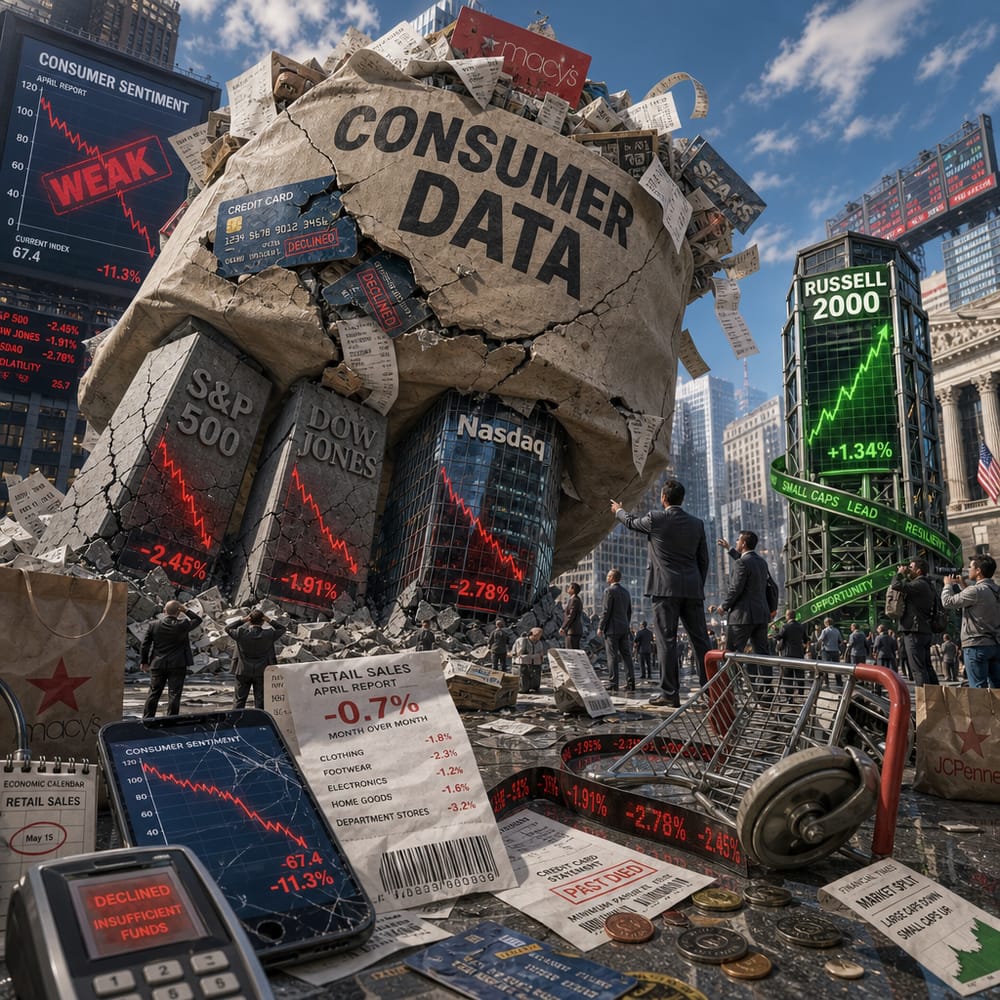
WALL STREET'S LITTLE ENGINE THAT COULD: SMALL CAPS DEFY THE GLOOM
Batten down the hatches, folks. The market's latest erratic dance could send investors' emotions on a roller coaster ride — and it's driven by consumer data that more or less says "meh" to 2026. While the whizz kids in Wall Street's tower of power keep spinning their wheels over consumer sentiment and retail sales, the spotlight is shifting to an unlikely hero: small-cap stocks. In a world where the Dow is sulking in a corner, these scrappy underdogs are rallying with an energy that would make Rocky Balboa proud.
Let’s tee up the drama: recent consumer sentiment and retail sales data have come in weaker than expected. To put it simply, American consumers are in a funk, and they’re keeping wallets tightly zipped. This doesn’t just affect retail therapy; it’s a key barometer for economic health. If consumers aren’t spending, the economy’s petrol gauge is pointing perilously toward 'E.'
Here comes the kicker. You might expect this economic hangover to affect everyone equally, like bad karaoke. But just as Adele's ballads may not appeal to metalheads, weak consumer data doesn’t seem to bother small-cap stocks much. Small caps, represented by the Russell 2000 index, are showing resilience, even as the big shots from the S&P 500 to the Nasdaq sulk like teenagers grounded on a Saturday night.
So what’s driving this seemingly paradoxical trend? Why are these pint-sized players standing tall while their larger cousins trip over their own feet?
For starters, small-cap companies often have a domestic tilt. They’re less exposed to the global economic turbulence — the kind President Trump’s “economic warfare” on Iran could stir up. When trade winds get stormy, small caps are snug in their local harbors, less swayed by the international squall.
Moreover, these companies are like speedboats: agile and quick to adapt. In an economy that’s bobbing on the swells of consumer uncertainty, nimbleness is a major asset. This gives small caps the flexibility to pivot faster than their larger, Titanic-like counterparts, dodging icebergs of economic woe with relative ease.
But let’s not forget: sentiment can shift as quickly as reality TV plot lines. If consumer confidence starts catching up with the reality show that is our economy, small caps might lose some of their shine, especially if interest rates or inflation rear their heads like villains in a soap opera.
Still, for now, these little dynamos are offering a glimmer of positivity in an otherwise dour investment landscape. And it’s not just about consumer data; their performance could be a broader economic signal, pointing to where future market movements might head. If small caps keep outperforming, it could hint at a more resilient domestic economy, one that’s better insulated against global market jitters.
Investors may take this as a cue to adjust their portfolios, perhaps tilting towards small-cap stocks that have figured out how to endure a turbulent market. It might also suggest that the American economy has pockets of strength, even as the broader picture looks more like a watercolor of uncertainty.
All this to say, the market’s grand theater is complex and full of intrigue. But amidst the drama, small caps are strutting their stuff on the Wall Street stage, defying the doom and gloom narrative that’s haunting the big indices. This little engine that could might just have more steam than anyone anticipated. While nothing in investing is ever guaranteed, keeping an eye on these resilient underdogs might just be the plot twist the market needs.
So, whether you’re glued to your trading app or just watching the financial news unfold, remember: when the going gets tough, sometimes the smallest players make the biggest impact.
This article is for informational purposes only and is not investment advice. Always do your own research or consult a licensed financial professional before making investment decisions.
© Copyright 2024. All Rights Reserved.
© Copyright 2024. All Rights Reserved.