

Volatility & Sentiment Spike
Tuesday, November 17, 2026
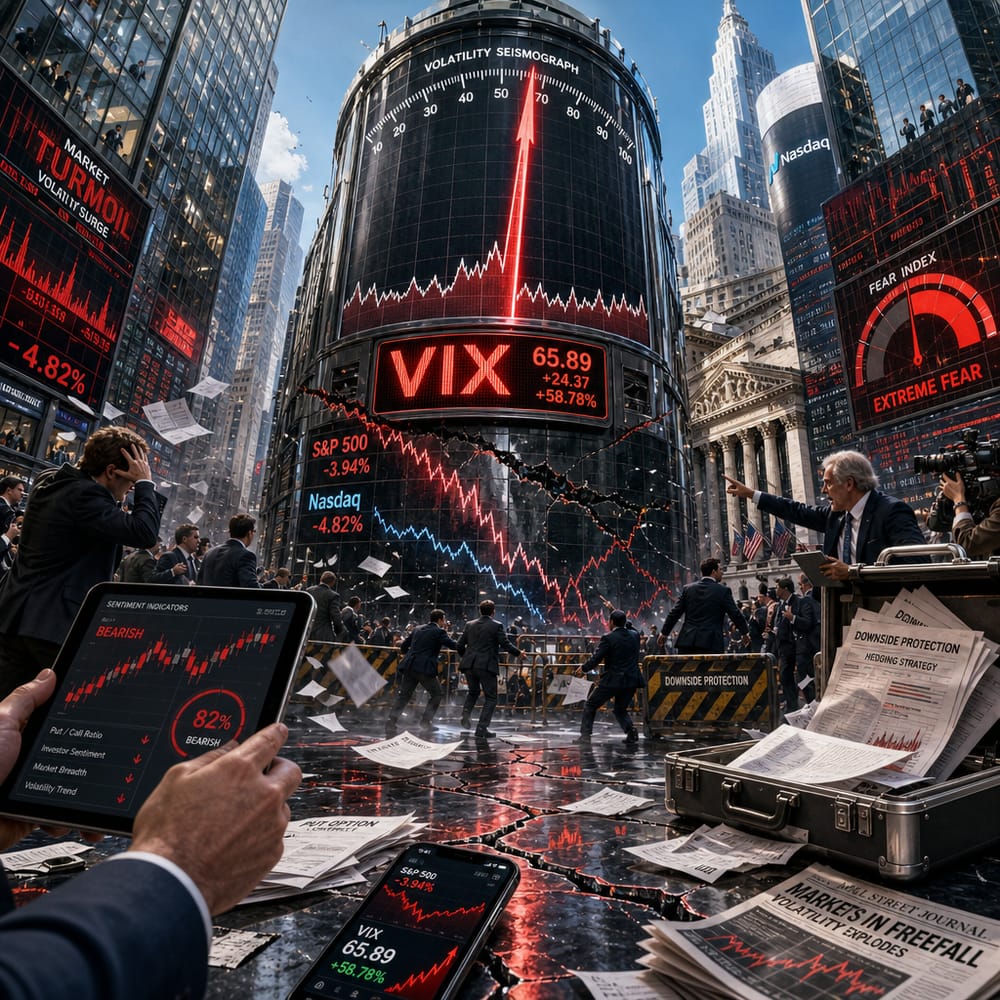
READ THE ROOM: THE VIX IS SENDING WARNING SIGNALS
If you haven't checked your portfolio lately, you might want to sit down. The VIX, Wall Street's infamous "fear gauge," is throwing a bit of a tantrum, and the implications are too big to ignore. This spike isn't just a blip — it's a red alert warning that volatility is back, and it's hungry for more action.
So, what's got the VIX climbing up the walls? For starters, we're living in a time of mixed signals and market schizophrenia. On one hand, tech giants like Nvidia are teetering on a precipice thanks to boardroom dramas spilling into public view, while geopolitical tensions are adding a layer of uncertainty thicker than your average conspiracy theory. The "will-they-won't-they" dance of the Fed's interest rate policy isn't helping either. Investors are like cats in a room full of rocking chairs, and they're acting accordingly.
But let's break it down, starting with Nvidia. The tech darling's rollercoaster ride isn't just due to earnings jitters. Nope, this time it's personal. Reports of CEO Jensen Huang's affairs — yes, plural — including a saucy entanglement that sparked security concerns, have put the chipmaker's stocks on a downward spiral. Such scandals can rock investor confidence, and when the confidence boat rocks, the VIX shoots through the roof.
Add in the geopolitical tensions, particularly President Trump's tense trip to Asia amidst talks of Iranian threats. If there's anything markets hate more than bad news, it's uncertainty. A potential geopolitical conflict is like giving a sugar-loaded toddler an espresso — it's unpredictable and makes everyone nervous.
All this drama is reflected in the S&P 500 and Nasdaq's jittery performances. Stock futures are doing the cha-cha between advances and losses, highlighting a broader sentiment that investors are plain spooked. They're bracing for some serious downside protection, which, by the way, is precisely what the VIX measures. That's why the VIX has become the talk of the town: it's the meteorological equivalent of seeing storm clouds gather on the horizon.
Now, how are investors reacting? In a nutshell: they're battening down the hatches. Many are pivoting their portfolios, leaning more towards safe-haven assets like U.S. Treasuries, though these too are interestingly flat right now. Others are hedging their bets with derivatives and options that protect against falling markets. Cash is once again king for those who are risk-averse, while some are eyeing alternative investments like commodities and cryptocurrency — anything to stay ahead of the potential storm.
Historically, volatility spikes like this aren't unprecedented. Remember the 2008 financial crisis? Almost everyone in the market wants to forget it, but the lessons linger: when the VIX surges, it usually signals a shift in risk-taking appetite. Back then, it was the subprime mortgage crisis. Today, it’s more of a tech and geopolitical cocktail served with a side of inflation concerns.
So what’s next? Well, savvy investors know that volatility, while scary, also means opportunity. Sure, the market's current state might not be a bull's paradise, but for those with a stomach for rollercoasters, there are gains to be made from the chaos.
In conclusion, the VIX's spike is a clarion call for retail investors to wake up and smell the risk. This isn't the time to snooze at the switch. Keep an eye on the news, especially on those pending Nvidia earnings and any geopolitical developments. Diversify those portfolios and stay nimble — because the VIX is telling us one thing for sure: it’s going to be a bumpy ride. Hold on tight, and maybe, just maybe, we’ll come out the other side with a little more wisdom — and, fingers crossed, a profitable position.
This article is for informational purposes only and is not investment advice. Always do your own research or consult a licensed financial professional before making investment decisions.
© Copyright 2024. All Rights Reserved.
© Copyright 2024. All Rights Reserved.