

Volatility Remains Low Amid Record Market Highs
Friday, August 14, 2026
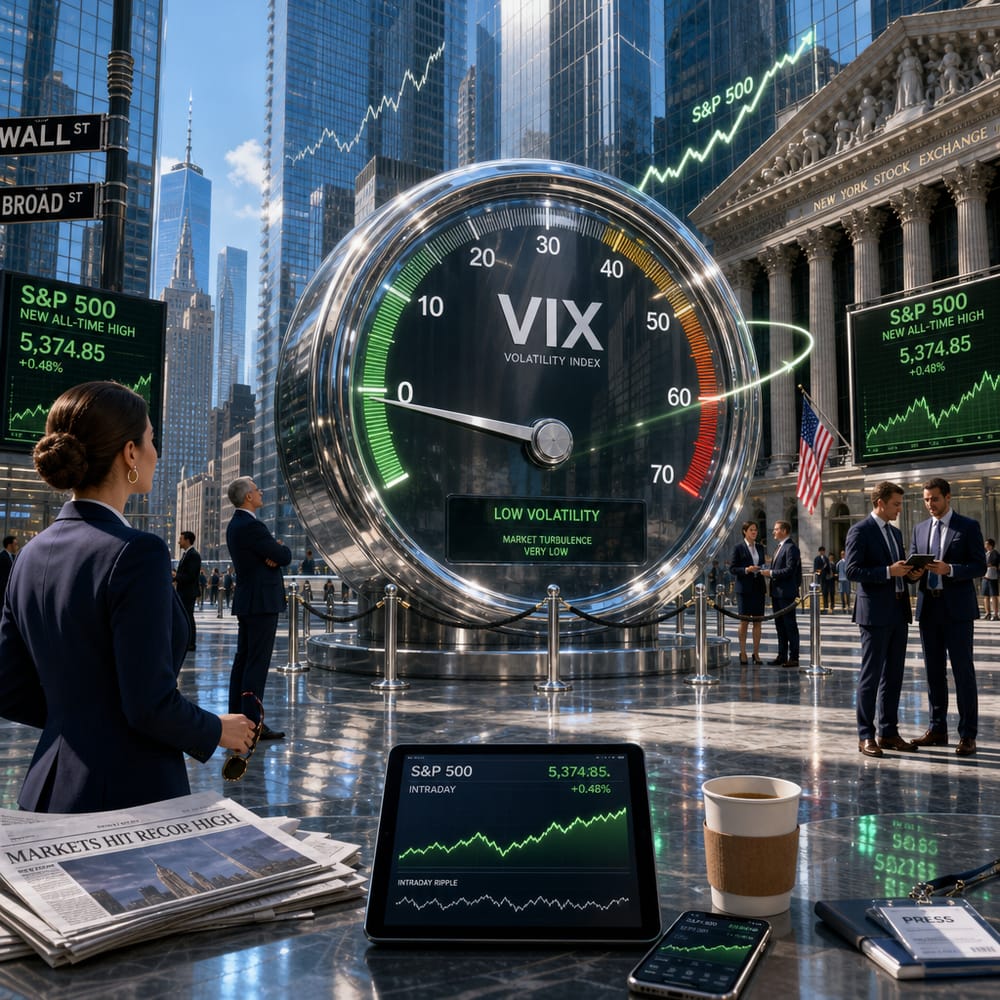
MARKET CALM AMID RECORD HIGHS: SHOULD YOU BE WORRIED?
Imagine a storm so serene that a sailboat could glide through it without a ripple. That’s your stock market right now — cranking out record highs while making nary a splash. The S&P 500 just hit the headlines with its latest all-time high, nudging past the 7,800 mark like it was a walk in the park. But what’s happening under the surface? Is this a sunny day to rejoice, or should we grab a life jacket?
Let’s talk about volatility — or rather, the lack of it. Volatility is like that unpredictable friend who either spices up a party or turns it into chaos. In financial terms, it’s the measure of how wildly stock prices swing. And right now, our unpredictable buddy seems to be on a chill vacation, sipping a piña colada.
The Volatility Index, known as the VIX, is waving its arms very low, indicating investors’ zen-like calm. Historically, a low VIX suggests we’re all getting a bit too cozy with the market’s rosy glow. The VIX is seen as Wall Street’s fear gauge — if it’s snoozing, it might mean investors are wearing their rose-tinted glasses. But are we too relaxed about the risks lurking beneath this market high?
Contrary to what you might think, this low-volatility environment doesn’t have a great track record. Remember those euphoric days before the 2008 financial crisis? The market was similarly calm, and we know how that story ended. No one’s ringing alarm bells just yet, but it’s worth noting that complacency can sometimes precede a surprise plot twist.
This isn’t the first time we’ve hit record highs with low volatility. Back in the dot-com era, before the tech bubble burst, markets soared to new heights with barely a wobble. It was as if the market was on a smooth, upward escalator — until a few steps suddenly gave way and sent everyone tumbling.
But what’s driving today’s tranquil seas? A blend of optimism and perhaps a dash of overconfidence. The bull market feels unbreakable at the moment, fueled by the tech boom, a surprisingly resilient economy, and the comforting thought that inflation is cooling off. It’s not quite a fortress, but it’s enough to pump up investor confidence. Bank of America says there are only two hurdles in sight: another spike in inflation and some unexpected monetary policy shifts.
Meanwhile, the S&P 500’s steady ascent seems unstoppable, set to close the week on yet another high note. Yet, it's intriguing to see that even when the market is sending us sky-high, the daily swings are anything but dramatic. Think of the markets as a jazz band playing a steady groove rather than an orchestra blasting a brass-heavy symphony.
Yet, we can’t ignore the market murmurs. International tensions, commodity price swings, and geopolitical risks haven’t vanished. They’re the hidden reefs that, if ignored, could surprise those sailing without caution. Copper trades are whispering hints about global economic barometers, and everyone is watching for tariffs like a cat eyeing a mouse.
So what’s a savvy investor to do? First, don’t be lulled into thinking the market will never change. Remember, it always rains after a dry spell. Stay diversified and keep a weather eye on those risk factors. Stocks may seem like a never-ending rollercoaster of gains right now, but don’t forget the old adage: what goes up must come down.
Take this lull as a chance to review your portfolio. Diversification can help you weather the storm when volatility decides to make a grand comeback. And maybe, just maybe, keep a little dry powder ready. Dry powder, in market lingo, is cash or liquid assets ready to deploy when opportunities arise.
So while you’re basking in the market’s current calm, remember: it’s the calm before the storm that can catch us off guard. Whether this is a new norm of stability or a prelude to a shake-up is anyone’s guess. Just make sure you’re ready for whatever comes next, because the market never forgets to keep us on our toes.
This article is for informational purposes only and is not investment advice. Always do your own research or consult a licensed financial professional before making investment decisions.
© Copyright 2024. All Rights Reserved.
© Copyright 2024. All Rights Reserved.