

Volatility Jitters: Russell 2000 Sharp Decline as Bond Markets Reprice
Saturday, August 29, 2026
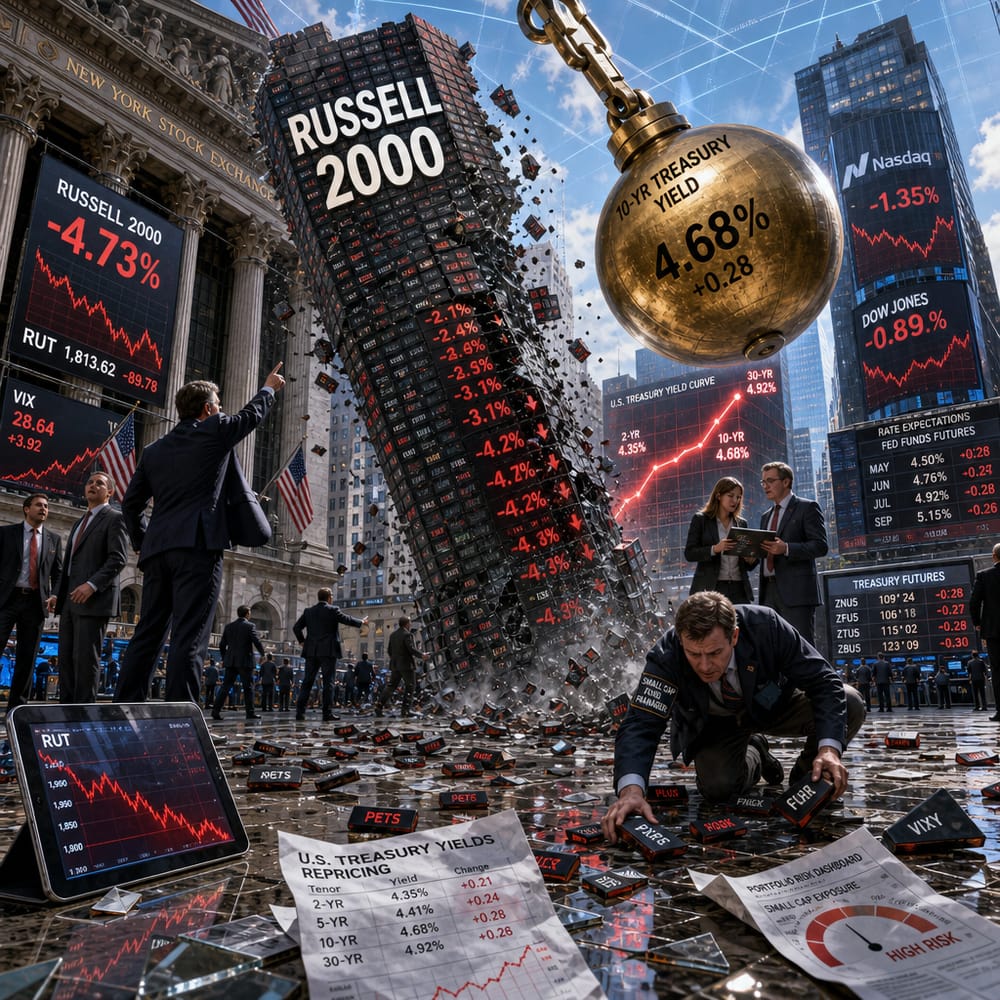
RUSSELL 2000 TAKES A ROLLERCOASTER RIDE AS BOND MARKETS SWAY
If the stock market had a dating profile, the Russell 2000 would definitely be the unpredictable wild child you swipe right on for a thrill. This index, which captures the performance of 2,000 of the smallest publicly traded companies in the U.S., is known for its rollercoaster tendencies. And what a ride it's been on lately, thanks to the bond market's latest mood swings.
Picture this: You're coasting along, perhaps sipping on a casual latte, and suddenly — wham! The Russell 2000 plunges, making hearts race faster than a caffeine overdose. What’s shaking its boots, you ask? Well, it's the bond market, baby.
BONDS ARE HAVING A MOMENT
The bond market right now is like that dramatic friend who loves attention and isn't afraid to shake things up. Recent comments from Fed Chair Kevin Warsh at the Jackson Hole conference set the stage, as he dropped hints that interest rates might be on their way up sooner than expected. Inflation, he noted, is a "concerning" little gremlin that needs taming.
This got investors squirming. They’re now recalibrating their expectations for future rate hikes, and this nervous energy is sending shockwaves across markets. Remember, when bond yields rise, borrowing costs climb, and that can be a downer for businesses counting on easy credit — especially the small guys.
HOW SMALL-CAPS ARE FEELING THE BURN
Enter our small-cap darlings in the Russell 2000. These are the pint-sized companies that thrive on low interest rates like we thrive on our morning coffee. They’re often more sensitive to changes in borrowing costs than their larger, more established counterparts on the Dow or Nasdaq. So, when bond yields flirt aggressively upwards, small-caps find themselves caught in the crossfire, and let's just say they're not enjoying the dance.
As investors scramble to reposition their portfolios, favoring the more sturdy giants, or seeking safer havens in the bond market itself, the Russell 2000 invariably catches the short end of the stick. For the small-cap investor, it's a reminder that these stocks come with a healthy dose of volatility. It's not for the faint of heart, but then again, you don’t ride rollercoasters if you’re scared of a few loops.
THE ECONOMIC ALPHABET SOUP
Peering into the economic crystal ball has never been trickier. Economists are all over the map, tossing out letters like they're playing Wordle. Is the economy shaping into a "K," where the rich get richer and the poor get, well, not richer? Or maybe it's a "C" or an "E" — though what those letters stand for is anyone's guess. While the alphabet soup simmers, investors are left pondering which way to steer their ships.
Amid this uncertainty, the broader market sentiment is jittery. While some sectors bask in the sunlight of potential growth — hello, AI boom! — others like small-caps are shivering in the chilly wind of rising rates.
WHAT TO WATCH
So, what’s next in this financial soap opera? Keep your eyes on the bond market. Any further signs of rate hikes or increased inflation could continue to rattle small-cap stocks. On the flip side, if the Fed decides to play nice and signals a more gradual approach, we might see some relief for these smaller companies.
Meanwhile, the broader market will be keeping an eye on the Fed’s every move like a hawk staking out its next meal. With inflation data looming and Fed meetings on the horizon, the suspense is palpable.
For investors in the small-cap space, staying informed and nimble is key. It's a landscape that changes with every tick of the bond market clock. But for those with a stomach for the ride, the Russell 2000 remains a thrilling, if sometimes bumpy, journey through the ever-evolving world of finance. So, buckle up and keep your eyes sharp — the market is nothing if not an adventure.
This article is for informational purposes only and is not investment advice. Always do your own research or consult a licensed financial professional before making investment decisions.
© Copyright 2024. All Rights Reserved.
© Copyright 2024. All Rights Reserved.