

VIX Spike Suggests Potential Market Bounce
Monday, November 23, 2026
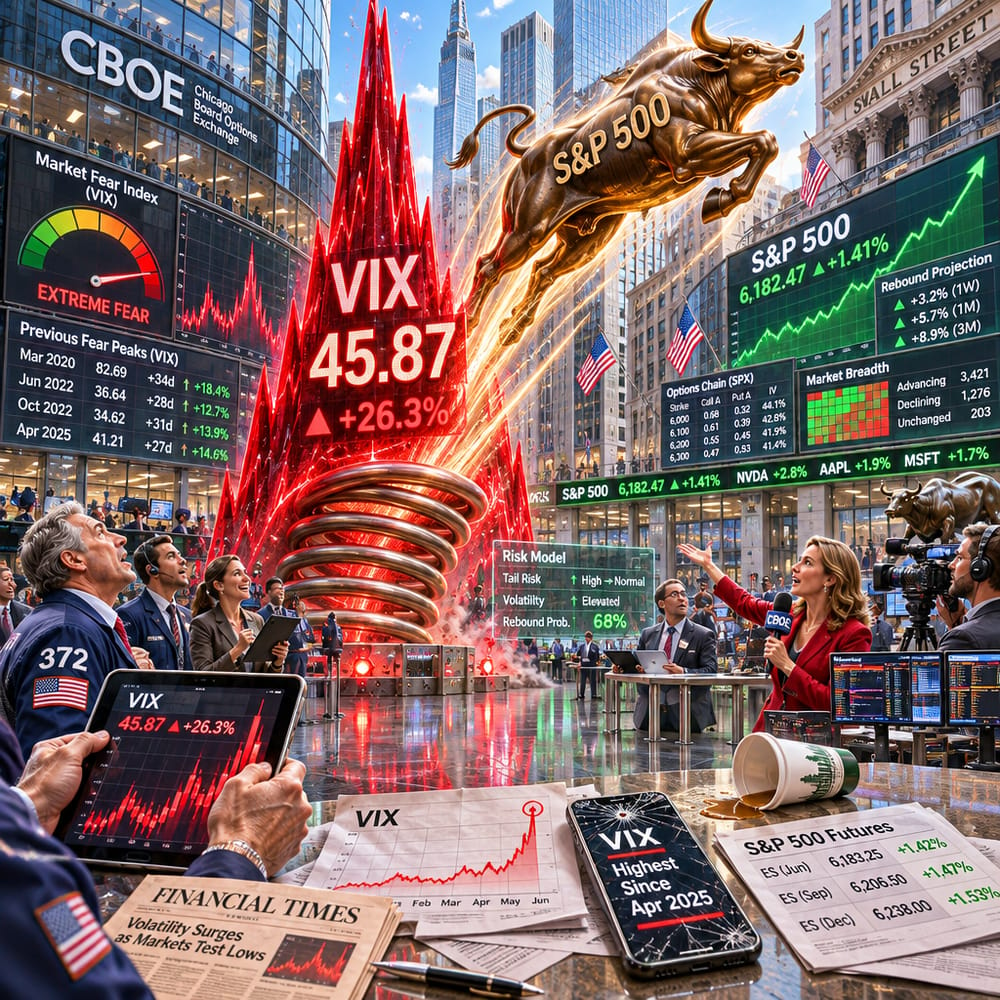
VIX SPIKE SUGGESTS POTENTIAL MARKET BOUNCE
Hold onto your portfolios, folks! The CBOE Volatility Index, known to the cool kids as the VIX, just spiked to its highest level since April 2025. Think of the VIX as the market's mood ring, but instead of colors, it flashes numbers that scream "panic!" to traders everywhere. And when it climbs this high, history suggests that a swoon now might just be your future boon.
So what’s up with this spike, and why should you care? The VIX, often dubbed Wall Street’s “fear gauge,” measures expected market volatility based on S&P 500 index options. When investors are edgy, the VIX jumps. Right now, it's leaping like it's had too much coffee, but that's not all doom and gloom. Historically, when the VIX hits the roof, investors often end up with a rosy glow in their cheeks—if they have the guts to stick it out.
HISTORICAL PATTERNS AND POTENTIAL PROFITS
Here's the juicy bit: whenever the VIX skyrockets into the rarefied air above 40, it’s like a neon sign flashing "BUY." Take it from market connoisseur Charlie Bilello, who points out that the S&P 500 typically enjoys a nice uptick following these fear-fueled spikes. How nice? Let’s just say the one-year return after such VIX peaks nearly doubles the norm, clocking in at 29%. That's far more impressive than the standard 12% you might see from less dramatic market jitters.
But wait, there's more! Noel Smith from Kai Asset Management crunched some numbers and found that in the 13 instances the VIX has kissed the 40-mark since 1990, the S&P 500's median return over the next month was a cool 3.6%. Expand that timeline to three months, and you’re looking at 8.1%. Compare these numbers to the usual market returns, and you can see why market mavens get excited when the VIX acts like a hyperactive toddler.
WHAT DOES THIS MEAN FOR YOU?
So, should you dive headfirst into the market amid this maelstrom of volatility? Well, let’s not get too hasty. While a high VIX has historically coincided with future market gains, timing is everything. Dive in too soon, and you might find yourself gasping for air as the market dips lower before rebounding. But don't nail your shoes to the sidelines either—missing these bounce-back windows could mean leaving a hefty chunk of potential profit on the table.
The key is to stay informed and level-headed. Understand that volatility is a natural part of the market's ebb and flow. It might be unnerving, but it's also where the opportunities lurk. As retail investors sold off last week, breaking a long streak of buying the dip, it’s worth considering if you’re ready to swim against the tide with a calculated risk.
THE WAY FORWARD IN CHOPPY WATERS
The market is a wild ride, and the recent VIX spike is a reminder that it’s not for the faint-hearted. This is where your strategy becomes your life raft. Diversification, having a mix of investments across different sectors and asset types, can help cushion the blows from market swings. Sectors like tech might see a rollercoaster ride (just ask Nvidia, whose stock rocketed back up after CEO Jensen Huang's unexpected return), while others might bob along more gently.
Remember, while the VIX provides a snapshot of market sentiment, it's only one piece of the puzzle. Keep your eyes peeled for broader economic signals and sector-specific news. Whether it’s major mergers reshaping cybersecurity, like CrowdStrike's bold move to acquire Zscaler, or geopolitical tensions affecting energy prices, staying informed will give you an edge.
So, next time the VIX spikes and the headlines scream panic, take a deep breath. History might just be in your favor if you play your cards right. After all, what's a little market chaos if not an opportunity in disguise?
This article is for informational purposes only and is not investment advice. Always do your own research or consult a licensed financial professional before making investment decisions.
© Copyright 2024. All Rights Reserved.
© Copyright 2024. All Rights Reserved.