

Utilities as Defensive Plays Amid Volatility
Friday, July 10, 2026
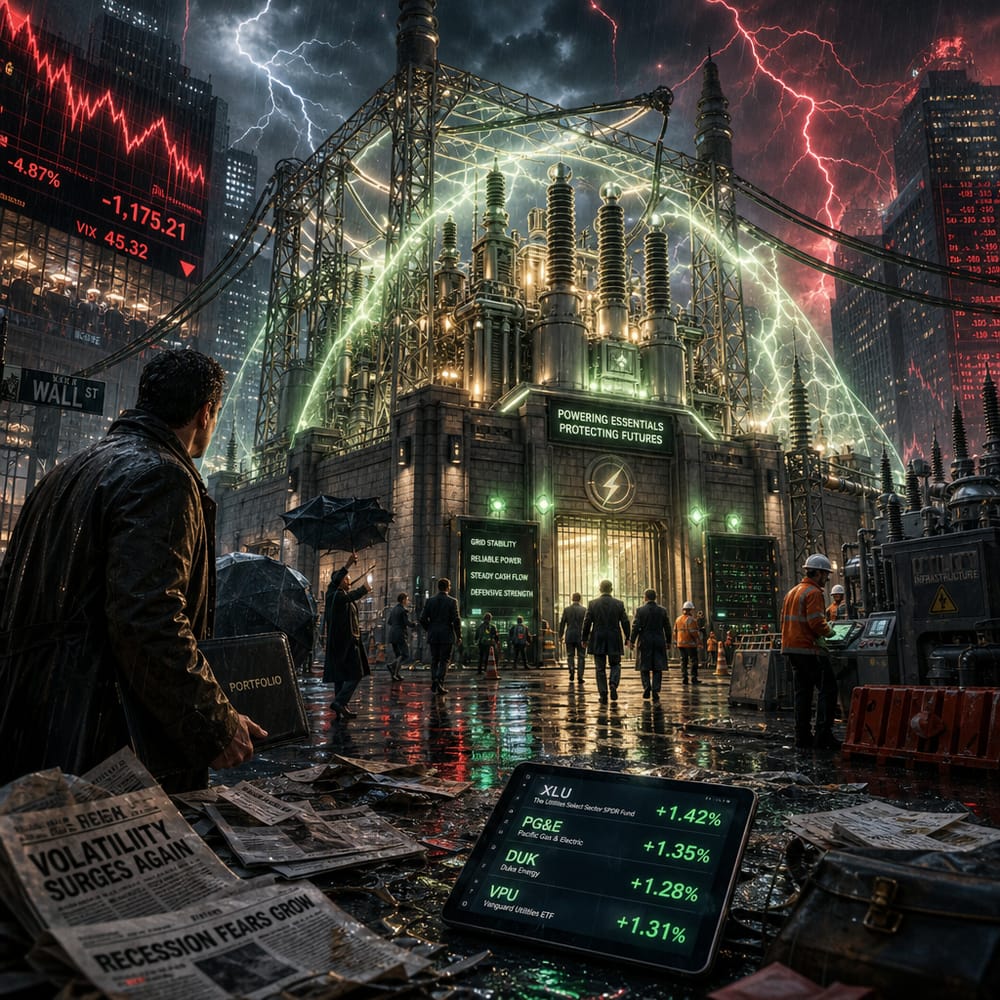
UTILITIES TO THE RESCUE: WHY THESE BORING STOCKS ARE THE HOT NEW TREND
Brace yourselves, investors—it's time to talk about the unsung heroes of our portfolios: utility stocks. You know, those companies that bring you electricity, water, and heat, while quietly minding their own business, far from the chaos of Silicon Valley or Wall Street. In a world where flashy AI and tech startups usually steal the spotlight, utilities are emerging as the unassuming stalwarts of stability. And right now, they might just be the cool-headed play you didn't know you needed.
Let’s not pretend utility stocks are the rockstars of the market. They're more like the reliable bassist in a band—they won’t hog the limelight, but you'd miss them dearly if they weren't around. When markets start feeling like a rollercoaster ride you'd rather skip, utilities come into play. Their steady flow of dividends and relative immunity to economic ups and downs make them the Wall Street equivalent of comfort food.
MARKET VOLATILITY MEETS UTILITY STABILITY
Picture this: global oil demand is taking a nosedive for the first time since the pandemic, with geopolitical tensions and economic uncertainties throwing everyone for a loop. The markets are jittery, and tech stocks are experiencing wild mood swings. Meanwhile, your utility stocks are like, "Hey, remember us? We're here, just doing our thing."
Utilities are holding their ground, precisely because people still need to keep the lights on, regardless of what's happening in the Persian Gulf or the latest twist in the AI saga. They offer a sense of security while other sectors are riding the volatility wave.
TAKING A CLOSER LOOK AT PG&E AND DUKE ENERGY
Let's zoom in on PG&E and Duke Energy, two giants in the utility world. PG&E, based in California, has been through the wilderness of financial and operational challenges, but they're emerging stronger and steadier. Investors are watching closely as they refocus on delivering reliable power amidst the state’s complex regulatory landscape.
Meanwhile, Duke Energy, with its expansive reach across several states, is playing it smart by investing in renewable energy. As climate concerns gain momentum, Duke's green pivot is not just a nod to environmental trends but also a move to future-proof its earnings.
Both companies are well-poised to provide that sweet mix of stability and income that investors crave when everything else feels unpredictable.
THE BROADER MARKET IMPLICATIONS
Could the rise of utilities as a defensive play signal a broader market trend? Absolutely. When utility stocks start gaining attention, it's often a sign that investors are getting skittish about riskier assets. In times of turbulence, people tend to gravitate towards safe havens. The utility sector, with its strong cash flows and dependable dividends, offers just that.
Utility ETFs, which bundle these stocks into a neat package, are also drawing interest. They allow investors to hedge against volatility without placing all their eggs in one basket. It's like betting on the whole team rather than just one player. With economic uncertainties likely to persist, we might see more people hopping onto the utility train.
THE FINAL WORD
In an era where the Fed is flirting with interest rate changes and geopolitical dramas are unfolding faster than a soap opera, utilities offer a reassuring presence. They might not provide the adrenaline rush of high-growth tech stocks, but what they lack in excitement, they make up for in consistency.
So, if your portfolio has been giving you more headaches than a suspense novel, it might be time to give some love to those unsung heroes of the market. PG&E, Duke Energy, and their utility pals are ready to add a layer of calm to your investment chaos. Who knew that steady and stable could be the new edgy?
This article is for informational purposes only and is not investment advice. Always do your own research or consult a licensed financial professional before making investment decisions.
© Copyright 2024. All Rights Reserved.
© Copyright 2024. All Rights Reserved.