

USD Weakness Across EUR, GBP, CAD Flows as Dollar De-hedging Surges
Monday, August 24, 2026
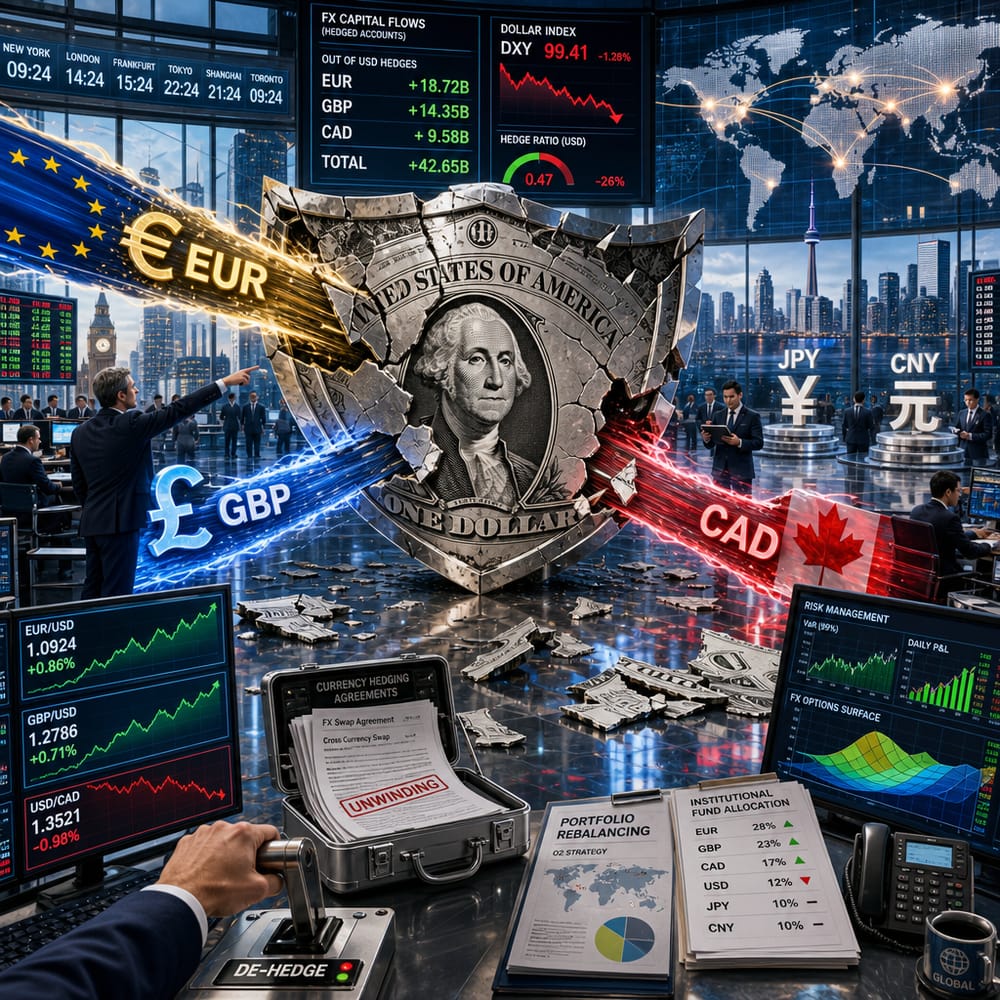
What do you get when you mix a volatile currency market with a dash of geopolitical fun and a sprinkle of economic intrigue? You get the wild ride that is the current dollar de-hedging trend. It’s a currency cocktail just frothy enough to keep investors on their toes and potentially reshape global trade dynamics. Let’s dive into this swirling vortex and see what's making investors drop hedges on the dollar and why it matters to you.
The dollar, it seems, has lost a bit of its mojo. For years, it's been the undisputed heavyweight champ of the global currency ring. But now? Investors are starting to hedge their bets—literally. The heavyweights of hedging who usually clung to the dollar, like a safety blanket, are now letting go, particularly against the euro (EUR), British pound (GBP), and Canadian dollar (CAD). Meanwhile, the Japanese yen (JPY) and Chinese yuan (CNY) remain stable, watching this dance from the sidelines.
So, what's with the dollar de-hedging craze? Let's break it down. First, President Trump’s fiery rhetoric and tariff threats against Canada are shaking up the North American trade scene. When a president starts slapping higher tariffs like stickers at a yard sale, currency markets falter. Investors are jittery about the future of U.S.-Canada trade relations, which is nudging them away from the dollar.
And then there's the inflation monster. With inflationary fears bubbling up faster than a pot of Italian espresso, investors are left scrambling. Inflation decreases the purchasing power of currency, and an inflation-wary investor is a nervous investor. The recent rally in gold—a classic inflation hedge—echoes these concerns like a loudspeaker on Wall Street.
But here's the twist: the de-hedging trend is particularly pronounced with the EUR, GBP, and CAD, leaving the JPY and CNY relatively unfazed. Why the difference? Well, Japan and China might be playing it cool, but their economic and geopolitical antics have not stirred the pot enough to send investors running for the hills—or rather, away from the dollar.
Let’s not forget the broader implications. The shift in hedging strategies is like a pebble dropped in a pond—ripples will spread. We're talking potential shifts in currency valuations that could shake up international trade dynamics. If the dollar continues to lose its sheen, the ripple effect could push U.S. exporters to sharpen their pencils, as a weaker dollar could make American goods cheaper and more attractive abroad. On the flip side, a weaker dollar could mean more expensive imports, pinching consumers’ pockets here at home.
Let’s bring this back to some numbers you might be watching on your brokerage app. The current dance between the EUR/USD, GBP/USD, and USD/CAD is more like a tango than a waltz, with each currency pair reflecting these shifting hedging trends. If you’re trading, this is your moment to watch for potential swings and adjust your strategy accordingly.
But here’s the million-dollar question: how might these trends evolve? If inflation continues to loom over the economy like a dark cloud, and if trade skirmishes turn into full-blown wars, the dollar might keep losing its swagger. That could mean more de-hedging and further shifts in currency values. On the other hand, if cooler heads prevail and inflation eases, we might see the dollar regain some strength, stabilizing the market merry-go-round.
So, dear retail investor scrolling feverishly through your phone, what does this mean for you? Keep your eyes peeled and your strategy flexible. The markets are like a rollercoaster with no seatbelts, and currency plays can change direction with the wind. Whether you’re hedging your bets or playing the field, the name of the game is adaptability. The world of currency trading is fraught with unpredictability, and today’s market move could be tomorrow’s opportunity—or pitfall. Happy trading, and may your portfolio be ever in your favor!
This article is for informational purposes only and is not investment advice. Always do your own research or consult a licensed financial professional before making investment decisions.
© Copyright 2024. All Rights Reserved.
© Copyright 2024. All Rights Reserved.