

USD/CAD Slides to Lowest Since Early June as U.S. Jobs Data Disappoint
Thursday, August 13, 2026
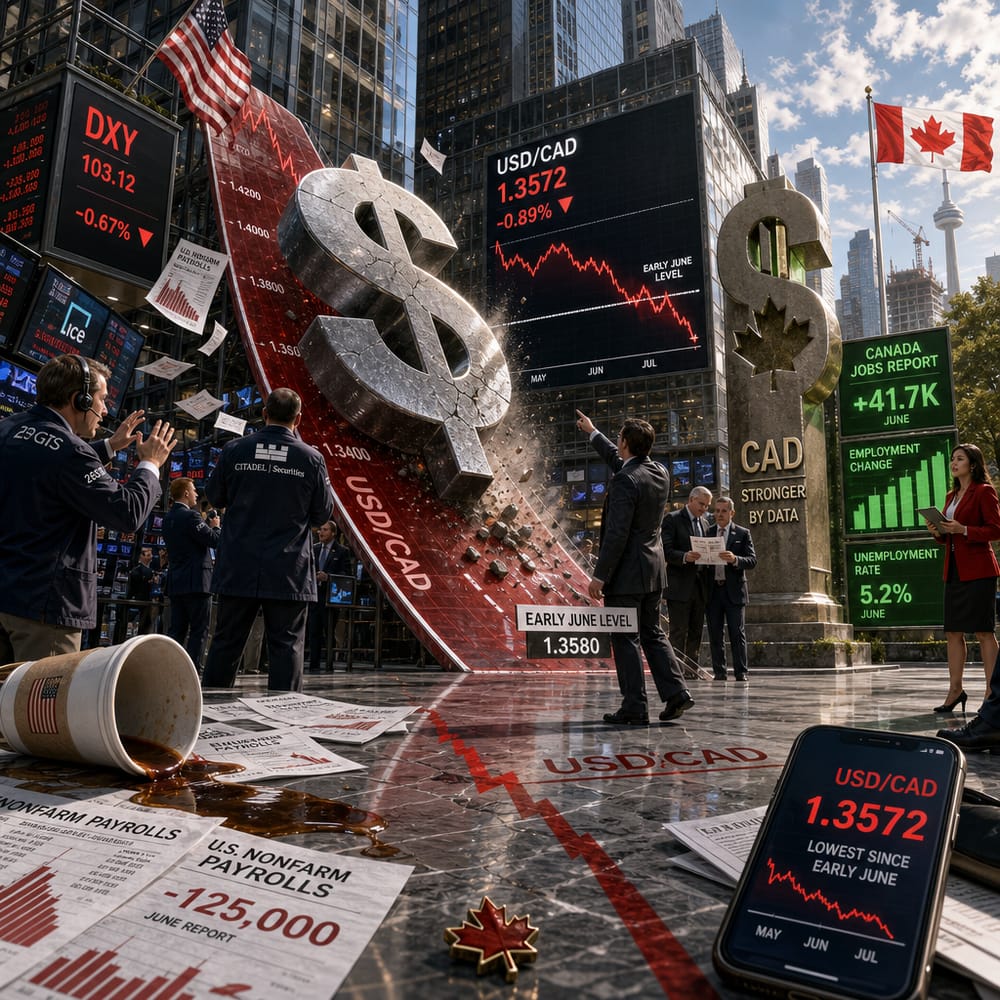
WALL STREET’S CURRENCY TANGO: U.S. JOBS WOES VS. CANADIAN STRENGTH
Brace yourself, folks, because the USD/CAD exchange rate has just taken a nosedive to its lowest point since early June. The culprit? A report as disappointing as a soggy sandwich: U.S. nonfarm payrolls showing a decline of 23,000 jobs. Meanwhile, our neighbors to the north are dancing to a different beat with stronger-than-expected labor data. So what does this mean for investors, and why should you care? Let’s dive in.
THE JOBS REPORT THAT SAID, “MEH”
Remember those labor market dramas you’d hear about in macroeconomics class? Normally they’re a snooze, but this episode is actually worth tuning into. The U.S. jobs market just flopped harder than a fish on dry land. Instead of adding jobs, it shed 23,000, leaving many scratching their heads and the U.S. dollar ($USD) looking a bit dull next to its Canadian counterpart. The Canadian labor market, on the other hand, is strutting its stuff with unexpected strength. The loonie (a term for the Canadian dollar) is flying high, and it’s making waves.
WHY CURRENCY PAIRS MATTER
Before you dismiss currency pairs as some Wall Street secret code, let’s break it down. The USD/CAD pair tells us how many Canadian dollars you’d need to buy one U.S. dollar. So, when the USD/CAD rate falls, it means the U.S. dollar is weaker compared to the Canadian dollar. This shift has big implications, not just for currency traders but for everyone from businesses buying goods across borders to tourists planning vacations.
THE FED’S NEXT MOVE: A GAME OF GUESS WHO
With the U.S. jobs data looking like a set of train tracks heading in the wrong direction, the Federal Reserve is under pressure to make its next move wisely. The Fed has been tightrope walking with interest rates, trying to balance inflation and economic growth. A weak jobs report could make them less likely to raise interest rates anytime soon, fearing an even bigger economic slowdown. Investors are keenly watching this dance, as interest rate decisions can send ripples through everything from stock prices to mortgage rates.
CANADA’S MOMENT IN THE SPOTLIGHT
Usually, the U.S. hogs the spotlight, but Canada’s got its moment to shine right now. With its labor market outperforming, the Canadian economy looks appealing to investors, hiking up demand for the Canadian dollar. If this trend continues, we might see the loonie holding strong against the greenback for a while. It’s a boost for Canadian exporters, making their goods cheaper and more competitive internationally.
THE IMPACT ON INVESTORS
For investors, these currency shifts are akin to a roller coaster ride. If you’re holding U.S. assets, a weaker dollar might munch away at your returns when converting back to the mighty loonie. On the flip side, holding Canadian investments could give you a pleasant surprise when you count your returns. Investors are not only watching central bank moves but are also looking at sectors that might benefit from dollar dynamics.
In this topsy-turvy ride, it’s clear that labor markets can shake up more than just your morning coffee routine. They’re a powerful force behind currency values, and they provide clues on the future direction of economies and central bank policies. Currency pairs, like the USD/CAD, are not just numbers flashing on a screen; they’re storytellers narrating the complex dance of economies around the world.
So the next time you hear about a jobs report, don’t just shrug it off. It might just be the key to understanding the next big market move. Whether you’re a casual observer or a savvy investor, keeping an eye on these trends could help you stay ahead in the ever-evolving financial landscape. And remember, when in doubt, just follow the money—or in this case, the loonie.
This article is for informational purposes only and is not investment advice. Always do your own research or consult a licensed financial professional before making investment decisions.
© Copyright 2024. All Rights Reserved.
© Copyright 2024. All Rights Reserved.