

USD/BRL Weakens Sharply Amid Dollar Softening Across Major and EM Pairs
Thursday, August 13, 2026
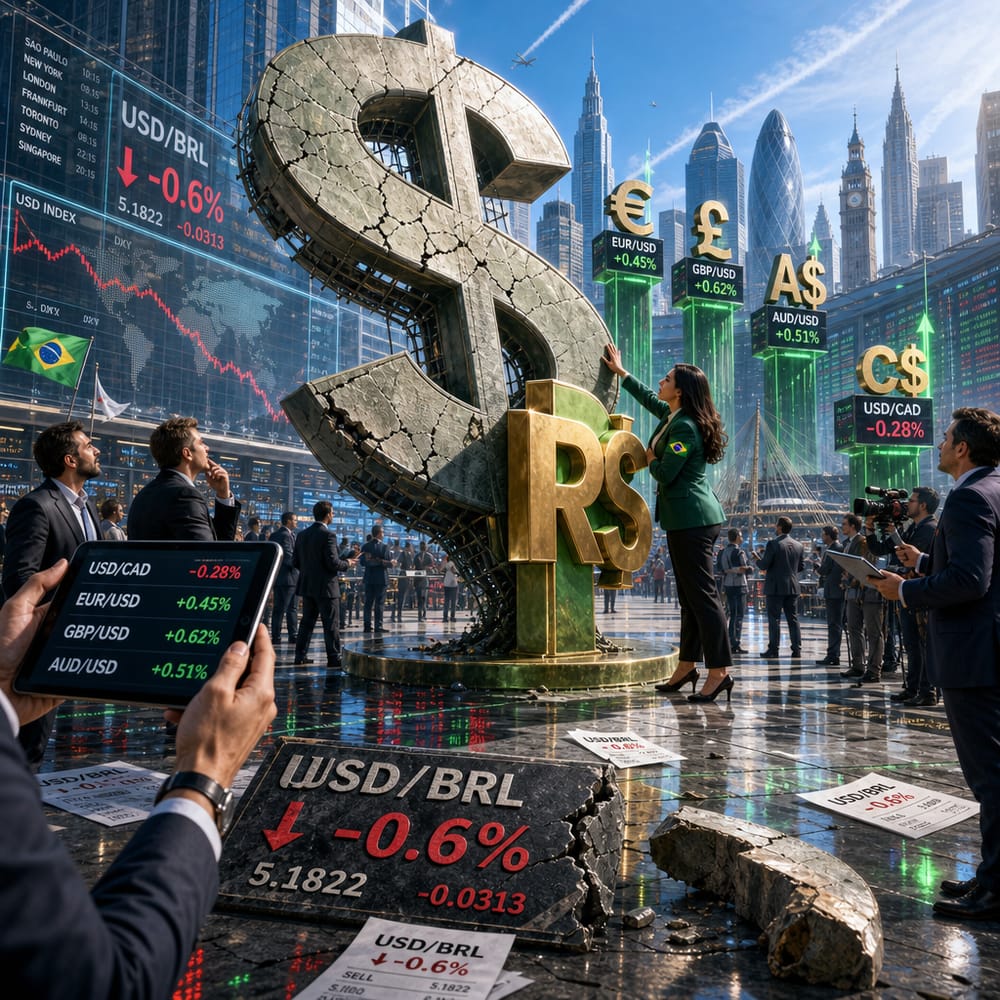
If U.S. retail investors thought the dollar was sturdy as a rock, they might be surprised to find it's acting more like a marshmallow on a hot summer day. On August 5, the USD/BRL—the exotic dance between the U.S. dollar and the Brazilian real—dropped a spicy 0.6%. This isn't just some blip on the radar; it's one of the largest moves among major emerging-market currencies. Coupled with a softening USD/CAD and modest gains in GBP/USD, EUR/USD, and AUD/USD, it looks like the dollar’s losing the bling in its ring.
So, what's got the greenback feeling blue? Let's break it down.
THE MYSTERY OF THE WILTING DOLLAR
Our first suspect? U.S. inflation cooling off faster than a popsicle in Antarctica. Recent reports suggest inflation isn't rising as steeply as feared. The Producer Price Index, a measure of the prices businesses pay each other, showed less heat, hinting that price hikes for consumers might just chill out soon. For the dollar, this means the Federal Reserve may ease off the interest-rate hike pedal, making yield-hungry investors look elsewhere.
Enter the commodity currencies like the Brazilian real and the Aussie dollar, which are now like well-baked soufflés, rising nicely. When the U.S. takes a breather on rate hikes, it often means good news for emerging markets. Why? Because lower U.S. rates typically push investors to chase higher returns elsewhere, often in riskier markets.
THE EMERGING-MARKET CURRENCY FIESTA
So, what happens when investors pack their bags and head south? Emerging-market currencies, like the Brazilian real, tend to strengthen. This flip in fortune isn’t just a financial fiesta for Brazil. Countries rich in commodities see their currencies soar as investors bet on rising demand for raw materials.
But not all that glitters is gold—or Brazilian reals in this case. Emerging markets are often a mixed bag. Political instability or economic vulnerabilities can spook investors, making these currencies as unpredictable as your favorite soap opera. Yet, for now, the party seems to be rolling, largely thanks to the dollar's wobbles.
WHAT DOES IT MEAN FOR GLOBAL TRADE AND INVESTMENT?
The dollar’s rollercoaster ride has several implications for global trade and investment. A weaker dollar can be a boon for U.S. exporters, making American goods cheaper abroad. That's good news if you're in the business of selling bourbon to Britons or jeans to Japanese.
For emerging markets, it's a double-edged sword. On one hand, stronger local currencies can increase purchasing power, driving up imports and boosting consumer-spending power. On the flip side, it might hurt their exports since goods priced in reals or pesos might be costlier overseas.
Investors should also keep an eye on what this means for commodities. A weaker dollar often means higher commodity prices. If your portfolio has a soft spot for gold, oil, or other raw materials, you might see some shine in returns.
BOTTOM LINE? KEEP YOUR EYES PEELED
The current dollar weakness signals a shift, and wise investors should be as alert as a meerkat on espresso. With inflation cooling in the U.S., the Federal Reserve's next moves are as crucial as ever. Emerging markets are on the rise, but they bring their own set of risks and rewards.
In the end, the dance of currencies is a complex choreography influenced by interest rates, trade balances, and investor sentiment. So, if you're scrolling through your phone, pondering your next move, remember: the global financial market is one giant game of chess. And right now, the dollar's pawns are moving in intriguing ways.
This article is for informational purposes only and is not investment advice. Always do your own research or consult a licensed financial professional before making investment decisions.
© Copyright 2024. All Rights Reserved.
© Copyright 2024. All Rights Reserved.