

US Dollar Index (DXY) Slides to ~98.6–99 Amid Easing Yields & Fed Splits
Wednesday, August 26, 2026
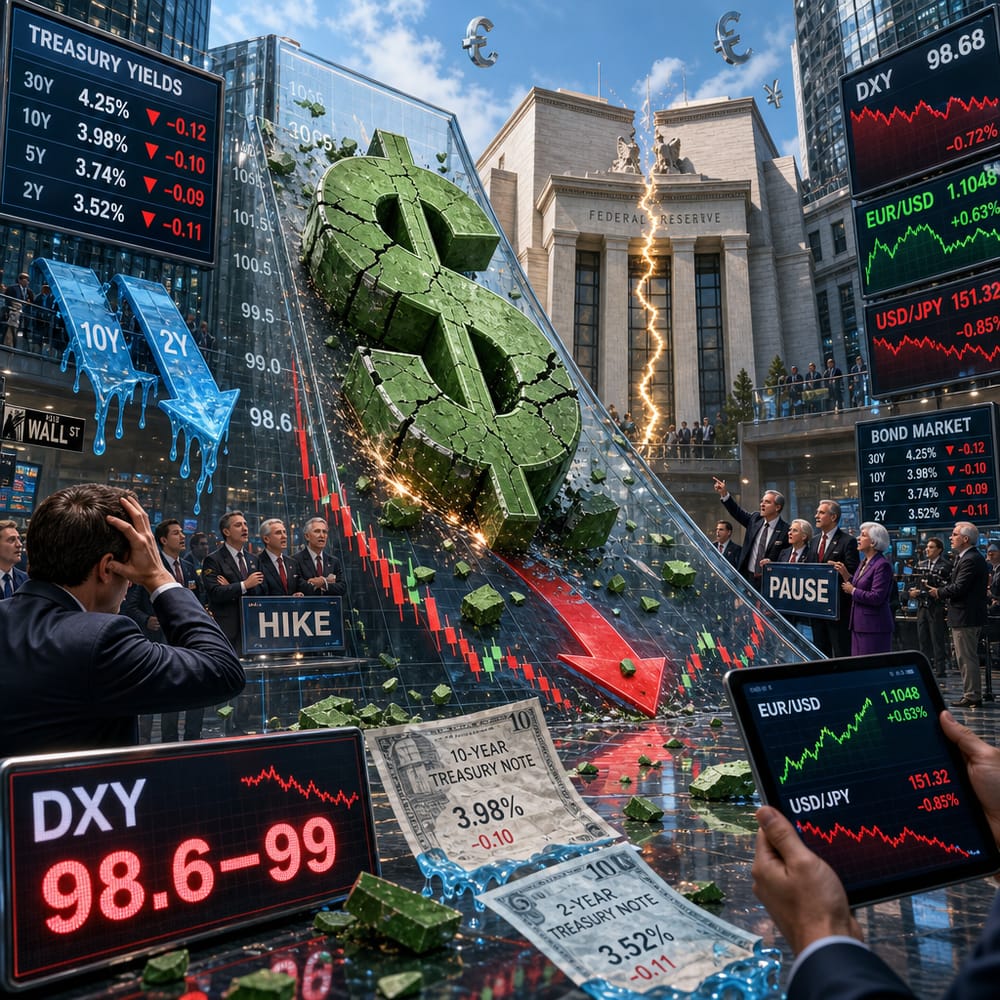
The US Dollar Index (DXY) has slipped to around 98.6–99, marking its weakest presence since mid-May 2026. This descent into bear territory isn't just a number on the board—it's a seismic shift, fueled by easing Treasury yields and, more intriguingly, a Federal Reserve that can't find its own pulse. So why should you care? Because the dollar’s downturn could reshape the global economic chessboard, taking down some currency pairs with it, like the EUR/USD and USD/JPY. Buckle up, because the implications could be huge.
THE FED'S FAULT LINES
If the Federal Reserve were a rock band, they’d be in their “Fleetwood Mac Rumours” phase—lots of internal disagreement leading to some chaotic energy. The Fed has always been the maestro behind the interest rate symphony, raising and lowering to keep the economic music going just right. But right now, they’re struggling to decide whether to keep playing their inflation-fighting opus or switch to a softer, gentler tune.
Why does this matter? Internal strife at the Fed means uncertainty in future policy decisions. Will they keep raising rates to squash inflation, or will they ease up to give the economy some breathing room? The indecision has made investors jittery, weakening the dollar and making other currencies look more attractive by comparison.
GLOBAL RIPPLE EFFECTS
A weaker dollar isn't just a U.S. issue; it reverberates across the globe. When the greenback stumbles, other currencies often rise. For everyday investors, this means that currency pairs like the EUR/USD and USD/JPY could see significant moves. A stronger euro or yen might have Europeans and Japanese prancing with joy, but it can also hurt U.S. exports, making American goods more expensive overseas. Ouch!
But what about your portfolio? If you're invested in multinational companies or foreign stocks, a weaker dollar might actually be a blessing. Overseas earnings are worth more when converted back into dollars, potentially boosting your returns. However, if you're more U.S.-centric in your investments, keep an eye out: the dollar’s decline might just be the headwind you didn't see coming.
THE TREASURY YIELD SEE-SAW
Enter Treasury yields, the ultimate drama queens of the financial world. Recently, they've been easing up, an indication that investors are expecting lower interest rates in the future—or at least a gentler approach from the Fed. Lower yields tend to weaken the dollar, as they make it less appealing to hold U.S. assets.
This yield decline sends another message: investors are eyeing safer grounds, anticipating a softer economic landscape. If they’re right and the Fed finally decides to take a breather on rate hikes, we might see a shift in market dynamics. Think of it as the Fed giving the economy a cozy blanket during a cold, uncertain winter.
WHAT TO WATCH
All eyes are on the Fed's next move. If the internal disagreements become a full-blown feud, expect more volatility in the currency markets. The Fed’s choices could also morph into a political spectacle, especially with elections on the horizon and the ongoing debate over affordability and cost of living.
For the average investor, staying informed and flexible is key. Keep tabs on Fed announcements, Treasury yield movements, and global currency shifts. Diversification will be your best friend as these seismic shifts play out. Consider exposure to foreign markets or sectors that may benefit from a weaker dollar.
THE BOTTOM LINE
As the US Dollar Index slides, the Fed’s indecision and easing yields offer a complex, uncertain backdrop. While the dollar weakens, the global chessboard reshuffles, and your portfolio might feel the tremors. Stay sharp and nimble, because this might be just the first act in a long drama of financial intrigue. If you thought the markets were a calm sea, it's time to think again. Grab your lifejacket, because the ride is about to get bumpy.
This article is for informational purposes only and is not investment advice. Always do your own research or consult a licensed financial professional before making investment decisions.
© Copyright 2024. All Rights Reserved.
© Copyright 2024. All Rights Reserved.