

UBS Downgrades Truist Amid CEO Uncertainty
Monday, July 13, 2026
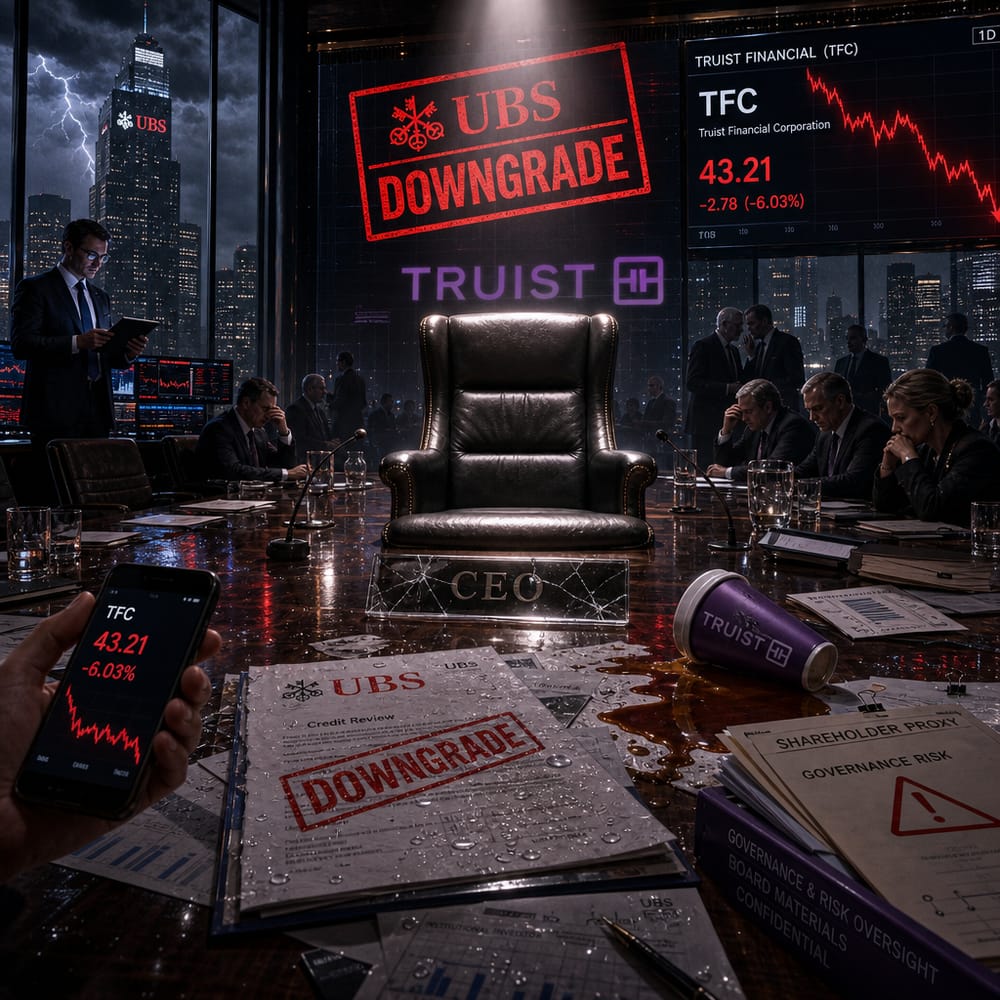
UBS Downgrades Truist Amid CEO Uncertainty: A Cautionary Tale for Regional Bank Investors
Imagine you're settling into your favorite armchair with a steaming cup of coffee, ready to scroll through the day's financial headlines. Suddenly, you spot a shocker: UBS has just downgraded Truist Financial (TFC), dropping it like a hot mic at a karaoke night. The culprit? CEO uncertainty and governance concerns that could make even the most seasoned investors clutch their pearls.
But why all the fuss over who's sitting in the corner office? In the world of banking, leadership is as crucial as your grandma’s secret recipe. A change at the top can send ripples through a company and, by extension, its stock. UBS's downgrade is a red flag waving vigorously, and it’s not just a heads-up for Truist shareholders — the whole regional banking sector might feel the tremor.
WHAT'S DRIVING GOVERNANCE CONCERNS?
Let's dive into the drama. Truist, a heavyweight in the regional banking world, is experiencing a leadership cliffhanger that could rival your favorite TV thriller. The bank's CEO, Bill Rogers, is set to retire, and his successor is still a mystery. It’s like watching the final episode of a series without knowing if your favorite character will make it to the next season.
Why is this such a big deal? Simple: confidence. Investors need to know who's behind the steering wheel. Uncertainty at the top can lead to doubts about a company's strategic direction, operational efficiency, and ultimately, its profitability. And when UBS, a respected voice on Wall Street, raises its eyebrows, it’s time to pay attention.
The governance concerns at Truist don't stop at the CEO saga. There have been whispers about the company's overall transparency and board dynamics. It's like peeling an onion—each layer reveals another potential tear-jerker, and investors aren't fond of surprises that can lead them to the tissue box.
SPILLOVER EFFECTS ON PEERS
Now, Truist's woes aren't happening in a vacuum. The regional banking sector has been under pressure, with the shifting interest rate environment and economic uncertainties already shaking the boat. Truist's hiccups could be the proverbial straw that spooks others in the herd.
Let's face it, banks thrive on consumer trust. If Truist starts looking wobbly, it could set off a chain reaction of skepticism towards its peers. Imagine you're at a party, and the host suddenly looks uneasy—you’d probably start questioning the stability of the whole gathering, right? Similarly, investors might start eyeing other regional banks with suspicion, wondering if they too have skeletons lurking in their closets.
But here’s the juicy twist: this isn’t just doom and gloom. The sector’s volatility could also present opportunities for savvy investors who can stomach the risk. After all, if you see a storm coming, you might want to grab a surfboard.
WHY IT MATTERS
Leadership changes aren't just resume shuffles—they’re seismic shifts with the power to alter market sentiment and stock performance. For retail investors, staying ahead of these changes is key to protecting and growing their portfolios.
Truist's situation is a textbook example of how governance issues can ripple through a sector. It highlights the importance of not just looking at the stock chart but also peering into the boardroom. And as much as it’s about Truist today, it’s a cautionary tale for the entire banking sector tomorrow.
For investors scrolling through their news feeds, the takeaway is clear: in the treacherous waters of the financial markets, stay informed, stay curious, and never underestimate the power of leadership stability—or lack thereof. As UBS's move shows, a little uncertainty at the top can lead to a lot of uncertainty in your portfolio. So, keep those eyes peeled and those investment strategies flexible, because in the world of finance, there’s always a plot twist around the corner.
This article is for informational purposes only and is not investment advice. Always do your own research or consult a licensed financial professional before making investment decisions.
© Copyright 2024. All Rights Reserved.
© Copyright 2024. All Rights Reserved.