

U.S. Stock Indexes Enter Correction as AI Sell-Off Deepens
Sunday, November 22, 2026
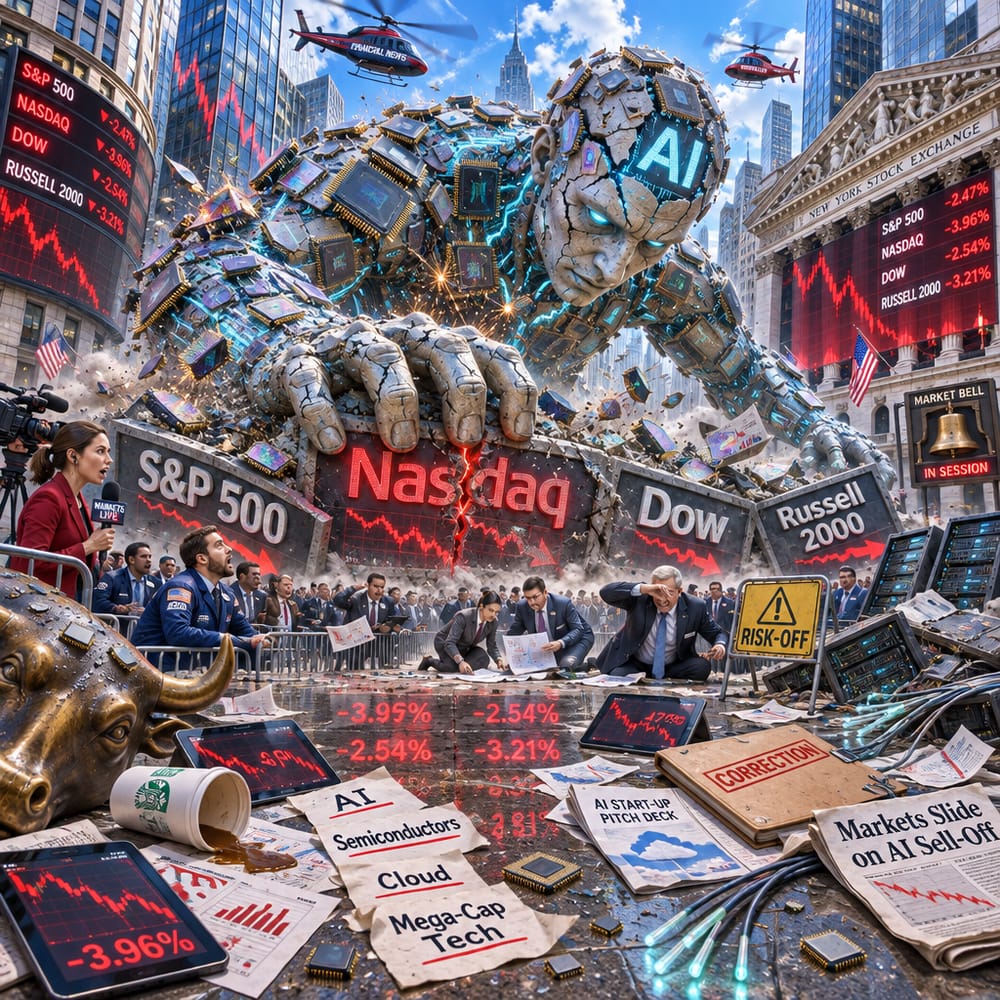
Buckle up, folks. The stock market roller coaster just took a sharp dive, leaving investors clutching their stomachs and checking their portfolios with sweaty palms. The S&P 500 has officially entered what we finance folks like to call "correction territory." Translation: it’s down more than 10% from its highs. And the Nasdaq? Well, it's forgotten all those sweet gains it made in 2026, thanks to a deepening sell-off in AI stocks.
You might be wondering, "Why is this happening?" Let’s dive into the nitty-gritty of what’s got Wall Street’s knickers in a twist.
THE AI PARTY HANGOVER
First off, remember when AI was the life of the party, with everyone talking about how it was going to change the world? Well, it turns out that party might have been a bit too raucous. Investors had poured money into AI companies like there was no tomorrow, but now reality is kicking in. Some of these companies just aren't living up to the hype — or their lofty valuations. Imagine buying a ticket to a magic show and then realizing the magician only knows one trick. Disappointing, right?
Recent tech outages haven’t helped matters, with concerns over system vulnerabilities sparking fears of potential cyberattacks. Director of National Intelligence Jay Clayton may have tried to reassure us, but the “bumps in the road” he mentioned feel more like giant potholes as we navigate this AI landscape.
THE RIPPLE EFFECT
The ripple effects of this AI sell-off are making waves far beyond Silicon Valley. Just like that one bad apple in the fruit basket, the tech sector’s woes are spoiling the mood for the entire market. The S&P 500 and Nasdaq aren't just tech-heavy; they're tech-reliant. So when AI stocks sneeze, these indices catch a cold — and so do investors.
It's not just tech feeling the heat. Other sectors are getting dragged into this market mudslide, too. Financials, for instance, are getting jittery as tech companies are their big clients. With tech's struggles, the banks aren't exactly throwing a party.
Small-cap stocks, represented by the Russell 2000, are also having a rough time. These companies, often seen as a bellwether for economic health, are more volatile and sensitive to economic shifts. And with the current market sentiment, they're tumbling like a house of cards.
WHAT’S NEXT FOR THE MARKET?
So, what does all this mean for future market trends? Are we heading for a sustained downturn or just a temporary blip? Well, like any good cliffhanger, the answer isn't straightforward.
For one, the market correction could be a necessary detox. Let’s face it, the euphoria around AI had reached fever pitch, and maybe this is the reality check we all needed. Overvaluations are being reeled in, and this could pave the way for more sustainable growth in the long run.
But strap in for some turbulence. With continued fears over tech vulnerabilities and changing market dynamics, uncertainty remains the name of the game. And while some sectors might bounce back quicker — think consumer staples and healthcare, which tend to be more resilient — others could take longer to find their footing.
WHAT SHOULD RETAIL INVESTORS DO?
In times like these, it’s tempting to either panic or do nothing at all. But savvy investors know there's a middle path. Diversification is your best friend. By spreading investments across different sectors, you can cushion the blow when one part of the market takes a hit.
Keep an eye on companies that show real promise and have strong fundamentals, as opposed to just riding the AI hype train. These firms are more likely to weather the storm and come out stronger on the other side.
And lastly, remember that market corrections are part and parcel of the investing game. They may feel like a gut punch, but they're also opportunities to reassess and pick up undervalued gems.
So, retail investors, stay sharp, stay informed, and don't let the market's mood swings knock you off your game. After all, the stock market is less like a stroll in the park and more like a roller coaster at Coney Island — thrilling, unpredictable, and sometimes a little nauseating. But isn't that why we love it?
This article is for informational purposes only and is not investment advice. Always do your own research or consult a licensed financial professional before making investment decisions.
© Copyright 2024. All Rights Reserved.
© Copyright 2024. All Rights Reserved.