

U.S. Memory Chip Stocks Slump on CXMT Competitive Breakthrough
Thursday, October 15, 2026
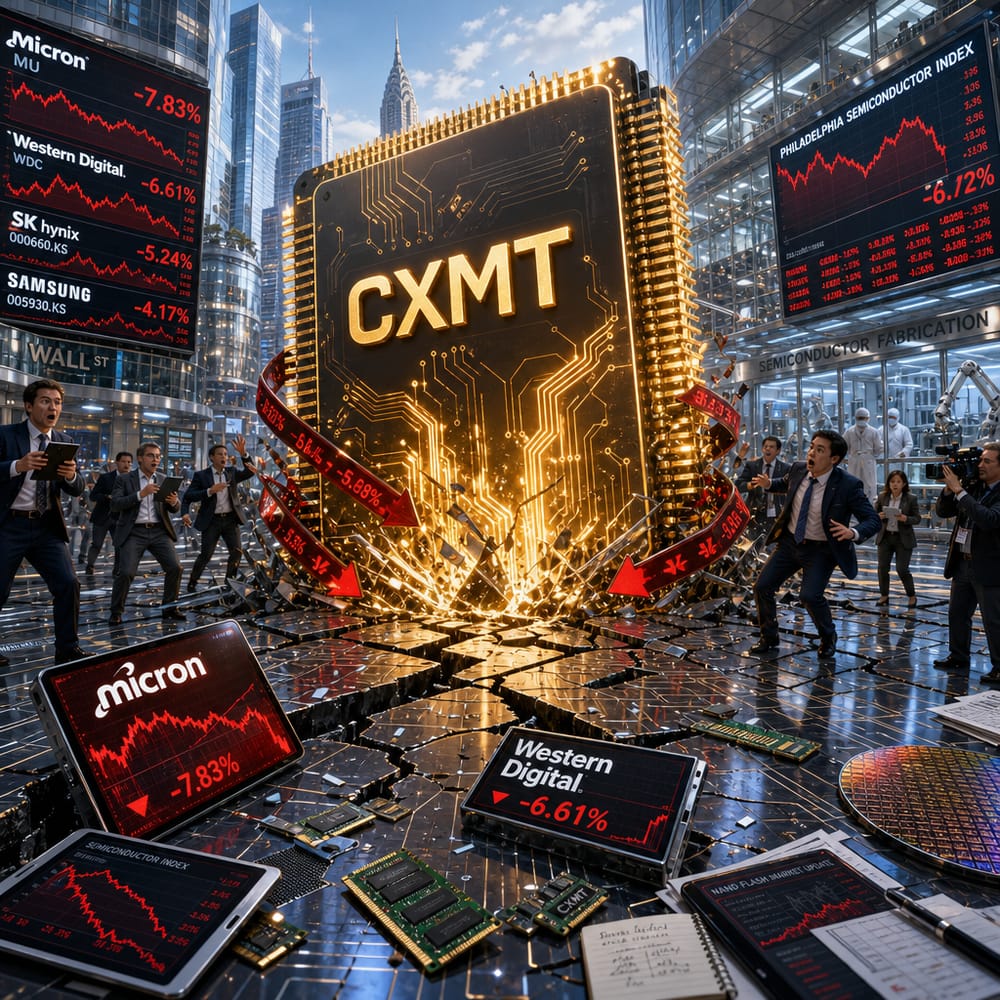
U.S. MEMORY CHIP STOCKS SLUMP ON CXMT COMPETITIVE BREAKTHROUGH
The battle between David and Goliath just took a tech-savvy twist in the world of semiconductors. An unexpected move by a rising Chinese player has sent shockwaves through the U.S. memory chip industry, leaving investors clutching their phones with sweaty palms. ChangXin Memory Technologies (CXMT) may not yet be a household name, but their latest breakthrough has certainly put them on the map—and investors on edge.
The drama unfolded when CXMT announced they've cracked a new memory cell architecture, a tech savvy tweak that lets them pack more data into less space. Think of it as a suitcase that magically fits an extra dozen pairs of shoes. This leap in design could allow CXMT to churn out memory chips with higher storage density, shaking the confidence of industry giants like Micron and Western Digital. With CXMT eyeing a chunk of the lucrative memory market, it's basically a Silicon Valley soap opera.
But what does this mean for the U.S. players in this chip soap opera? First off, it's a hit to their pricing power. The memory chip business has been a high-margin paradise, where companies could charge a pretty penny thanks to their cutting-edge tech. Now, with CXMT potentially offering similar (if not better) tech at a lower cost, those margins could be as endangered as a dodo bird. It's no wonder Wall Street's ringing the alarm bells.
In the immediate aftermath, investors didn't take the news lightly. Shares of memory stalwarts like Micron and Western Digital took a nosedive. Micron’s stock spiraled down by around 11%, leaving investors feeling more queasy than a rollercoaster ride. Even the likes of SK Hynix and Samsung, who are no strangers to fierce competition, felt the heat, suffering double-digit declines in their share prices. It's like CXMT threw a tech grenade into the memory chip clubhouse and everyone scrambled for cover.
So, is this breakthrough really a game-changer, or just a blip on the tech radar? While CXMT's new design is undeniably impressive, the skeptics are quick to point out that creating a revolutionary product is only half the battle. Scaling it to mass production without losing performance or jacking up costs is the holy grail—and it's not clear if CXMT can walk that tightrope yet. Analysts are nervously watching to see if CXMT can actually deliver on its promise or if this is just a well-executed headline grab.
Looking down the road, the implications for U.S. memory chip companies are significant. If CXMT successfully infiltrates the market, these companies might face the tough choice of slashing prices or losing market share. Either way, profit margins could slim down faster than a New Year’s resolution. Plus, there's the looming specter of oversupply in the market by 2029, which could further depress prices. In short, those high-margin days could be numbered.
As for the broader semiconductor sector, CXMT's advancement nudges the competitive landscape towards a more level playing field. The Philadelphia Semiconductor Index, a barometer for the industry, has been reflecting these jitters, echoing the sentiment that the tech throne is up for grabs. For U.S. chipmakers, adapting and innovating isn’t just a strategy—it’s a survival tactic.
In the whirlwind that is tech investing, there's a lesson to be learned here. The scene can change faster than you can say "semiconductor." As U.S. investors grapple with the implications of CXMT muscling into their turf, one thing's for certain: the semiconductor saga promises twists and turns that would make a Netflix drama green with envy. Whether CXMT can maintain its momentum and disrupt the memory chip hierarchy remains to be seen, but for now, it's a story that's far from over. Investors, buckle up—it's going to be a wild ride.
This article is for informational purposes only and is not investment advice. Always do your own research or consult a licensed financial professional before making investment decisions.
© Copyright 2024. All Rights Reserved.
© Copyright 2024. All Rights Reserved.