

U.S. Equities Drift Lower as Bond Yields Climb to Multi-Decade Highs
Tuesday, September 29, 2026
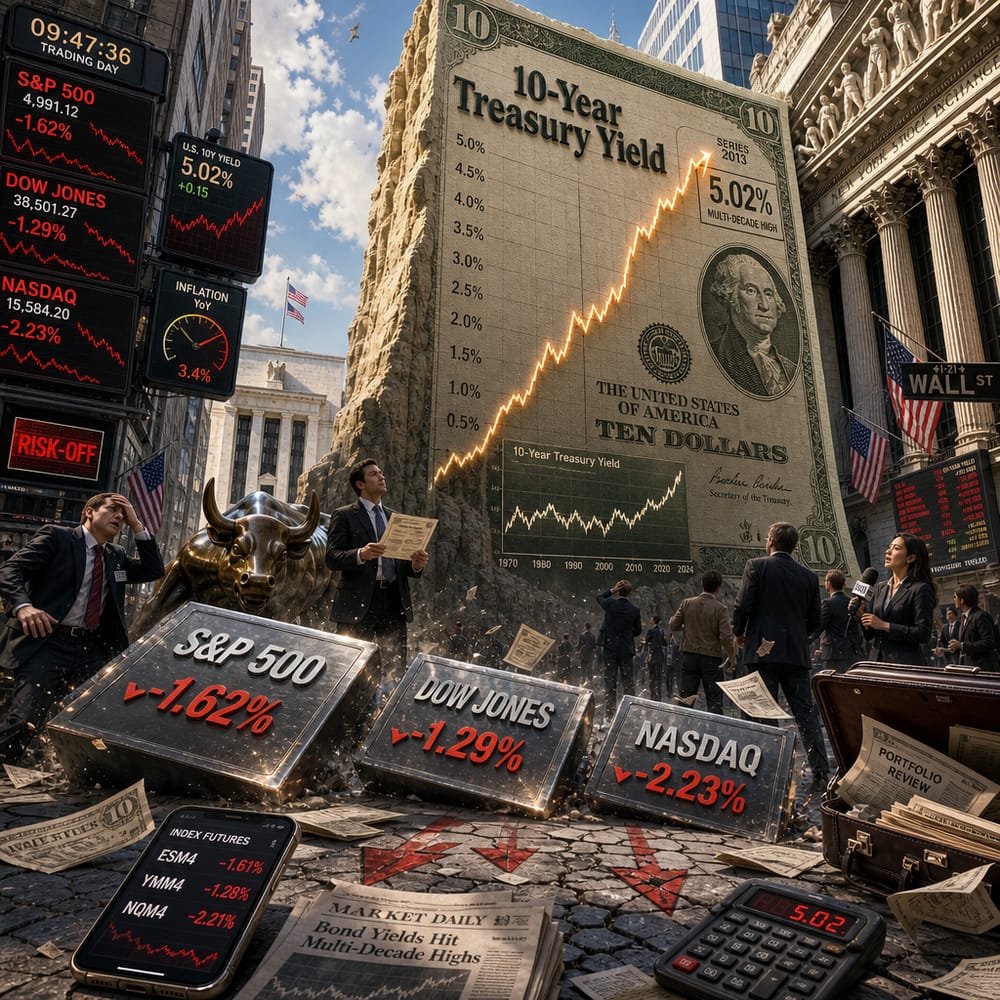
It's not every day that the world of finance feels like a suspense thriller, but with U.S. equities dancing nervously and long-term Treasury yields hitting multi-decade highs, it's starting to look more like Wall Street has decided to give Hollywood a run for its money. So grab some popcorn—or maybe an antacid—and let's dive in.
If you've got a financial pulse, you've probably noticed that major U.S. stock indices—think S&P 500, Dow Jones, and Nasdaq—are in a bit of a funk. The Dow recently shrugged off 131.59 points like it was shedding an old coat, while the S&P 500 and Nasdaq followed suit, each posting back-to-back losses. The culprit? Treasury yields climbing like they're trying to summit Everest without a guide.
The 30-year Treasury yield has jumped to the dizzying heights of 5.6%, a place it hasn't visited since 2002. For those of us who can remember that far back, 2002 was the year of flip phones and AOL Instant Messenger. Nostalgia aside, high Treasury yields are a headache for stocks, particularly the tech giants that have been the darlings of the market for years. You see, when yields rise, it makes the future cash flows from stocks less attractive. Investors start to wonder if their money might be better off collecting dust (and interest) in bonds.
So what does this mean for the likes of Apple and Microsoft? Well, the tech sector is often the first to feel the heat when yields climb. These companies, with their sky-high valuations, rely on the promise of big future earnings. But those earnings look a lot less appealing when you could just park your cash in a Treasury bond and earn a decent return with a nap thrown in for free.
The implications for Fed policy are as slippery as a greased pig at a county fair. The Federal Reserve has been walking a tightrope, trying to combat stubborn inflation without sending the U.S. economy into a tailspin. The latest inflation measure, the personal consumption expenditures price index, isn't providing much comfort either. Both overall and core inflation rates remain well above the Fed's 2% target, suggesting that inflation isn't going to roll over and play dead anytime soon.
With higher yields flashing like a neon sign, the Fed is likely scratching its collective head, wondering if it should crank up interest rates again or hold its fire. Rising yields might alleviate some pressure on the Fed by slowing down the economy naturally, but with inflation still hovering, the central bank's next move is anyone's guess.
Investors, not ones to sit idly by, are rethinking their portfolios. While some are rotating out of tech and into sectors less sensitive to interest rate hikes—think utilities and consumer staples—others are hedging their bets by snapping up bonds, especially as yields look more tempting than a discount on GameStop stock. There's also a larger conversation about geopolitical risks and fiscal deficits, which have been driving more investors toward the perceived safety of government bonds.
But wait, there’s more drama! The IPO market is throwing its own curveballs. Biometric ring maker Oura and a parade of other companies have hit pause on their initial public offerings, citing the unpredictable market conditions caused by—you guessed it—those pesky rising yields. Analysts suggest this isn't just company-specific jitters but a broader market hesitation. It seems no one wants to walk the plank into an ocean of uncertainty.
So, what's the savvy investor to do amid this chaos? Diversification remains the name of the game. A balanced portfolio that includes a mix of stocks, bonds, and perhaps even a dash of international exposure could be your best bet for weathering this storm. While the future is murky, one thing’s for sure: keeping a keen eye on Treasury yields and Fed signals will be crucial as we chart our financial course forward.
In the meantime, keep that popcorn handy. This financial saga is far from over, and the next twist could be just around the corner.
This article is for informational purposes only and is not investment advice. Always do your own research or consult a licensed financial professional before making investment decisions.
© Copyright 2024. All Rights Reserved.
© Copyright 2024. All Rights Reserved.