

U.S. Equities Decline on Inflation Concerns and Rate Hike Fears
Tuesday, November 10, 2026
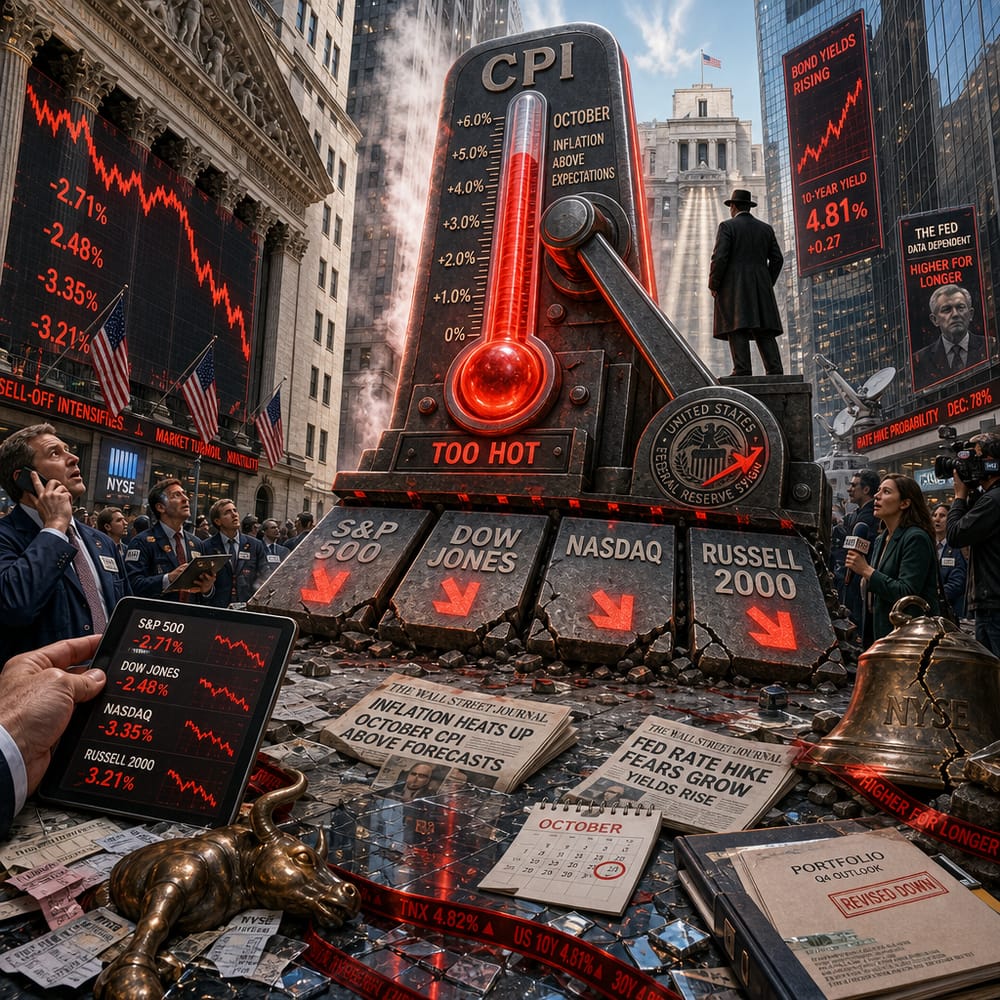
U.S. EQUITIES DECLINE ON INFLATION CONCERNS AND RATE HIKE FEARS
Hold onto your wallets, folks. If you thought the stock market was a rollercoaster, wait until you see what inflation just did to the ride. The major U.S. stock indices are having a bad hair day, and it’s all thanks to a hotter-than-expected Consumer Price Index (CPI) report. Turns out, inflation is not going quietly into that good night, and investors are starting to sweat.
The S&P 500, Dow Jones, Nasdaq, and Russell 2000 all took a nosedive after October's CPI data rolled in like a storm cloud. Prices rose 0.4% in October, more than the 0.3% that economists had their fingers crossed for. Now, I know what you're thinking: a tenth of a percent doesn’t sound like much. But in the financial world, it's enough to make everyone from Wall Street to Main Street do a collective double-take.
So, what’s the big deal? Why does a little uptick have such a massive ripple effect? Well, the fear is that if inflation keeps rising, the Federal Reserve might get trigger-happy with interest rate hikes. And those rate hikes are like bad news at a family dinner: no one wants them, but everyone knows they’re coming. Higher interest rates mean higher borrowing costs. For businesses, that could mean rethinking expansion plans. For consumers, it’s the dreaded blow to mortgages, car loans, and credit card rates. Essentially, everything gets pricier, and not in a fun, “life of luxury” way.
Investors are reacting as if someone just shouted "Shark!" at the beach. The stock market doesn’t like uncertainty, and an uptick in inflation brings a whole carnival of uncertainties. Are we heading for more rate hikes? How aggressive will the Fed be? While we don’t have a crystal ball, we do know one thing: the market is bracing for a rollercoaster ride, and no one remembers fastening their seatbelt.
The implications of a potential rate hike are sending jitters through the markets. Treasury yields, for instance, are on something of a caffeine high. The yield on the 10-year Treasury note — which influences everything from mortgage rates to student loan interest rates — shot back up above 5%. That's a level not seen since your neighborhood Blockbuster had a decent selection. Yields and prices move inversely, and with yields rising, it signals that investors are dumping bonds, wary of the coming rate hikes.
The tech-heavy Nasdaq was particularly hard-hit, partly due to Nvidia’s drama. The chipmaker’s stock sank more than 5% amid CEO Jensen Huang's scandal involving an alleged Chinese spy — a subplot worthy of a spy novel. So, it's not just inflation that's got this market spooked. Even as Nvidia tries to keep its head above water, the broader tech sector is feeling the burn.
Meanwhile, CoreWeave is showing us that not all clouds have a silver lining — some have a neocloud lining. The company defied fears of a slowdown in AI demand by reporting a revenue beat and raising its guidance. While Nvidia stumbled, CoreWeave caught a slight uptick in extended trading. For investors, it’s the market equivalent of “one man’s trash is another man’s treasure.”
As you scroll through your feed, you might wonder: Is there any good news in all this? Well, for homeowners, the spike in HELOC balances suggests that people are tapping into home equity like it’s a piggy bank. Why? Perhaps because with rates set to climb, locking in any available cash seems like a safe bet.
So, what should we expect next? While it's tempting to believe the Fed will play nice, history tells us they're more like that strict teacher who won’t budge on deadlines. If inflation remains sticky, more rate hikes could be a reality we all have to live with.
In the meantime, investors are left with a choice: put on the blindfold and ride out the volatility or brace for impact and adjust their portfolios accordingly. Either way, the market has spoken, and it’s saying, “Buckle up, it’s going to be a bumpy ride.”
This article is for informational purposes only and is not investment advice. Always do your own research or consult a licensed financial professional before making investment decisions.
© Copyright 2024. All Rights Reserved.
© Copyright 2024. All Rights Reserved.