

U.S. Economy Loses 23,000 Jobs in July — Unemployment Rate Still Falls
Sunday, August 09, 2026
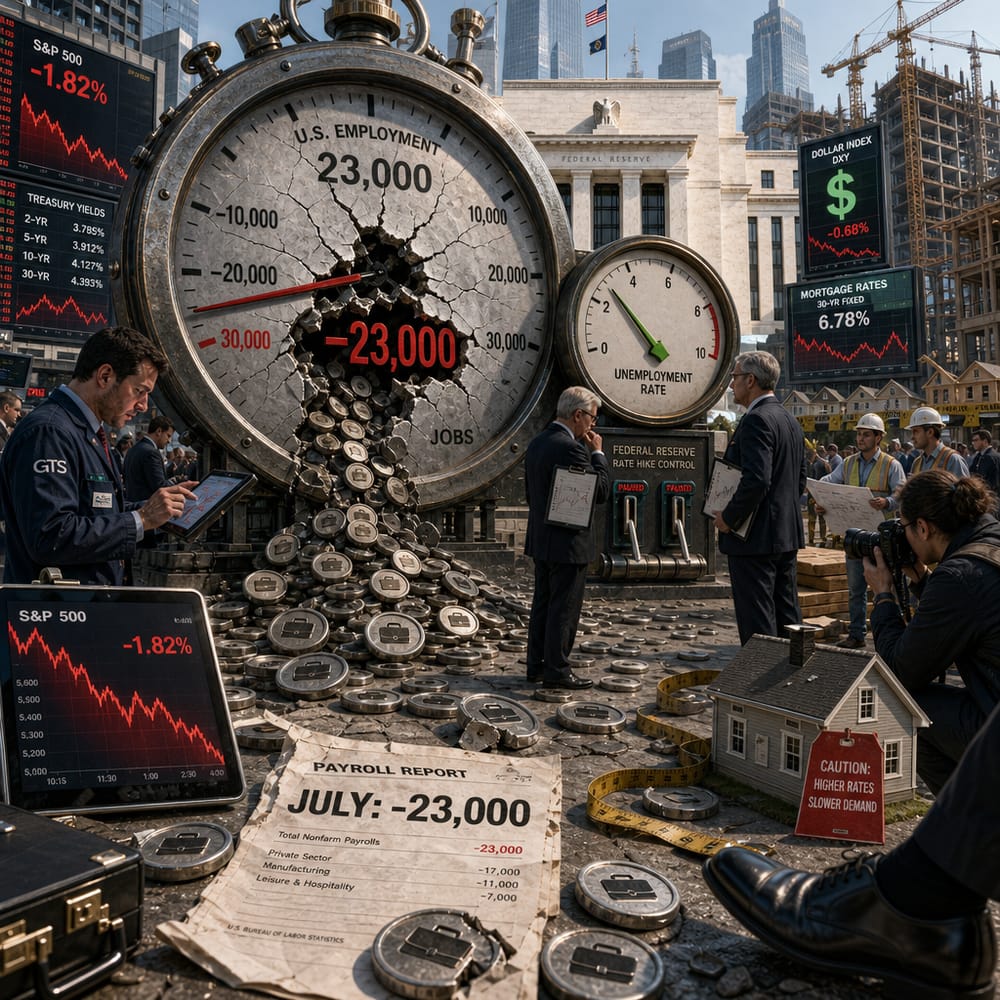
THE US JOBS CONUNDRUM: WHEN LOSING JOBS MAKES UNEMPLOYMENT FALL
In the land of employment data, July pulled a rabbit out of the hat—or perhaps a gremlin from the machine—when it reported the loss of 23,000 jobs but somehow also managed to decrease the unemployment rate. If your head is spinning, you're not alone. Economists, investors, and, yes, the Federal Reserve, are all clutching their abacuses trying to make sense of this head-scratching scenario.
Let's unpack this mess, shall we?
THE NUMBERS NOBODY WANTED
To say that the U.S. economy had a surprising July would be an understatement. Economists were sitting around waiting for a neat and tidy job gain of 95,000. Instead, they got a thunderclap of disappointment: 23,000 jobs vanished into thin air. Yet, paradoxically, the unemployment rate dipped to 4.1% from a previous 4.2%. It’s like stepping on the scale, losing weight even though you’ve just devoured a double cheeseburger.
So, where did all the jobs go? The culprits were widespread, but the usual suspects included retail and manufacturing, which have been shedding jobs like last year’s fashion.
WHAT'S WITH THE LABOR FORCE PARTICIPATION?
Here's the kicker: the shrinking unemployment rate isn't necessarily a sign of economic health. It’s a trick of light caused by fewer folks looking for work. The labor force participation rate—the proportion of people either working or actively looking for work—declined, making the jobless rate look rosier than it is. Think of it as using a Snapchat filter on your economic selfie.
Fewer people in the workforce means fewer people counted as unemployed, even as jobs disappear. It’s a bit like counting only the apples left on the tree after a strong wind has blown away half the orchard.
WHAT THIS MEANS FOR THE FED AND THE MARKET
Now, you might think: fewer jobs would mean less pressure on wages, right? Not so fast. This wobbly job market could make the Federal Reserve's life a lot more complicated. A weaker labor market might suggest slowing inflation, but fewer people working also means less spending power. It's like trying to juggle flaming torches while riding a unicycle.
For the market, this mixed bag of signals has created more uncertainty than a cat in a room full of rocking chairs. The S&P 500 took a slight dip, reflecting investor anxiety. Yield-sensitive sectors like banks and homebuilders are particularly jittery as they try to predict whether the Fed will slam the brakes, keep coasting, or floor it on interest rates.
Sectors that felt the earth shift the hardest? Bank stocks already stressed by interest rate fluxes, and homebuilders who rely on stable, predictable rates to function.
INVESTORS' REACTIONS AND MARKET MOVES
In the financial game of musical chairs, no one wants to be left standing when the music stops. As soon as the jobs report hit the wires, odds of a Fed rate hike took a nosedive. Suddenly, the odds of another rate hike this year seemed about as likely as a snowstorm in July.
What's more, this labor report has left the U.S. dollar doing a bit of a two-step. Investors, ever the jittery bunch, have been re-evaluating their portfolios faster than you can say "rate cut."
IT'S A QUANDARY
The July jobs report paints a picture as muddled as a Jackson Pollock painting. On one hand, a falling unemployment rate might suggest that the economy is stronger than we think. On the other hand, the falling number of jobs and a declining workforce participation rate hint at underlying weaknesses. It's a riddle wrapped in a mystery inside an economic enigma.
So, what’s a savvy retail investor to do? Keep a close eye on how the market digests these mixed signals. While the unemployment rate suggests one narrative, the loss of jobs and labor force participation paints another. It’s a classic case of the left hand not knowing what the right hand is doing, or rather, the economy not knowing what it's up to next.
In the meantime, hold onto your investment hats, because this roller coaster ride isn’t over yet. Whether you're banking on a Fed pivot or holding steady for the long haul, July's unexpected employment twist will keep economists and investors alike buzzing well into August. Stay tuned, because in the world of finance, the only certainty is uncertainty.
This article is for informational purposes only and is not investment advice. Always do your own research or consult a licensed financial professional before making investment decisions.
© Copyright 2024. All Rights Reserved.
© Copyright 2024. All Rights Reserved.