

U.S. Economy Grows at Modest 1.5% Annualized Rate in Q2
Thursday, August 27, 2026
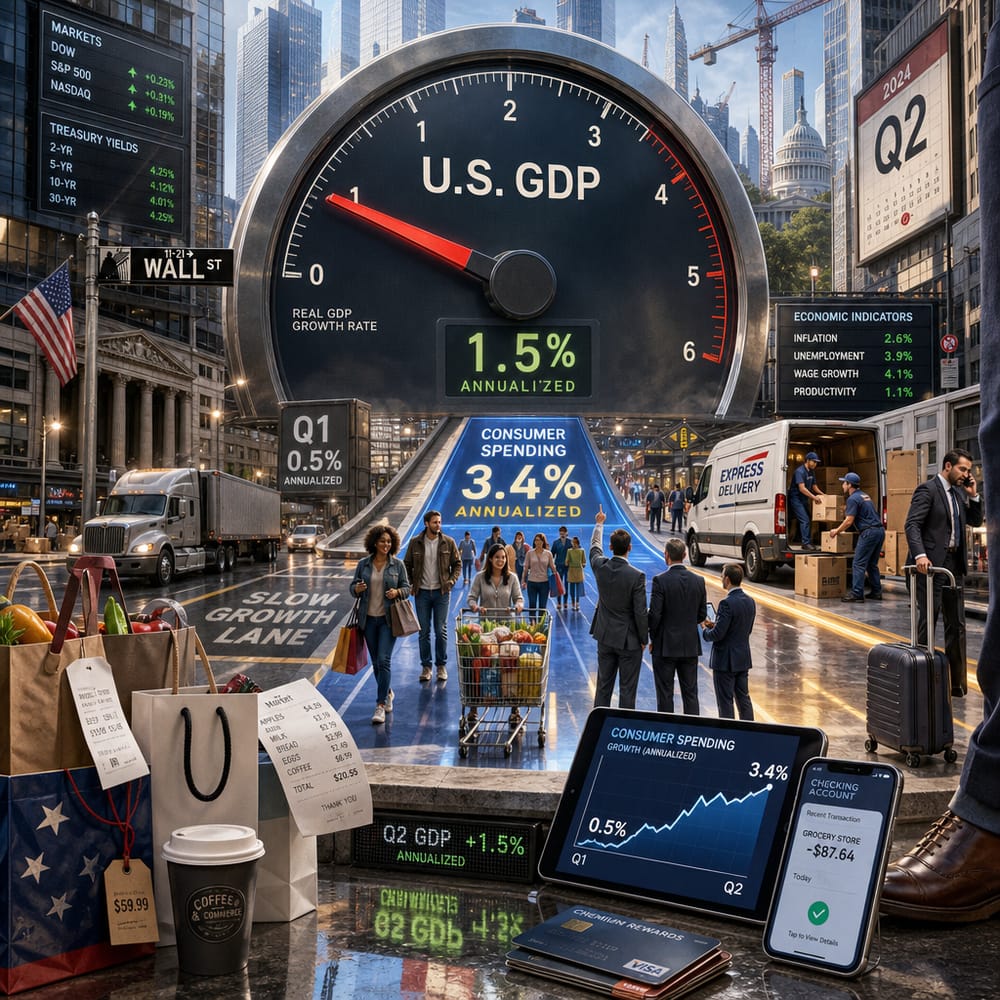
GUESS WHO'S CARRYING THE U.S. ECONOMY? HINT: IT'S YOU, CONSUMER
Congratulations, dear consumer, you’re the MVP of the U.S. economy—again. In the second quarter, while the overall economy was crawling at a sluggish 1.5% annualized pace, your spending rose a sprightly 3.4%. Not bad for an economy supposedly on its last legs, right? So, what gives? How can you—yes, you—be shopping up a storm while Uncle Sam's GDP is napping on the job?
Let’s dive into this economic paradox, where the consumer is king, but the kingdom’s growth is slower than a snail on sedatives.
THE ELEPHANT IN THE ROOM: SLOWER GDP GROWTH
First, let's talk about the 800-pound gorilla in the room: the GDP growth rate. While a 1.5% annual growth might not sound like a funeral dirge, it's certainly no victory parade. The real puzzle is why the economy is barely tickling 1.5% when consumer spending—the backbone of GDP—is flexing its muscles.
One of the culprits behind this tepid overall growth is the manufacturing sector, which might as well be wearing a "Do Not Disturb" sign these days. Sluggish production and investments, especially in energy and certain durable goods, are draining the oomph from GDP figures. Construction isn’t doing any favors either; with rising interest rates, the housing market is feeling more like a concrete block tied to the economy’s ankle. And let's not forget the export sector, which has been as lively as a frozen fish, thanks to global trade tensions.
CONSUMER SPENDING: CAN IT KEEP THE PARTY GOING?
Now, let’s zoom in on you, the hero of this story. Your spending spree isn’t just a happy accident; it’s supported by a still-healthy labor market and wages that, while not soaring, are steady enough to burn a hole in your pocket. But, sustainability is the million-dollar question. Can consumers keep carrying the torch, or are they on the verge of a burnout?
Historically speaking, consumer spending thrives on confidence, and confidence tends to waver when inflation plays its cruel tricks. So far, spending has held up remarkably well, but there are signs that the strain of fluctuating prices is starting to tell. If energy costs spike or if inflation decides to ditch its current plateau, we might see consumer confidence take a nosedive faster than you can say “recession.”
FEDERAL RESERVE: THE WILD CARD
And then there’s the Federal Reserve, which, under Chairman Kevin Warsh, is playing a cryptic game of "Who Knows What’s Next." Instead of spoon-feeding Wall Street with clear guidelines, Warsh has taken a zen-like approach, urging markets to rely on the raw data. This has left investors scratching their heads and trying to decode cryptic signals from the Fed like they’re deciphering a modern-day Rosetta Stone.
Warsh’s enigmatic dance could shift consumer behavior significantly. If the Fed hints at raising interest rates, borrowing could get pricier, dampening big purchases like homes and cars, and in turn, consumer spending.
MARKET'S MIXED BAG
Meanwhile, markets are their own soap opera. Tech stocks like Nvidia and Salesforce are laughing all the way to the bank with stellar earnings, while many others remain in the doldrums. The drama doesn’t stop there. Just take a look at the Biofuel sector, where potential regulations are blending uncertainty into the equation. This adds more fuel to the fire of an already perplexing economic tableau.
THE BOTTOM LINE: HOLD ON TIGHT
So, what’s the takeaway here for you, the everyday investor scrolling through your phone on your lunch break? Watch those consumer spending trends like a hawk, because they’re the pulse of our economic health. Keep an ear out for any cryptic utterances from the Fed, because they could be the gust of wind that changes everything. And most importantly, as you plan your next financial move, remember: in this topsy-turvy economy, one thing is clear—never underestimate the power of the consumer. That means you.
This article is for informational purposes only and is not investment advice. Always do your own research or consult a licensed financial professional before making investment decisions.
© Copyright 2024. All Rights Reserved.
© Copyright 2024. All Rights Reserved.