

U.S. Dollar Index (DXY) Faces Headwinds from AI-Jitters Despite Hawkish Fed Outlook
Monday, November 23, 2026
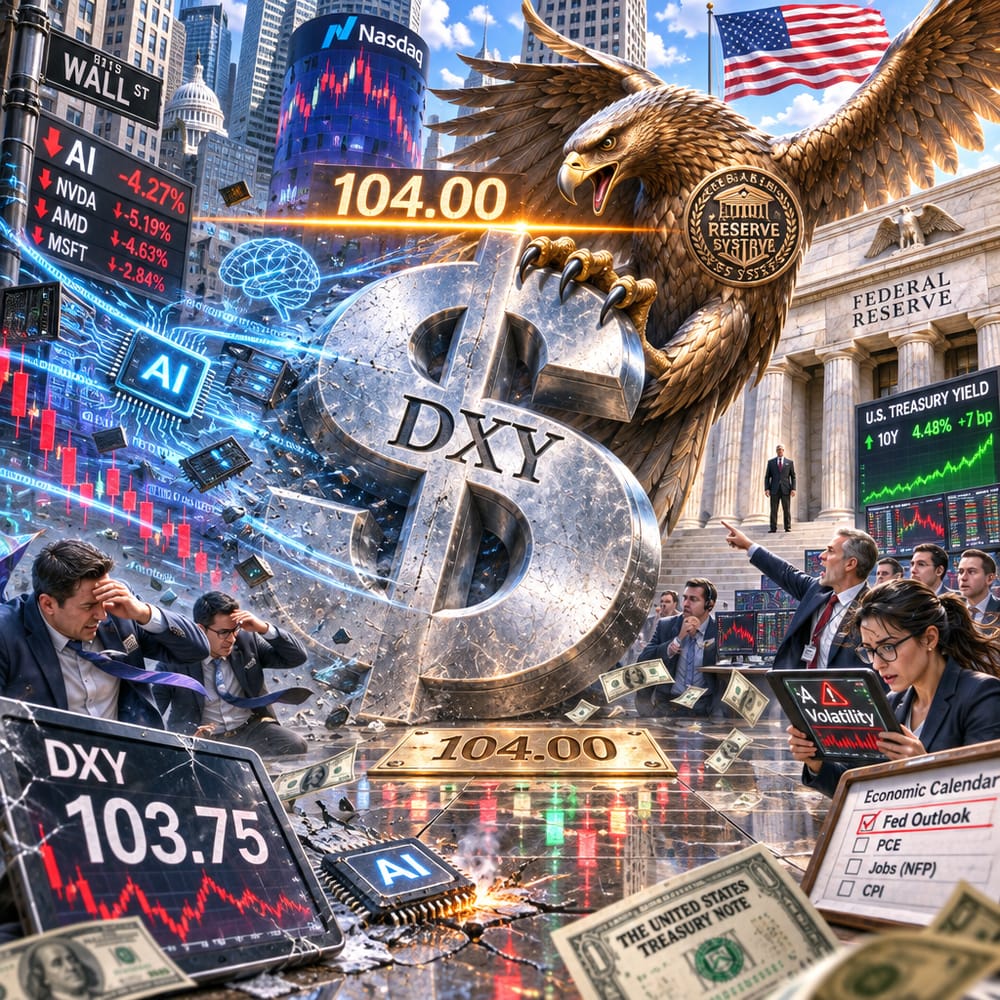
AI JITTERS GIVING THE US DOLLAR THE JITTERS
Ah, the U.S. Dollar Index (DXY). Not exactly the star of the daily market soap opera, but this week, it's certainly earned a supporting role. While the dollar hangs out at a slightly anxious 103.75, just shy of the big 104, it’s getting poked and prodded by some serious tech drama starring Nvidia and its beloved AI chips.
What’s the fuss, you ask? Well, it seems the market has been on a caffeine-induced high from all the AI buzz before getting slammed with a dose of reality. Turns out, AI isn’t just about sci-fi dreams and sky-high stock prices. There’s drama there too, and it’s making the dollar a little queasy.
AI JITTERS AND THE DOLLAR'S DILEMMA
It all started when Nvidia decided to reenlist its charismatic, albeit scandal-tinged CEO, Jensen Huang. This bombshell sent Nvidia shares—and the entire tech sector—flying. Suddenly, AI-linked stocks were the life of the party, and everybody wanted a piece. But here’s where the plot thickens: It’s not all champagne and roses in AI land. Huang’s reinstatement, while a boon for Nvidia’s stock, didn’t exactly erase investor concerns about the volatility swirling around AI investments.
Now, here’s the catch if you’re following the DXY drama. The currency’s value often reflects investor sentiments about economic stability and future growth. If tech and AI stocks look shaky, people get nervous. They start wondering if the AI boom is more bubble than breakthrough, and those jitters ripple out to the broader market, tapping on the dollar’s shoulder and saying, “You nervous, bro?”
FED TIGHTENING: THE DOLLAR'S SPOT OF SUNSHINE
Meanwhile, the U.S. Federal Reserve is like that stern parent who insists on leaving the party early. The Fed’s hawkish stance—meaning they’re hinting strongly at interest rate hikes—should, in theory, be a dollar booster. Why? Higher rates can attract foreign investments, thereby bolstering the dollar's value. Just picture investors lining up for a piece of that sweet, safe U.S. treasury pie.
Yet, despite the Fed’s tough talk, the dollar isn’t exactly flexing its muscles. It’s a bit like a heavyweight boxer who’s taken a jab from a tech-sector featherweight, feeling a tad winded but not down for the count. The Fed’s tightening is definitely a backstop for the dollar; it’s that safety net keeping the dollar from free-falling amidst AI price swings.
WHAT DO THE ANALYSTS SAY?
Analysts, those sages of Wall Street, are trying to make sense of it all. Some believe the DXY’s wobbles are temporary, a slight hiccup in the grand scheme. They argue that once investors start believing in the Fed’s conviction to control inflation and keep the economy steady, the dollar will find its confidence again.
Others, however, see the current scenario as a harbinger of more complex shifts. If AI continues its roller-coaster ride, it might prompt a deeper reevaluation of tech’s growth potential. The sentiment here is that tech volatility could cast longer shadows on the DXY, potentially keeping it on a lower trajectory than one might expect amidst Fed tightening.
THE GREAT TUG-OF-WAR
So, where does this leave you, dear retail investor, who’s just trying to make sense of all this market mayhem while scrolling through your phone? Well, imagine the dollar as the rope in a grand game of tug-of-war. On one side, you’ve got the Fed, pulling with all its hawkish might, promising higher rates and a stronger dollar. On the other, you have the capricious tech sector, with its AI-induced mood swings, pulling in the opposite direction.
For now, the DXY sits awkwardly between these two forces, trying to find its footing. As an investor, keep one eye on the Fed—and maybe keep some popcorn handy for the AI drama. Where it all lands could spell opportunity or risk, depending on which side of the rope gains the upper hand. Just remember, in this market, even the underdogs can pack a punch.
This article is for informational purposes only and is not investment advice. Always do your own research or consult a licensed financial professional before making investment decisions.
© Copyright 2024. All Rights Reserved.
© Copyright 2024. All Rights Reserved.