

U.S. Dollar Index (DXY) Consolidates in 98.5–99.0 Range as Fed Hike Odds Fade
Wednesday, August 26, 2026
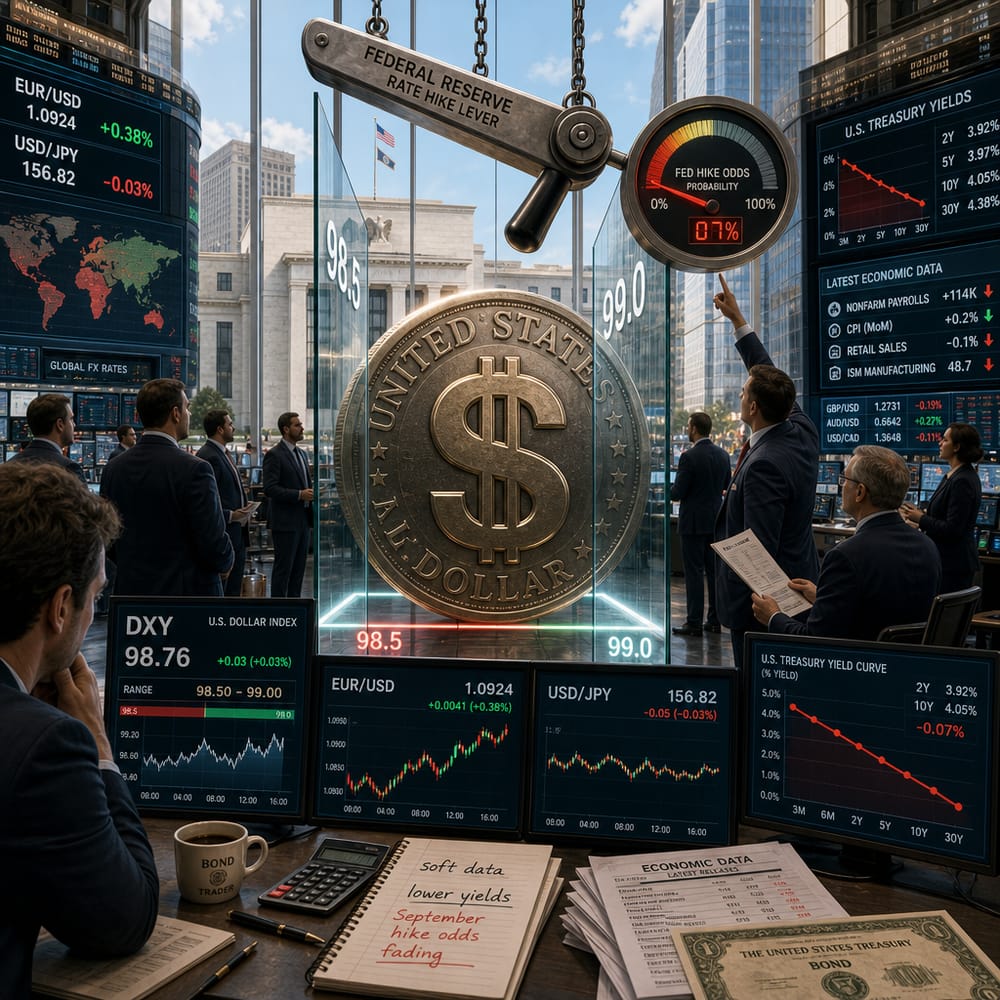
THE U.S. DOLLAR INDEX: POISED AND READY FOR ITS NEXT MOVE
Imagine you're on a seesaw. On one end sits the Federal Reserve with a toolbox labeled "Interest Rates," and on the other, the rest of the financial world, anxiously waiting to see which way things will tip. For now, the seesaw has barely shifted, leaving the U.S. Dollar Index (DXY) chilling comfortably in the 98.5 to 99.0 range. The question on everyone's mind—how long will this delicate balance last?
First, let's talk about why the DXY matters. This index, a cocktail of major world currencies mixed with a twist of the greenback, is essentially the scorecard of the U.S. dollar's health against its peers. If you're wondering why you should care, consider this: a stable DXY impacts everything from the price of your favorite imported cheese to the cost of that dream vacation overseas. It's also a key player in the world of investing, influencing currency pairs like EUR/USD and USD/JPY, which financial markets obsessively watch.
Right now, the DXY is resembling a calm lake on a summer's day. Why? Blame or thank—depending on your portfolio—the fading odds of a Fed rate hike in September. Softer economic data and lower bond yields have played the charming tunes that lulled the Fed's hawks back into their coops. With inflation showing some stubbornness, but not the kind that Fed nightmares are made of, the central bank's rate-raising trigger finger is feeling a lot less itchy.
So, what does a stable DXY mean for the global markets? In short, predictability. When the dollar is stable, it provides a reliable measure against which trade and investment flows can be gauged. Companies and investors alike get some confidence to plan ahead without worrying about sudden, sharp currency moves dinging their bottom lines.
But don't get too comfortable. The financial markets are a bit like a high-stakes game of Jenga—move one piece, and the whole thing could come crashing down in a flurry of market mayhem. If the Fed decides to surprise us with a rate hike, or if economic data swings wildly one way or the other, all bets on the DXY staying steady are off. A stronger dollar could make U.S. exports more expensive, potentially hurting American companies abroad, while a weaker dollar might boost exports but could scare off foreign investors who'd get less bang for their buck.
Then there's the matter of the DXY breaking out of its current range. Should that happen, expect fireworks. Imagine the index popping above 99.0. Not only would traders and investors be scrambling to adjust their strategies, but global trade relations might also experience a tectonic shift. Conversely, if it dips below 98.5, you'd better believe central banks around the world would be on high alert.
The potential risks of such a breakout are akin to rolling the dice in a game of Risk. Currency volatility could lead to abrupt shifts in trade balances, impacting countries that are heavily reliant on exports. It could also provoke a currency war, where nations engage in competitive devaluations to boost their own economies—never a good look.
So, what's next? As always, keep your eyes peeled on the Fed and economic indicators like employment figures and inflation data. Future Fed decisions will likely continue to hold sway over the DXY. If the Fed plays it safe with rates, expect the DXY to keep its cool, but if they decide it's time to shake things up with a rate hike, the DXY could very well decide it's time to party.
In this financial theater, the DXY is the star of the show, and the world is watching its every move. Whether it will maintain its current graceful dance or suddenly decide to break into a wild jig remains to be seen. For now, we're left peeking through the curtains, popcorn in hand, waiting to see if the DXY will continue its stable act or decide to bring the house down. Stay tuned, because in the world of finance, the only constant is change.
This article is for informational purposes only and is not investment advice. Always do your own research or consult a licensed financial professional before making investment decisions.
© Copyright 2024. All Rights Reserved.
© Copyright 2024. All Rights Reserved.