

TSMC's Increased Capex for 2026
Tuesday, August 11, 2026
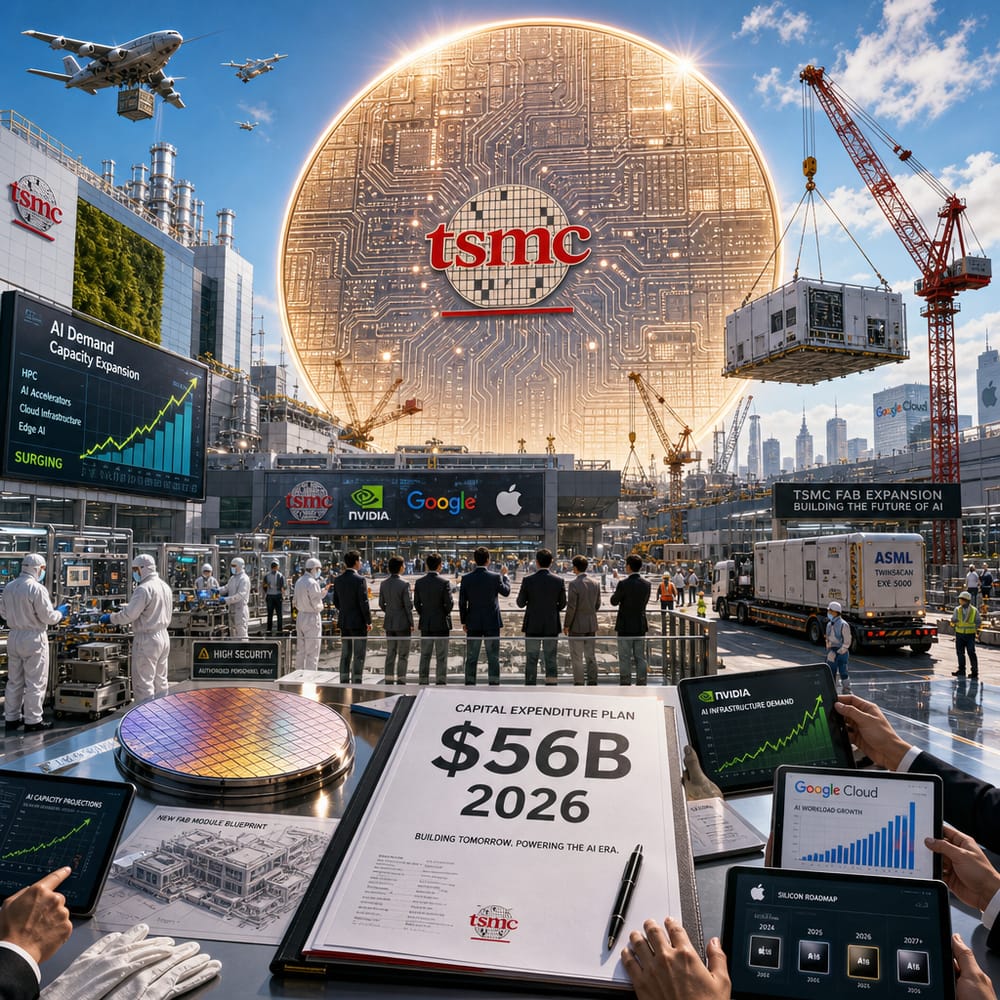
TSMC’S $56 BILLION BET ON THE FUTURE: SAVVY OR SPICY ARMAGEDDON?
In a world where chip demand outpaces celebrity gossip, TSMC has just announced it's throwing down a staggering $56 billion to beef up its manufacturing muscles by 2026. That’s not just the price of being a semiconductor behemoth; it’s a declaration of war in the silicon arms race. And guess what? The battlefield is none other than the rapidly expanding AI economy.
TSMC, or Taiwan Semiconductor Manufacturing Company for those who like to spell things out, is betting big on the future. But let’s break this down—what’s in it for the everyday retail investor scrolling through their phone while sipping their morning coffee?
THE CHIP GIANT'S GRAND PLAN
First off, TSMC’s capital expenditure (capex) isn't just a ploy to dazzle investors with big numbers. It’s about preparing for a tech future where AI isn’t just a buzzword—it’s our reality. From self-driving cars to drones that deliver your dinner, these applications are only limited by our imaginations. What powers these dreams? You guessed it—chips.
With giants like Nvidia, Google, and Apple as its key clients, TSMC’s decision to crank up its production capacity is like a Hollywood studio investing in blockbuster sequels. They’re gearing up for the demand these tech titans have for AI-driven innovations. And in this high-stakes game, the stakes are as real as they get.
THE SWEET AND SOUR OF MASSIVE INVESTMENTS
Now, before we pop the champagne, let’s consider the flip side. A $56 billion investment isn’t without its risks. For starters, TSMC is putting a lot on the line in a market notorious for its volatility. Anyone remember the silicon shortage saga that had tech companies scrambling like it was the last Black Friday sale on earth?
This monumental capex move is akin to playing poker with a massive pile of chips—pun intended. If the AI boom doesn’t pan out as projected, or if competitors like Intel, who’s recently upsized its stock offering to meet AI demand, catch up faster than expected, TSMC might find itself in a less-than-favorable position.
Then there’s the geopolitical shakiness. Let’s not forget the ongoing tensions in Taiwan, which have more drama than a soap opera. Any disruption there could impact the chip supply chain with repercussions that would ripple across the tech landscape.
FRIENDS, FOES, AND FIERCE COMPETITORS
Speaking of ripples, TSMC’s relationship with its clients is also worth a look. A production boost could strengthen ties, allowing major players like Apple and Google to scale their dreams of tech dominance even faster. But as any savvy investor knows, relationships can be as fickle as stock markets.
Clients may rejoice today, but the question is will they stay loyal tomorrow? TSMC is not the only chip game in town. Intel, for instance, is already expanding its horizons with a $20 billion stock offering aimed at capital expenditures. If TSMC can’t maintain its edge, these tech giants might just swipe right on a new semiconductor suitor.
THE VERDICT FOR INVESTORS
So, what’s the takeaway for you, the retail investor? In essence, TSMC’s move is a high-risk, high-reward gamble. If the AI wave turns into a tsunami, TSMC could ride it all the way to the bank. But if it falters, or if disruptions in production arise, the financial fallout could be, well, less than pleasant.
For now, TSMC remains a key player worth watching closely. Its decision to supercharge its capex is a testament to the vibrant, albeit unpredictable, future of tech. For those with a taste for risk and a belief in AI’s potential, this might just be the spicy investment opportunity you’re looking for.
And there you have it—TSMC’s $56 billion gamble in a nutshell. As always, do your homework, because in the world of investing, the chips are always on the table.
This article is for informational purposes only and is not investment advice. Always do your own research or consult a licensed financial professional before making investment decisions.
© Copyright 2024. All Rights Reserved.
© Copyright 2024. All Rights Reserved.