

Treasury Yields Surge Again; Evercore Questions Sustainability of Tactical Interventions
Saturday, August 22, 2026
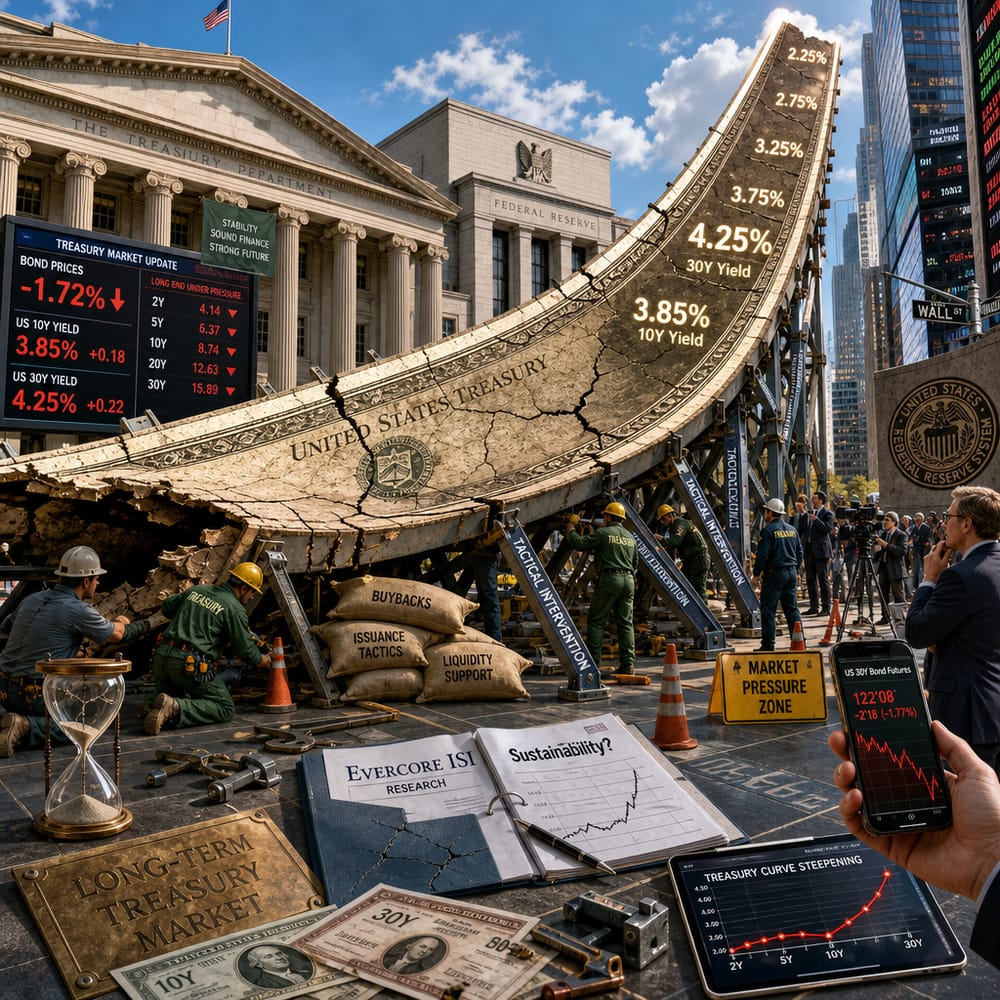
THE GREAT TREASURY YIELD JUMP: WHAT IT MEANS FOR YOUR WALLET
If Treasury yields were a rock band, they're going platinum — with a surge that would make even the most daring investor's heart skip a beat. Once again, long-term Treasury bonds are having a sell-off, pushing yields skywards in a way that screams 'rollercoaster' more than 'safe haven.' So, what's the deal with these skyrocketing yields, and what does it mean for the average Joe who's just trying to keep their retirement fund afloat?
YIELD LEVELS ROCKETING UP
Let's get you up to speed. Right now, the yield on the 10-year Treasury is flirting with levels not seen since the days when bell-bottoms were out and mullets were in. The mighty 10-year yield has catapulted past 4.5%, sending shockwaves through the investment world. For context, that's a healthy jump from the sub-2% yields we saw just a few years back. The 30-year yield isn't taking a back seat either, dancing around the 4.7% mark.
But hold on — why do these yields even matter to you? Well, whether you realize it or not, Treasury yields are the fingerprints on nearly every financial pie. Mortgage rates, credit cards, auto loans — they all take cues from these numbers. Rising yields mean borrowing costs are heading north, and your wallet might start feeling the squeeze.
THE TREASURY'S INTERVENTION DILEMMA
Now, let's talk strategy — the Treasury's strategy, to be exact. Evercore ISI, the Wall Street gurus who live and breathe bonds, are raising eyebrows over the Treasury's latest interventions. Think of it as trying to hold back a tidal wave with a beach towel. The Treasury's been doing a little dance with bond buybacks and other maneuvers, hoping to keep yields from running too wild.
But here's the kicker: Evercore ISI is questioning just how sustainable this approach is. Bond strategists are like those friends who know exactly what to say to make you question your life choices, and they're casting doubt on whether these interventions can hold back the tide in the long run. After all, it's a bit like trying to put a band-aid on a gaping wound. Can the Treasury really keep yields from soaring even higher? Or are we just kidding ourselves?
BORROWING COSTS AND THE YIELD CURVE DRAMA
The ripple effect of these razzle-dazzle yields doesn't stop at just higher borrowing costs. Nope, they're playing a leading role in the drama of valuation models and the yield-sensitive sectors. Think utilities and real estate — the sectors that swoon or faint at the mere mention of interest rate changes.
It's a tangled web, my friends. Rising yields can make stocks look less appealing compared to bonds, nudging investors into the latter. However, when interest rates climb, companies have to shell out more to borrow money, which could put a damper on their growth plans. It's a delicate dance between risk and reward, and right now, we're all treading on some pretty thin ice.
WHAT THE EXPERTS ARE SAYING
Here's the million-dollar question: what do the experts think? Well, I had a chat with a few bond strategists who spend their days deciphering these financial hieroglyphics. One strategist likened the current yield curve dynamics to a seesaw at the playground — one minute it's up, the next it's down, and someone always ends up in the dirt.
According to these market sages, the shifting dynamics might actually be signaling good news for the economy. Higher yields could hint that investors expect stronger economic growth and rising inflation. But let's not get carried away. There's always the risk that yields could rise too fast, too soon, sending borrowing costs sky-high and causing the economy to hit the brakes.
THE TAKEAWAY FOR INVESTORS
So, where does all this leave you, the intrepid retail investor? First, keep an eye on those borrowing costs. If you're planning to buy a house or refinance a loan, now's the time to sharpen your pencils and do some math. Also, if you're an investor, consider how rising yields might affect your portfolio. Bonds might start looking more attractive, but remember — higher yields can also impact the stock market.
In this tangled web of treasury yields, strategic interventions, and ripple effects, one thing's for sure: the financial landscape is anything but static. So, strap in, stay informed, and remember — the ride might be bumpy, but it can also be an opportunity to fine-tune your financial strategy. After all, in the world of investments, knowledge is not just power; it's survival.
This article is for informational purposes only and is not investment advice. Always do your own research or consult a licensed financial professional before making investment decisions.
© Copyright 2024. All Rights Reserved.
© Copyright 2024. All Rights Reserved.