

Treasury Yields Remain Elevated Despite Cooling Data
Sunday, August 16, 2026
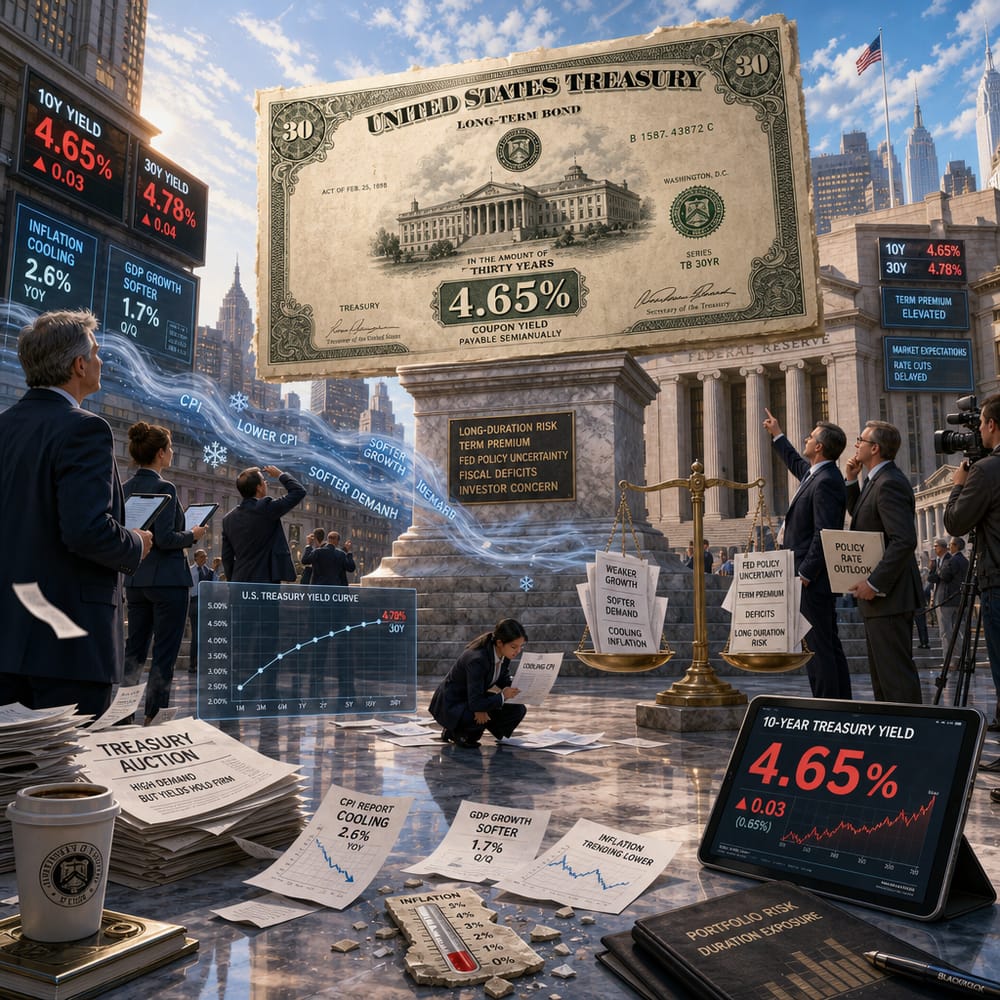
TREASURY YIELDS PLAY THE WAITING GAME IN A COOLING ECONOMY
If you've ever found yourself wondering if the finance world is playing a prank on you, you're not alone. Imagine a world where the economy is cooling faster than your coffee on a winter morning, yet long-term Treasury yields remain stubbornly sunny, sitting above 4.65%. You'd be scratching your head too, right?
Let's dive into this paradox. The key players in this mystery saga? Long-term Treasury bonds and the ever-watchful eye of the Federal Reserve. Spoiler alert: They don’t always play nice together.
THE PUZZLE OF PERSISTENT YIELDS
High Treasury yields in a cooling economy are the finance world's equivalent of wearing a heavy coat in July. Everyone expects those yields to drop when inflation cuddles up to cooler numbers, but instead, they're chilling out above 4.65%, as if they didn't get the memo.
So, what's up with that? There are a few theories. First, even though inflation has been showing signs of slowing down, investors still have some lingering concerns that inflation isn't done with its sneaky tricks. It's like that friend who says they're leaving the party but ends up staying till the end. In finance terms, this is called a risk premium—a little extra something investors demand to compensate for these uncertainties.
Another angle? Some investors think that a few spicy challenges might still be lurking in the economy's shadows. Sure, growth signals are softer than a marshmallow, but have you seen how global geopolitics are playing out? It's not exactly a calming symphony, and investors seem to be baking those uncertainties into their strategies.
THE FEDERAL RESERVE'S DILEMMA
Now, let's talk about the Federal Reserve. They're like the DJ at this financial festival, trying to spin the right tracks to keep everything balanced. But with these high yields, their job gets a whole lot trickier. The Fed has been dropping hints about potentially pausing or reducing interest rate hikes to accommodate the cooling data. Yet, with yields remaining high, it's like they're stuck between a rock and a synth-heavy hard place.
The reason? If yields stay elevated, it could mean the Fed has to keep rates higher than they'd like to curb inflation fears. This is the equivalent of asking them to juggle flaming torches while riding a unicycle—not impossible, but not exactly their idea of a good time.
INVESTORS' REACTIONS
Retail investors are the amateur sleuths of the finance world, always on the lookout for signs, signals, and occasionally, conspiracy theories. Some are cashing in on the high yields, while others are tiptoeing with caution, worried about what comes next.
Bond investors are having a field day with the higher yields since they equate to better returns—it's like finding a crisp twenty-dollar bill in an old coat pocket. On the flip side, stock investors might be raising an eyebrow, as higher yields could mean more competition for stocks, especially if the Fed keeps rates elevated.
But, as with any good mystery, everyone is waiting for the next plot twist. Will the Fed pivot? Will inflation make a surprise comeback? Investors are glued to their screens, ready for the next clue.
THE BOTTOM LINE
In this finance thriller, the jury’s still out on what happens next. But one thing's for sure: long-term Treasury yields aren't following the usual script. They're like that defiant teenager refusing to clean their room—staying elevated when everyone expected a drop.
While the economy shows signs of slowing, and inflation looks to be catching a chill, those yields are telling a different story. Whether they're right or wrong remains to be seen, but for now, they’re keeping the Fed, and investors, on their toes, and everyone’s guessing what the next chapter in this economic saga will bring.
So keep your popcorn handy and stay tuned; this financial drama is far from over.
This article is for informational purposes only and is not investment advice. Always do your own research or consult a licensed financial professional before making investment decisions.
© Copyright 2024. All Rights Reserved.
© Copyright 2024. All Rights Reserved.