

Treasury Yields Hold Firm Despite Softer Data, Raising Questions on Market Confidence
Tuesday, August 18, 2026
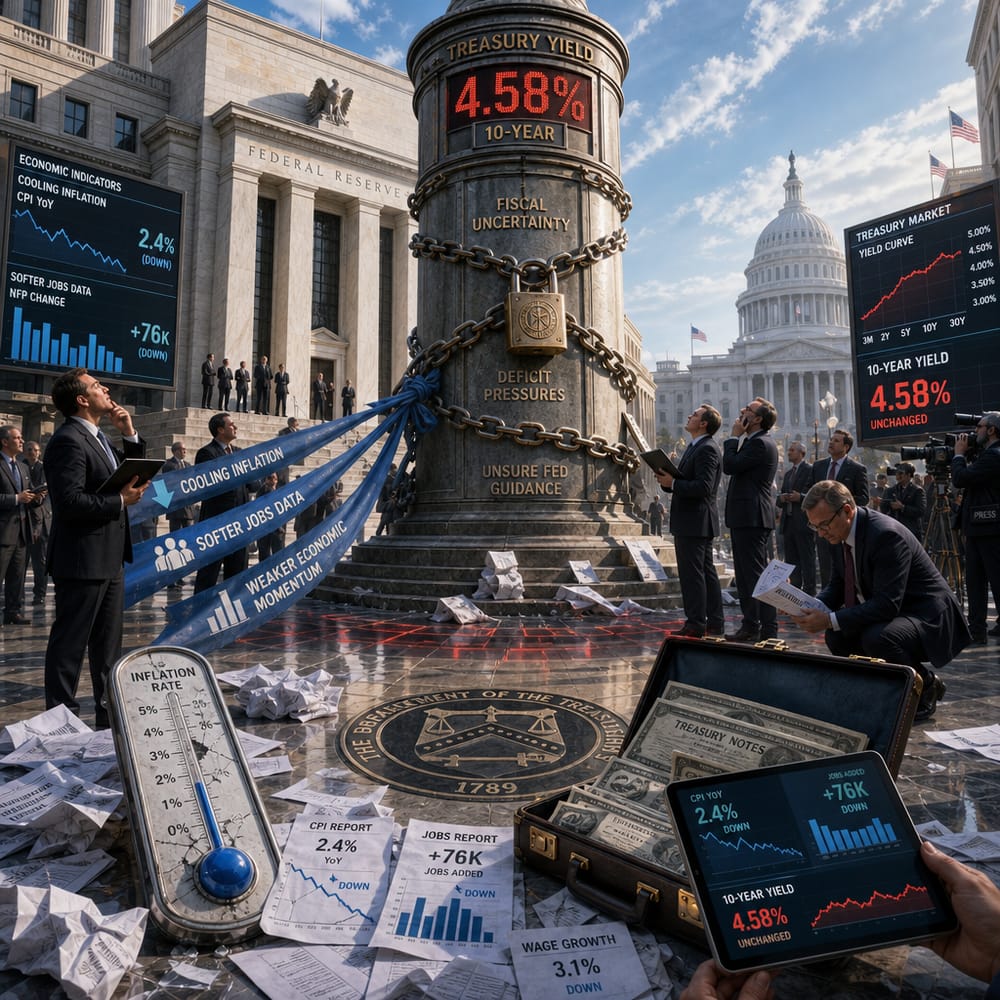
TREASURY YIELDS HOLD FIRM DESPITE SOFTER DATA, RAISING QUESTIONS ON MARKET CONFIDENCE
In a world where everything from your avocado toast to your mortgage rate is in a constant state of flux, you'd think softer economic data would give the market a breather, right? Wrong. Instead of taking a coffee break, Treasury yields are holding their ground like a stubborn barista who refuses to add more foam. While softer inflation and labor data might have signaled a time for relaxation, Treasury yields chose to party on like it's 2004.
Now, why on Earth are Treasury yields playing hard to get? For the uninitiated, yields are the return on investment for U.S. government debt; when they're high, borrowing costs go up, impacting everything from home loans to the national debt. You'd expect them to dip when inflation data cools off, but these yields seem unfazed, strutting their stuff at levels not seen in decades.
So why are Treasury yields not slumping with softer data? Cue the dramatic background music: It's mostly about market confidence—or the lack thereof—in fiscal policy and Federal Reserve guidance. Imagine you're at a party, and the host (a.k.a. the U.S. government) suddenly stops refilling the chips. Do you stick around? Probably not, unless you're really into awkward small talk.
Market participants are acting on similar instincts. They're worried about an escalating fiscal deficit that's running to the tune of $1.8 trillion this year alone, not to mention a national debt that’s flirting with $40 trillion. The concern that fiscal policy has gone off the rails, like a roller coaster with a broken steering wheel, keeps investors clinging to higher yields.
Then there's the Federal Reserve, whose cryptic signals are about as clear as a foggy morning in San Francisco. Investors are left guessing whether the Fed will continue to hike rates or take a chill pill. With the Fed's mood swings rivaling that of a teenager on TikTok, it's no wonder investors are skittish. They'd rather demand a higher yield to cushion against the unpredictability than gamble on a potential rate cut.
What does this all mean for fiscal policy? It’s like a game of fiscal Jenga: one wrong move, and the whole tower could come crashing down. With the high cost of borrowing, every decision is scrutinized like a reality show contestant during elimination week. Higher yields mean the government has to fork over more dough to finance its ever-expanding debt, leaving less room for essential spending like infrastructure, education, or, heaven forbid, healthcare.
The stubbornly high yields hint at an overarching mistrust in how fiscal challenges are being addressed. Bond traders aren’t exactly rushing to buy what Uncle Sam is selling, and it's putting extra pressure on policymakers to figure out how to steady the ship before it sails straight into a financial iceberg.
In the meantime, as policymakers wrestle with these challenges, the rest of us are left grappling with the implications. Higher Treasury yields ripple through the economy, inflating borrowing costs for businesses and consumers alike. It's like a financial game of musical chairs with fewer seats—someone’s bound to be left standing when the music stops.
So if you're scrolling through your news feed, coffee in hand, and wondering why that mortgage rate isn't budging despite all the soft economic signals, now you know. The high Treasury yields are like that one friend who insists on staying late at the party—stubborn, with obscure motives, and a penchant for complicating things.
As we turn our eyes to the horizon, the market waits for some clarity from fiscal policymakers and the Fed. Will they manage to send the right signals and ease the tension in the bond markets? Or will they continue their enigmatic dance, leaving investors to navigate through a haze of uncertainty? Only time—and perhaps a few more economic indicators—will tell. Until then, keep your portfolio diversified and your coffee strong—it’s going to be a long fiscal season.
This article is for informational purposes only and is not investment advice. Always do your own research or consult a licensed financial professional before making investment decisions.
© Copyright 2024. All Rights Reserved.
© Copyright 2024. All Rights Reserved.