

Treasury Yields Dip Amid Oil-Fueled Volatility and Bond Issuance Pressures
Tuesday, August 11, 2026
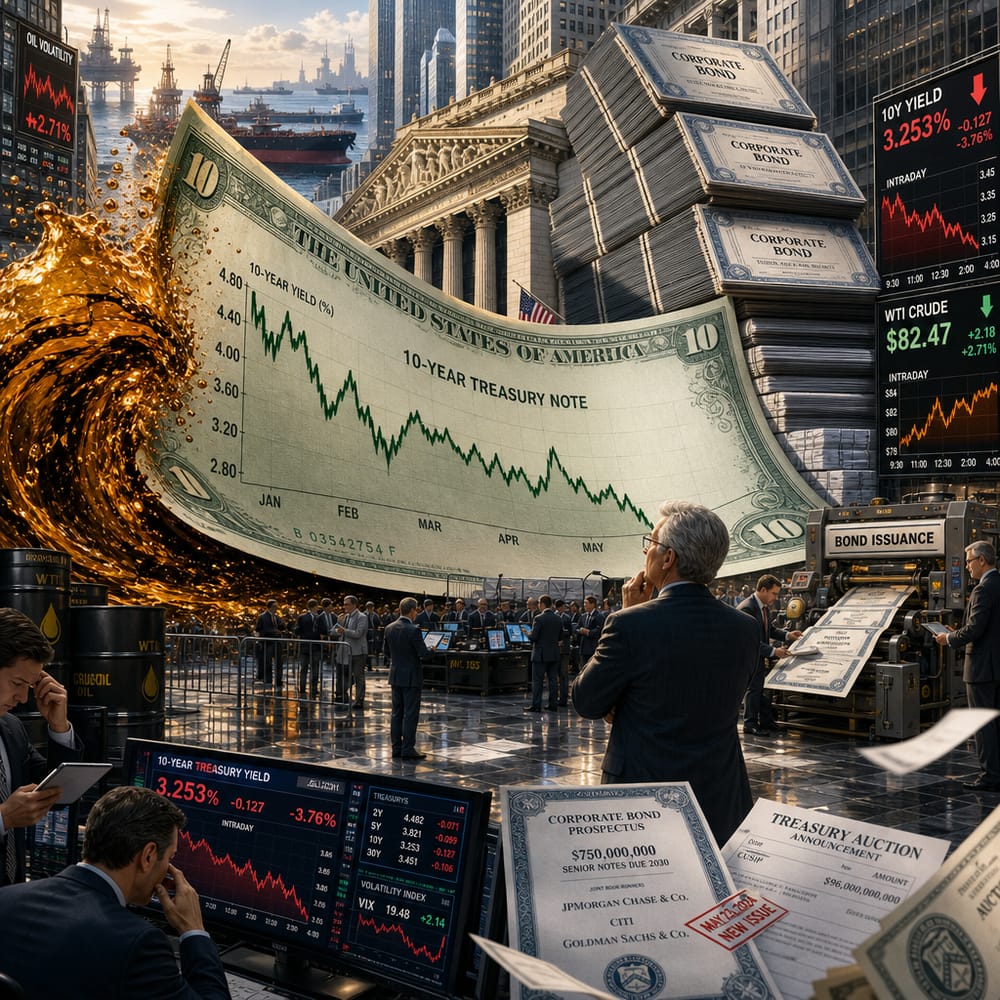
TREASURY YIELDS DIP AMID OIL-FUELED VOLATILITY AND BOND ISSUANCE PRESSURES
If recent swings in the 10-year Treasury yield have left you feeling like you're riding the Wall Street roller coaster, you're not alone. The financial markets have been a whirlwind, with factors ranging from geopolitical tensions to corporate bond deluges pulling yields in all directions. But fear not, intrepid investor—let's break down the drama into bite-sized, easy-to-digest pieces.
WHY TREASURY YIELDS MATTER
First, a brief (and painless) primer: Treasury yields, especially the 10-year variety, are like the financial world's version of a weather vane. They give us clues about where the economy might be heading. High yields can signal robust economic growth, while low yields often mean anxiety is in the air. So when the 10-year yield sneezes, the market tends to catch a cold. Recently, this yield has been more like a yoyo than a weather vane. Why? Let's dive in.
GEOPOLITICAL TENSIONS STIR THE POT
Key driver number one: the never-ending drama that is the Middle East. Picture this: the Strait of Hormuz, a tiny yet mighty waterway that sees a fifth of the world's oil flow through it, becomes the new center of geopolitical tensions. Iran's recent flexing—shutting down passage through this crucial corridor—sent oil prices climbing like an ambitious rock climber scrambling up a cliff.
Rising oil prices typically mean investors expect inflation to heat up, prompting them to demand higher yields on bonds to compensate for that nasty thing we call inflation risk. However, when you're dealing with the geopolitical equivalent of a pressure cooker, it's never straightforward. Investors also scurry towards the safety of U.S. Treasuries, driving yields back down. It's a tug-of-war where neither side ever seems to win.
THE CORPORATE BOND BONANZA
Now, onto driver number two: a flood of corporate bonds. Imagine Wall Street as a giant marketplace where bonds are the apple of everyone's eye. Recently, corporations have been issuing bonds like it's Black Friday, eager to lock in financing before interest rates climb any further.
But here's the kicker—when there's a cornucopia of corporate bonds on offer, demand for Treasuries can take a backseat. Why buy a Treasury note when that shiny new corporate bond is offering you a better return? With more mouths to feed in the bond market, Treasury yields feel the pressure and sometimes, just sometimes, they dip.
THE BROADER ECONOMIC IMPLICATIONS
So, what does all this mean for our financial ecosystem, you ask? Well, Treasury yields reflect investor sentiment about future economic prospects and inflation. If yields start climbing again due to persistent inflation fears or more robust economic data, borrowing costs for everyone from Uncle Sam to your friendly neighborhood homebuyer could increase. That could put a damper on everything from business investments to home purchases.
On the flip side, if yields drop due to renewed fears of an economic slowdown, it might signal rough waters ahead. Either way, keeping an eye on these movements can help you make informed decisions about your investments.
NAVIGATING THE VOLATILITY
But here's the silver lining: volatility also brings opportunities. For those with a keen eye and a steady hand, these market gyrations can be the perfect time to reassess your portfolio, hedge against risks, or even venture into new territories. And while the bond market might resemble a frenetic chess game right now, remember that every move is a chance to learn and strategize.
So, whether you're watching from the sidelines or deep in the trenches of market action, these fluctuations are a reminder that the only constant is change. And in the ever-evolving world of finance, that's just how we like it. Keep your eyes peeled and your mind sharp—because the 10-year Treasury yield saga is far from over.
This article is for informational purposes only and is not investment advice. Always do your own research or consult a licensed financial professional before making investment decisions.
© Copyright 2024. All Rights Reserved.
© Copyright 2024. All Rights Reserved.