

Treasury Yields Continue to Pinch Equities
Thursday, October 01, 2026
TREASURY YIELDS CONTINUE TO PINCH EQUITIES
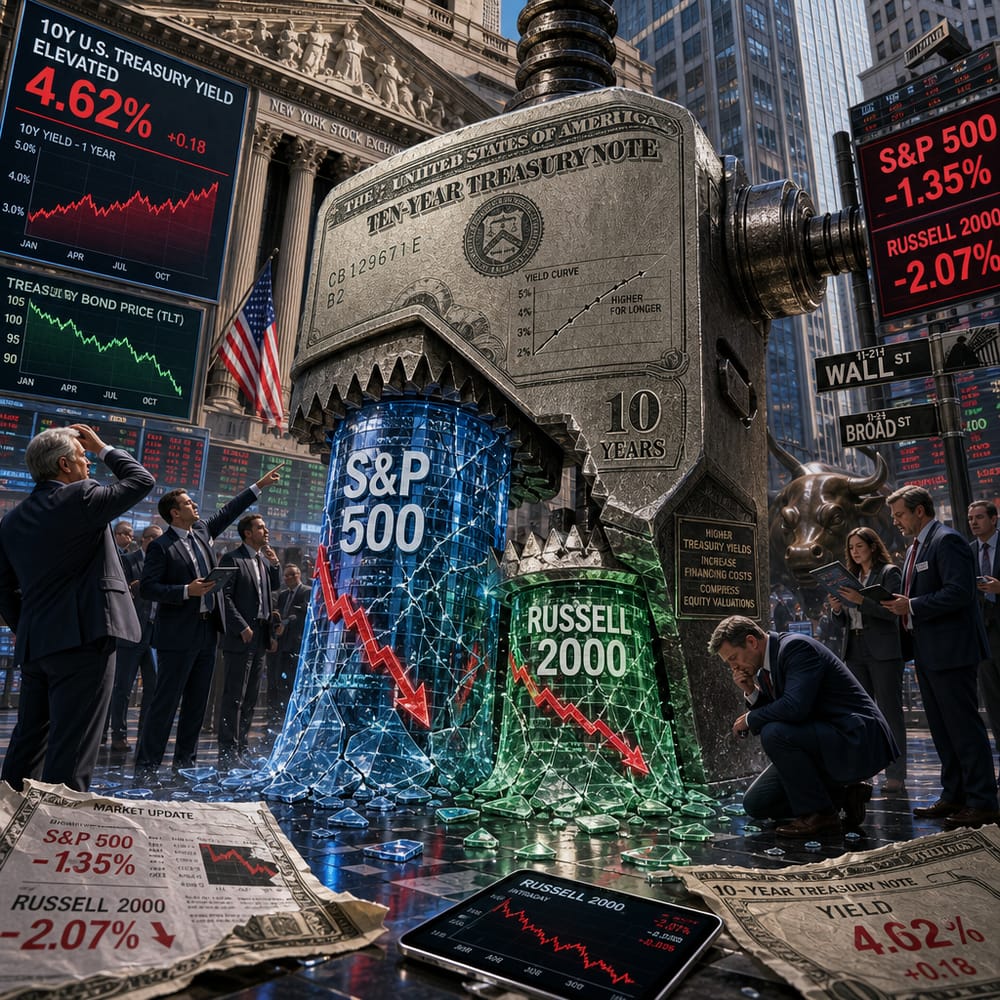
If you’ve been feeling like your investment portfolio is out to get you lately, you’re not alone. Stocks are having a rough go of it, and it’s all thanks to a heavyweight contender—Treasury yields. They’ve got the market in a chokehold, and investors are feeling the squeeze. Let’s break down why these seemingly innocuous government bonds are causing so much chaos.
Welcome to the world of long-term Treasury yields, where the stakes are high, and the drama is even higher. As these yields hover at elevated levels, they're dragging down the stock market with all the finesse of a cat swiping a glass off the table. The S&P 500 and the Russell 2000, two of the most-watched barometers of U.S. equities, have been on a steady downhill slalom. Why? Because when Treasury yields rise, borrowing costs for companies do too, directly impacting their bottom lines—and not in a fun way.
Think of Treasury yields like that one friend who always insists on splitting the bill down to the penny: annoying, but they’ve got a point. When yields go up, it signals that investors expect higher interest rates to persist, making stocks less attractive compared to those “safer” government bonds. It’s like choosing between a high-flying roller coaster and a comfy armchair—sometimes, you just don’t want the risk.
For small-cap stocks, which make up the Russell 2000, the pressure is particularly brutal. These companies often depend more on borrowing to fuel their growth compared to their larger, more established counterparts. With higher yields, the cost of borrowing kicks up like a hurricane, making it tougher for these companies to expand or even maintain operations. It's a financial tightrope with no safety net, and right now, the wind is picking up.
But here’s where things get spicy: upcoming economic data and Federal Reserve commentary could shift this tumultuous tide. The September jobs report is on the horizon, and all eyes will be on those numbers. A strong labor market might give the Fed more ammo to keep interest rates high, cementing the trek of Treasury yields. Conversely, signs of a slowdown might ease some pressure, allowing equities to breathe a little easier.
And don't forget about inflation—the other elephant in the room. If forthcoming data suggests that inflation is cooling, it might convince the Fed to dial back its hawkish stance. That would take some wind out of Treasury yields' sails, potentially sparking a rally in equities. But be warned, this is as much art as science. Predicting market moves based on data is like trying to guess if a cat will jump on your lap or just swat at your shoelaces. Good luck with that.
Meanwhile, the Federal Reserve is likely keeping a close eye on the economic landscape, ready to drop hints like bread crumbs for hungry market analysts. They’ve got the power to sway markets with their words alone, so any commentary could have investors hanging on every syllable, waiting to see if the cost of borrowing might ease up or stay the course.
Ultimately, the current saga of elevated Treasury yields is a reminder of the interconnectedness of our financial world. Equities are feeling the pressure, small-cap stocks are bearing the brunt, and investors are left wondering what’s next. Enjoy the show because this drama is far from over.
In the meantime, let’s cross our fingers and hope that the dance between Treasury yields, economic data, and Fed whispers turns into less of a tango and more of a waltz. Because right now? It’s feeling more like a mosh pit.
This article is for informational purposes only and is not investment advice. Always do your own research or consult a licensed financial professional before making investment decisions.
© Copyright 2024. All Rights Reserved.
© Copyright 2024. All Rights Reserved.