

Treasury vs. Fed: Diverging Approaches to Market Intervention
Friday, August 21, 2026
TREASURY VS. FED: DIVERGING APPROACHES TO MARKET INTERVENTION
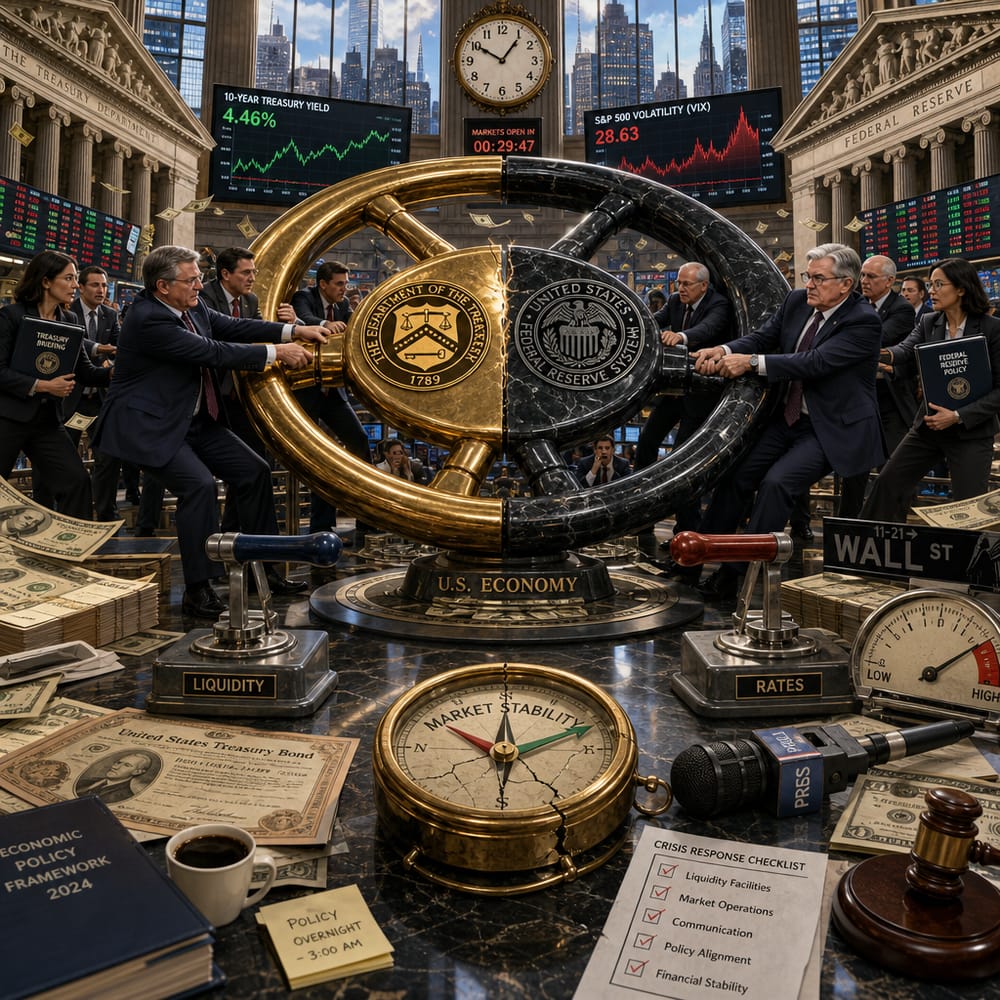
Picture two heavyweight champions in the financial ring, sparring over how best to play referee in the world's largest economy. In one corner, you have the Treasury, with its arsenal of fiscal tools, and in the other, the formidable Federal Reserve, wielding its monetary policy magic wand. It's a duel of economic titans, each armed with a playbook they believe is best for stabilizing the market, yet their strategies couldn’t be more different. So, what's on the line? Only the future of market confidence and economic stability, no pressure.
The Treasury recently took the stage with a bombshell move. By doubling its buybacks of long-dated government debt, it aimed to steady the wavering bond market. The market had been jittery, with rising Treasury yields turning once stable ground into a slippery slope. The hope? To calm fears of runaway inflation spurred by escalating oil prices. This seemed like a noble endeavor, but there’s just one hiccup: their strategy doesn’t exactly align with the Federal Reserve’s more conservative approach to monetary intervention.
Now, let's flip the coin to the Fed's side of the table. It has been playing the waiting game, sticking to its guns with gradual rate hikes and a watchful eye on inflation rates. While the Treasury is out there with its checkbook, the Fed prefers to let the economy simmer rather than boil over. The Fed’s mantra? "Don't rock the boat unless you must." But with inflation lurking around the corner, their zen-like patience has started looking more like silent panic to investors.
So, what happens when these two forces in the economic universe tug in opposite directions? For starters, it breeds uncertainty, that dreaded bugbear of markets everywhere. Investors, like deer in headlights, might hesitate to make bold moves, fearing the unpredictable outcome of these clashing strategies. This tension could send market stability on a roller-coaster ride, with stock futures rising and falling like ocean tides caught between the moon and the sun.
Differing strategies between the Treasury and Fed may also kick up some dust in the bond market. Just last week, when Treasury yields rose despite the buyback intervention, it triggered a sell-off in stocks as investors feared that higher yields could signal inflationary pressures ahead. Such pressures could discourage spending and investment, potentially slowing economic growth.
But let's not be doom and gloom about it. This could also open doors. The Treasury's assertive stance on buybacks might lure investors back into the bond market, providing a cushion against inflation and retaining value in long-term assets. Meanwhile, the Fed's cautious pace with interest rates could keep borrowing costs manageable, encouraging steady investments without the market overheating.
The wild card here is how the market perceives these mixed signals. If investors see the Treasury’s moves as an assurance of stability and the Fed’s restraint as wisdom, confidence could rebound, bringing market tranquility. Conversely, if this is seen as disorganization at the top, we could be in for some more market turbulence.
So, what's the bottom line for everyday investors watching this high-stakes chess match unfold? Keeping a diversified portfolio will be as crucial as ever. If you’re jittery about stocks, maybe it’s time to peek at bonds or even consider the steadier waters of commodities like gold and silver, which remain popular hedges against inflation.
And for those tempted by the siren call of Bitcoin, take its recent leap with a grain of salt. While crypto's been riding high on policy shifts, remember: it's still a volatile beast that can turn on a dime.
In this Treasury vs. Fed showdown, understanding the battle lines helps you brace for impact—or better yet, seize opportunity. Keep one eye on the yield curves and another on the rate hikes, and you might just navigate this financial storm with your portfolio intact. Like a well-informed friend might say, in this market, stay sharp or stay sidelined.
This article is for informational purposes only and is not investment advice. Always do your own research or consult a licensed financial professional before making investment decisions.
© Copyright 2024. All Rights Reserved.
© Copyright 2024. All Rights Reserved.