

Treasury to Double Long-End Buybacks Starting September 9
Wednesday, August 19, 2026
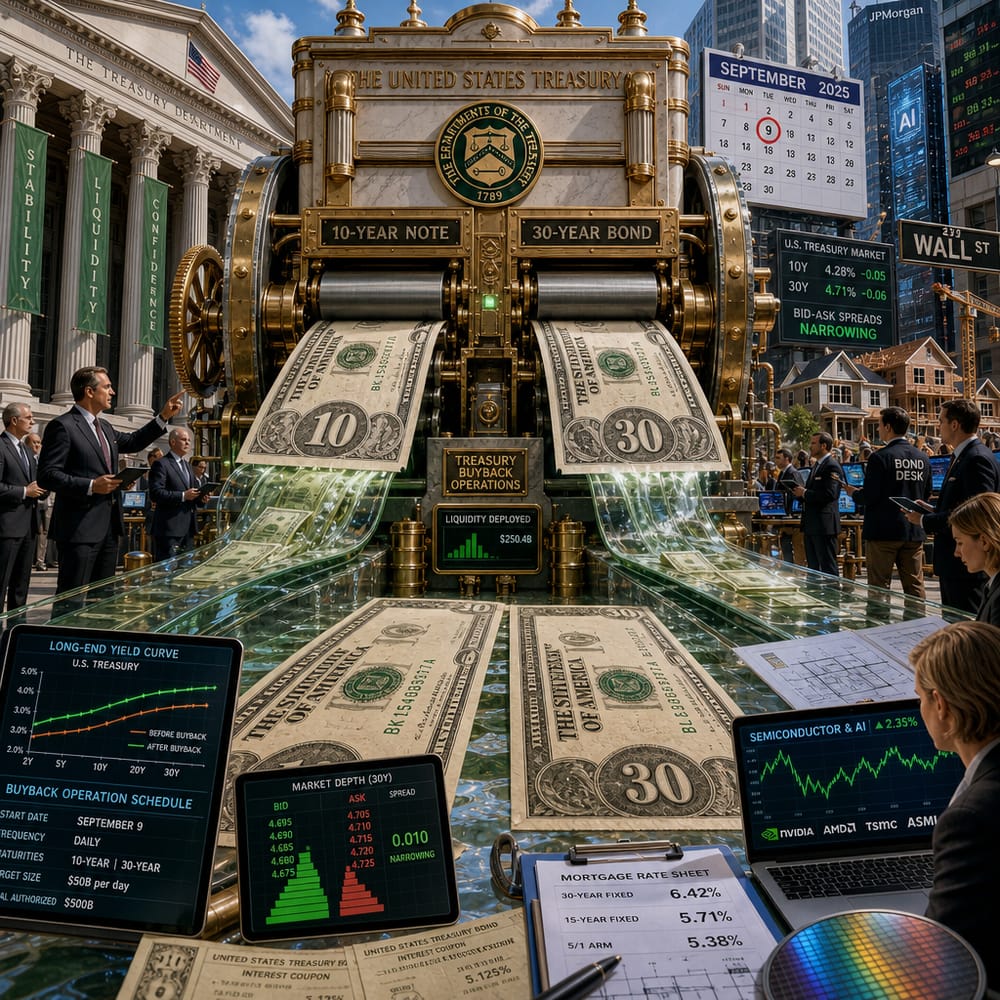
TREASURY TO DOUBLE LONG-END BUYBACKS STARTING SEPTEMBER 9: WHAT DOES IT MEAN FOR YOU?
Picture this: you're strolling through the financial jungle called Wall Street, and suddenly, a massive elephant named "U.S. Treasury" decides to start dancing. That's pretty much what happened when the Treasury announced they'd double their buybacks of longer-dated Treasuries starting September 9. Yep, it's a big deal, and you might be wondering what it means for your money. So, let's break it down.
THE BIG BUYBACK BONANZA
The U.S. Treasury, under the guidance of Secretary Scott Bessent, has decided to crank up the volume on its buybacks of government debt, focusing on longer-term bonds. In plain English, they're going to buy back a lot more of those 10-year and 30-year Treasury bonds, which are the financial world's equivalent of comfortable blue jeans—everyone's got them, and they're usually pretty reliable.
Why now? Well, the market's been a bit shaky lately, with yields (that's the payout you get from bonds) skyrocketing to levels we haven't seen in decades. It's like the stock market equivalent of discovering your Dad's old disco suit in the attic—unexpected and a bit alarming. By doubling these buybacks from $2 billion to $4 billion, the Treasury aims to steady the ship and calm the jittery bond market.
WHAT HAPPENS TO LONG-TERM YIELDS?
Yields and bond prices are like the seesaw of financial markets. When one goes up, the other goes down. So, with the Treasury stepping in to buy more bonds, prices are expected to rise, which means yields should cool down a notch. In fact, right after the announcement, we saw the 10-year note's yield drop by 6 basis points to 4.647%, while the 30-year 'long' bond yield tumbled 9 basis points to 5.196%.
For those keeping score at home, a basis point is a mere 0.01%, but in the bond market, even tiny shifts can echo like a stampede. So, if you're holding onto long-term Treasuries, you're likely breathing a sigh of relief.
THE RIPPLE EFFECT: HOUSING AND TECH IN THE SPOTLIGHT
Now, it's not just the bond market that quakes when yields move. Rate-sensitive sectors like housing and technology are also tuned in to every shift. Mortgage rates tend to follow those longer-term yields like a loyal golden retriever. If yields dip, mortgages might get a smidge cheaper, potentially giving a boost to the housing market. Picture more people affording homes and perhaps a surge in new home construction.
On the tech front, companies in this sector often rely on borrowing to fuel their relentless innovation. Lower yields can mean cheaper loans, which might embolden tech firms to ramp up investments or launch new projects. Imagine more innovations, maybe even new apps that do everything for you short of brewing your morning coffee.
A HINT OF STRATEGY IN TREASURY'S PLAYBOOK?
Could this strategic shift in buybacks signal a broader approach by the Treasury on managing the yield curve? Possibly. The yield curve, which maps interest rates across different bond durations, is sometimes used as a crystal ball to predict economic downturns or booms. By massaging the yields on these longer-dated bonds, the Treasury might be trying to smooth out some of the bumps and keep the economic engine humming.
While it's not a full-blown revamp of the Treasury's usual tactics, it's a move that suggests they're paying close attention to market murmurs and are ready to act decisively.
THE TAKEAWAY: WHAT SHOULD YOU DO?
If you're a retail investor, this is your cue to take a closer look at the sectors most impacted by these rates, like housing and tech. Opportunities might crop up as yields adjust and the ripple effects fan out across the economy.
The Treasury's move to double its buybacks is like a bold dance move on the financial stage—it grabs attention and could set the rhythm for how the market sways in the coming months. So keep your eyes peeled, your portfolio diversified, and be ready to groove to the tune of these market shifts. Because when big elephants dance, it's best to join in or step aside.
This article is for informational purposes only and is not investment advice. Always do your own research or consult a licensed financial professional before making investment decisions.
© Copyright 2024. All Rights Reserved.
© Copyright 2024. All Rights Reserved.