

Treasury's Long-Bond Buyback Plan
Wednesday, August 19, 2026
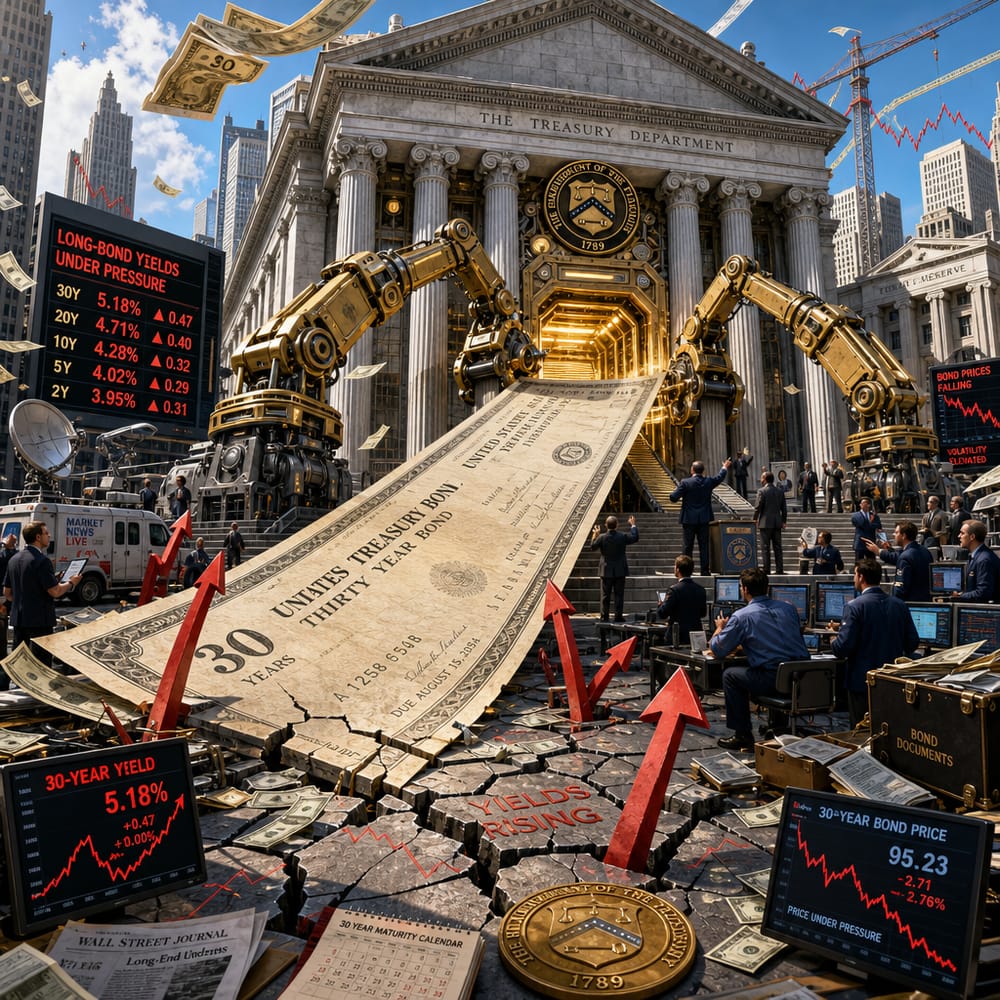
THE TREASURY'S GRAND PLAN TO HIT THE BRAKES ON BOND MARKET BEDLAM
If you thought the U.S. Treasury couldn't possibly surprise you anymore, buckle up. In an attempt to ride the rollercoaster of the bond market with a little more aplomb, they’ve decided to double down on long-dated Treasury buybacks. The aim? Alleviate market stress and squash those pesky surging yields. But why should you care? Well, my dear retail investor, let’s dive into the tangled mess of government debt and see what else is in Santa's – I mean, Uncle Sam's – bag of economic tricks.
First things first: why this move now? You don't need a crystal ball to see that the recent surge in Treasury yields has left quite a mark on Wall Street's mood and your 401(k). Yields on longer-dated U.S. Treasuries have been spiking, reaching highs not seen since the days of frosted tips and choker necklaces. The Treasury Department's solution? More than double its repurchases of 10-, 20-, and 30-year debt.
The mechanics are juicy. By repurchasing long-dated Treasuries, the Treasury tries to lower the supply of these bonds in the market. Less supply, assuming demand holds steady or increases, can put downward pressure on yields. And when yields fall, borrowing costs for everyone from your mortgage-wielding neighbor to massive corporations tend to follow suit. It's like economic dominoes, but less likely to make viral TikToks.
So, what’s in it for us mere mortals? Lower yields mean lower borrowing costs, which can stimulate economic growth. Think of it as a financial espresso shot for an economy that’s been running on decaf. Lower interest rates may encourage people and companies to borrow and spend, potentially fueling investments and jobs – the warm and fuzzy side of economics.
But before we break out the confetti, let's consider the risks. The Treasury's buyback frenzy doesn't come with a guarantee. The word "risk" wasn't invented for nothing, folks. First off, there's the credibility factor. If investors smell desperation or a whiff of tactics too short-term-focused, it may not lead to the desired confidence boost. Plus, there's the pesky $40 trillion national debt elephant in the room. Doubling down on buybacks doesn't mean a free ride. It's more like rearranging deck chairs on the Titanic – it might work for now, but it doesn’t solve the underlying issues.
Moreover, if this move doesn’t reassure bond markets, we could see yields remain stubbornly high or even climb further. And if yield increases persist, it could suck the wind out of the sails of any economic recovery attempt. Michael Schumacher, the former head of macro at Wells Fargo, isn’t convinced the respite in bond markets will last. He sees long-term rates trekking upwards, thanks in large part to Uncle Sam's infamous budget deficit and other fiscal shenanigans.
And let's not forget: tweaking interest rates is like playing with a hyperactive thermostat. Set it too low and you spark inflation; too high and you risk cooling the economy into a recession. The Treasury's move is akin to a high-wire act performed without a safety net. The fine balance of economic forces at play makes for a nervous audience.
At the end of the day, the Treasury's buyback plan is a bold gambit in a high-stakes game of economic poker. Will it ease some of the bond market chaos and trim those unruly yields? Perhaps. But unless these steps are part of a broader effort that includes addressing the sky-high national debt, it's only a temporary patch. Like trying to fix a leaky roof with chewing gum – it might hold for a while, but eventually, you're gonna need a more permanent solution.
So, retail investors, keep your eyes peeled and your portfolios diversified. The bond market is a wild beast, and the Treasury’s plan is their latest attempt to tame it. Whether it will be a hero's saga or a cautionary tale is yet to be seen. But one thing's for sure: when dealing with trillions, there are no small moves.
This article is for informational purposes only and is not investment advice. Always do your own research or consult a licensed financial professional before making investment decisions.
© Copyright 2024. All Rights Reserved.
© Copyright 2024. All Rights Reserved.