

Treasury's Bond Buybacks Clash with Fed's Market Signal Strategy
Monday, August 24, 2026
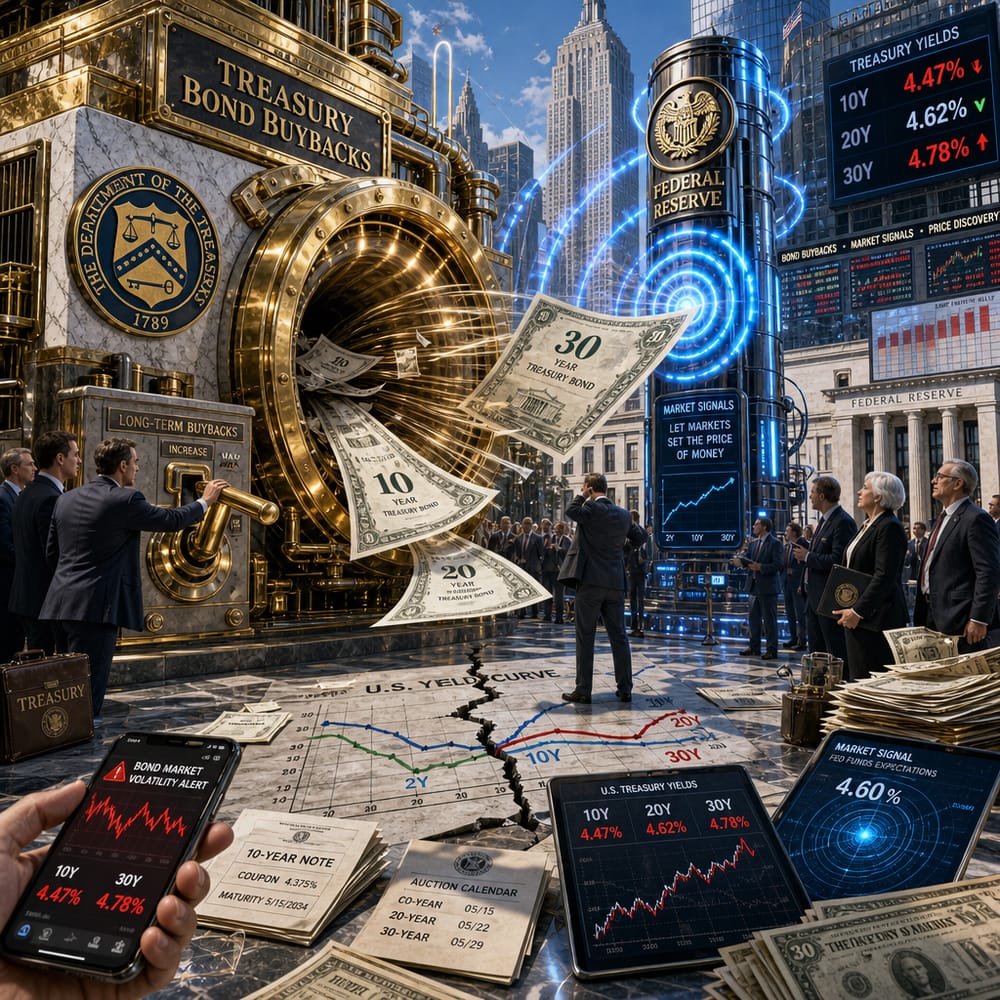
TREASURY'S BOND BUYBACKS CLASH WITH FED'S MARKET SIGNAL STRATEGY
Picture this: you're at a car dealership, thinking you’re about to snag a sweet deal. But suddenly, the dealer starts buying back his own cars, driving the prices up. Not exactly what you had in mind, right? Well, welcome to the world of Treasury bonds, where the U.S. Treasury and the Federal Reserve are the main players, and it’s getting a little unorthodox out there.
In a head-scratching twist, the Treasury Department has announced plans to ramp up its bond buyback program. Yes, they’re doubling down on long-term debt buybacks, a move that seems to be playing hopscotch on the long-end of the yield curve. Meanwhile, the Federal Reserve, like a meditation guru trying to keep everything zen, is hanging back letting market forces do their thing. The result? A quirky dance of conflicting economic signals that could impact your financial portfolio and the very credibility of monetary policy itself.
THE BIG BUYBACK BONANZA
So, what’s the Treasury doing exactly? They’re eyeing a $1 trillion General Account, hinting at a massive buyback of government bonds. In plain English, they’re planning to swoop in and start purchasing a hefty chunk of their own debt. While this might sound like a government-sponsored shopping spree, it’s got a tactical purpose: to bring some relief to the long-term Treasury yields that have recently been flirting with sky-high levels not seen since 2007.
But why does this matter for you, the casual observer of this financial stage play? Because when the government buys back bonds, it reduces the supply, potentially driving up the prices and lowering yields. And lower yields on long-term bonds generally mean more favorable borrowing costs across the economy, influencing everything from mortgages to corporate loans.
FEDERAL RESERVE: THE MARKET'S YODA
Then there’s the Federal Reserve, standing on the sidelines with a strategy that could be likened to channeling their inner Yoda—“Let the market forces flow.” The Fed’s approach has been to taper and unwind its balance sheet, essentially stepping away and letting natural market dynamics set the pace and pricing of Treasury bonds.
The Fed’s playbook aims to signal confidence in the economy's ability to stand on its own feet without hand-holding. It’s like an overprotective parent finally letting their teenager borrow the car keys—hoping they don’t joyride it into a ditch. By allowing market forces to determine pricing, the Fed maintains an aura of stability and confidence, crucial for its credibility.
WHAT'S AT STAKE?
This tug-of-war between the Treasury’s active involvement and the Fed’s laissez-faire attitude might sound like a mere policy quibble, but here’s the kicker: it could significantly impact financial market stability and the broader economic landscape.
For one, if the Treasury’s buybacks effectively lower long-term yields, it could undercut the Fed’s strategy of letting the market dictate terms. This could muddle the signals traders and investors depend on to make informed decisions. Imagine getting mixed messages from a GPS: "Turn left... no, actually keep going straight." Confusion ripe for financial mishaps.
Moreover, this could affect the Fed's credibility. If market participants start to perceive these mixed messages as a sign of discord or lack of coordination between Treasury and Fed policy, it could shake confidence. A fragile confidence could lead investors to second-guess their moves, fueling volatility—or worse, a lack of faith in monetary policy altogether.
ARE WE DANCING IN A MINEFIELD?
The big question is: Are we setting ourselves up for financial turbulence? Well, possibly. With the Treasury pulling one way and the Fed another, investors could find themselves navigating a minefield of unpredictability. Financial conditions could tighten or loosen in ways that may not align neatly with the Fed’s inflation and employment mandates.
The scenario raises a pertinent question for market observers and investors alike: can the economy handle this high-stakes dance, or could the competing strategies lead to a stumble that rattles everything from mortgage rates to stock valuations?
Only time will tell if this policy divergence turns into a synchronized ballet or a clumsy two-step. For now, savvy investors should keep their eyes peeled on the yield curve and any ripple effects across financial markets. Because in this economic game of chess, knowing the players’ next move might just be the difference between check and checkmate.
This article is for informational purposes only and is not investment advice. Always do your own research or consult a licensed financial professional before making investment decisions.
© Copyright 2024. All Rights Reserved.
© Copyright 2024. All Rights Reserved.