

Treasury's Bond Buyback: Short-Term Relief Amid Sustained Volatility
Friday, August 21, 2026
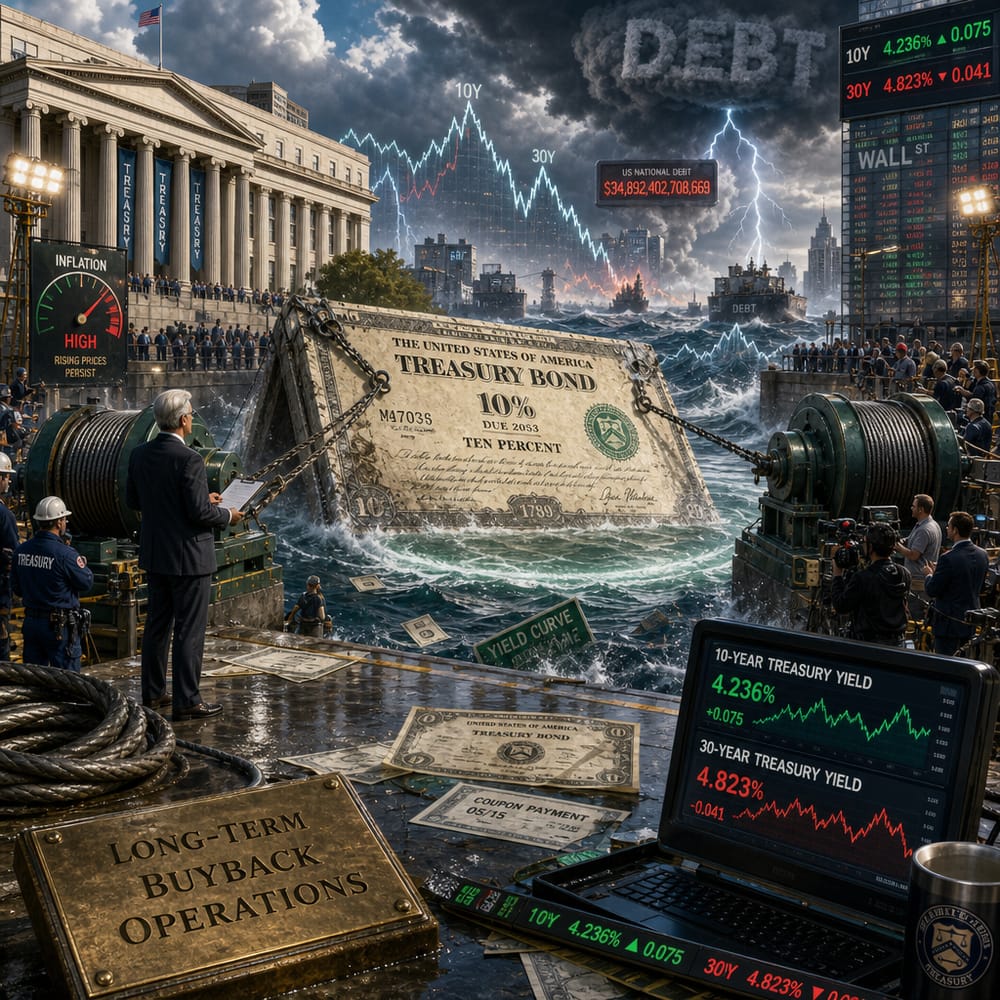
TREASURY'S BOND BUYBACK: SHORT-TERM RELIEF AMID SUSTAINED VOLATILITY
When the U.S. Treasury announced it was doubling down on its long-term bond buybacks, the market did a little jig of joy. Yields dipped, investors breathed a sigh of relief, and for a hot minute, it felt like the financial equivalent of happy hour. But that good cheer was about as enduring as a new year's resolution to hit the gym. Soon enough, the market was back to its jittery, caffeine-fueled self, with yields inching back up and volatility making its triumphant return.
So, what gives? Why can't the Treasury's buyback spree keep our economic nerves from fraying? Let's break it down like a seasoned market DJ spinning the latest financial tracks.
THE BOND MARKET ROLLERCOASTER
Treasury bonds, especially the heavy hitters like the 30-year and 10-year notes, are the backbone of the borrowing world. They set the stage for everything from mortgage rates to Uncle Bob's credit card APR. With yields rising, borrowing costs follow suit, and that can spook the market more than a horror movie marathon.
The Treasury's buyback move was supposed to be a soothing balm, a soft pillow for yields to rest their weary heads. Initially, it worked. Yields dipped, and Wall Street experienced a momentary Zen-like calm. But alas, external forces had other plans. Inflation fears, fueled by things like climbing oil prices, swooped in like a party crasher, ensuring the volatility shindig was far from over.
WHAT'S IN A BUYBACK?
Now, the Treasury’s buyback operation might sound like it's straight out of a Wall Street thriller, but it's really just the government stepping in to purchase its own debt from investors. Think of it as buying back an I.O.U. It’s a move to support the bond market by providing a cushion for bonds under pressure, theoretically stabilizing things when uncertainty is knocking at the door.
But unlike the Federal Reserve's quantitative easing magic, which can summon new money from the ether, the Treasury has to work with what's in the proverbial piggy bank. It's restricted by budgetary strings and, let's face it, our national debt isn't exactly making it rain.
THE SPICE OF LONG-TERM IMPACTS
In the short run, these buybacks can indeed be a soothing tonic. They reduce the supply of long bonds, which should ease the upward pressure on yields. But as with most market maneuvers, the story doesn’t end with the closing bell.
Long-term, the spectacle of sustained buybacks could send mixed signals. For one, it highlights the very volatility it's meant to quell, potentially spooking skittish investors who might start wondering just how wobbly the market’s legs really are. Plus, the persistent aura of inflation hanging over the economy — like an old cologne you can’t quite shake — means yields could continue to dance upwards, buybacks or no buybacks.
The broader market implications are just as tangled. If borrowing costs keep rising despite buyback efforts, the dominoes could fall across various sectors. Higher rates could dampen consumer spending and corporate investment, both of which are the lifeblood of economic growth. That’s not to mention the ripple effect on stocks, which tend to falter when borrowing costs rise, as we've seen with the recent sell-off.
IN CONCLUSION: A WAIT AND SEE GAME
So, are these buyback operations a knight in shining armor, or just a market bandaid? It’s a bit of both. They might offer temporary relief, but the persistent cacophony of inflation fears, debt concerns, and that ever-present market volatility symphony ensures that the road ahead is anything but smooth.
For investors, it’s a reminder to keep those seatbelts fastened and eyes on the horizon. The Treasury's intervention has certainly provided a momentary breather, but the long-term stability of the bond market — and indeed the broader market — hinges on larger, more complex economic dynamics. In the end, only time will tell if this strategy will be the market’s salvation or just another intermission in the ongoing drama.
This article is for informational purposes only and is not investment advice. Always do your own research or consult a licensed financial professional before making investment decisions.
© Copyright 2024. All Rights Reserved.
© Copyright 2024. All Rights Reserved.