

Treasury's Aggressive Long-Term Bond Buybacks Calm Yields—and Ignite Market Sentiment
Friday, August 21, 2026
TREASURY'S AGGRESSIVE LONG-TERM BOND BUYBACKS CALM YIELDS—AND IGNITE MARKET SENTIMENT
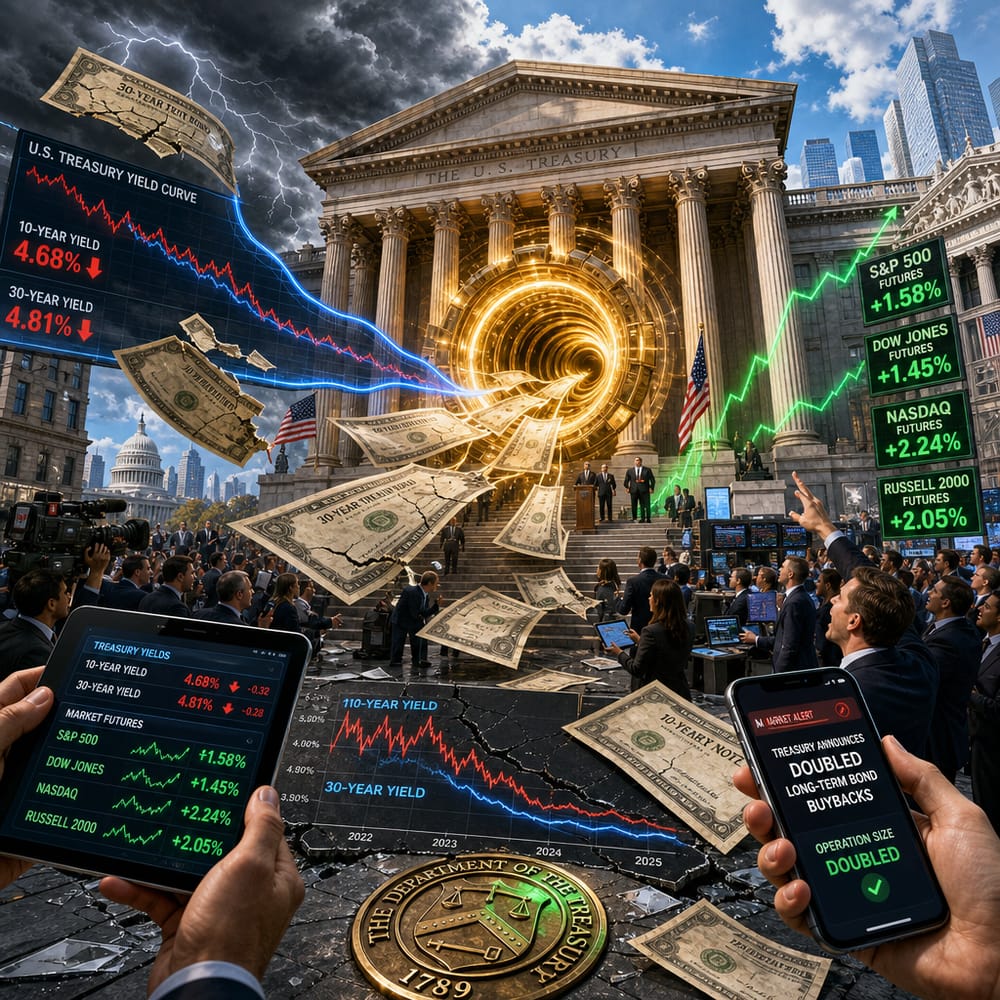
Hold onto your hats, folks, because the U.S. Treasury just pulled a rabbit out of its hat, and Wall Street is all ears. Yep, that's right. The Treasury Department's announcement to double its buybacks of long-term government bonds has flipped the market script, sending bond yields into a nosedive and giving major stock indices a hearty shot of adrenaline.
Now, let's get into the nitty-gritty. What does this chess move by Treasury actually mean? Picture this: long-term Treasury bonds have been the scene of a relentless sell-off party, with yields soaring to new heights thanks to inflation fears and sky-high oil prices. But in a single stroke of policy genius—or desperation, depending on whom you ask—the Treasury has decided to double down on its bond buybacks. This is their bid to cool down the feverish yields and stabilize the wobbly bond market.
So why does this matter, you ask? Well, when bond yields drop, it's like a soothing balm for the stock market's fevered brow. Lower yields make bonds less attractive relative to stocks, enticing investors back into the equity pool. This is exactly what we saw as the S&P 500, Dow, and Nasdaq all decided it was time for a bullish backflip, much to the surprise (and relief) of many frazzled investors.
But let's not jump the gun. How far can the Treasury stretch this buyback strategy? They have a limited arsenal, and this maneuver might just be a temporary Band-Aid rather than a long-term cure. Ray Dalio, the billionaire oracle over at Bridgewater Associates, is already waving the warning flag, suggesting this tactic might hint at an impending debt crisis. "This can't go on forever," he warns, urging investors to brace themselves.
Still, for now, the strategy seems to be lighting a fire under market sentiment. It’s a classic case of good news for stocks when bonds fall out of favor. Financials, materials, and even crypto-related stocks are riding the wave, with Robinhood shares leaping nearly 14%, and Coinbase tagging along with an 8% rise. Bitcoin, that ever-unpredictable beast, also saw a 22% weekly surge, fueled by this financial musical chairs.
Of course, with every move, there's a ripple effect. The big question is: how will investor sentiment towards equities morph if these bond buybacks continue to shape the narrative? Right now, the vibe is cautiously optimistic. If the Treasury succeeds in keeping long-term yields in check, equities could enjoy a sustained rally, soothing the nerves of those who’ve been bracing for more volatility.
However, there’s always the flip side. If this is a canary in the coal mine for economic trouble, investors should watch their step. As Dalio suggests, perhaps it's time to ballast portfolios with some of that trusty gold or even take a walk on the wild side with cryptocurrencies.
For now, though, the market's enjoying its moment in the sun. After enduring a rough patch, recent sessions have been a balm to the bruised egos of investors who've seen bond yields playing fast and loose with their portfolios. The Dow's recent 500-point surge was a satisfying sight, with the S&P 500 and Nasdaq joining the dance, thanks to these Treasury acrobatics.
As we wait to see how far Treasury Secretary Scott Bessent and his team can stretch this buyback bonanza, one thing's for sure: it's a bold bet. Whether it's a strategic masterstroke or a prelude to more turbulent times, the financial world is watching with bated breath.
So, if you're an investor wondering whether this is the light at the end of the tunnel or another train barreling down the tracks, stay sharp. Keep your eyes peeled for every nuance in this evolving financial drama because, as always, the market never sleeps, and neither should your investment strategy.
This article is for informational purposes only and is not investment advice. Always do your own research or consult a licensed financial professional before making investment decisions.
© Copyright 2024. All Rights Reserved.
© Copyright 2024. All Rights Reserved.