

Treasury Doubles Long-Bond Buybacks; Yields Fall Sharply
Wednesday, August 19, 2026
TREASURY DOUBLES LONG-BOND BUYBACKS; YIELDS FALL SHARPLY
The Treasury just threw a curveball, and investors are scrambling to catch it. Imagine this: You're at a concert, the music is flowing, and suddenly the band doubles the volume. That's what the U.S. Treasury did to the bond market this week, cranking up its buyback operations on long-term bonds and sending yields into a nosedive. If you're wondering why everyone's buzzing about this, let's dive into the details without hitting the snooze button.
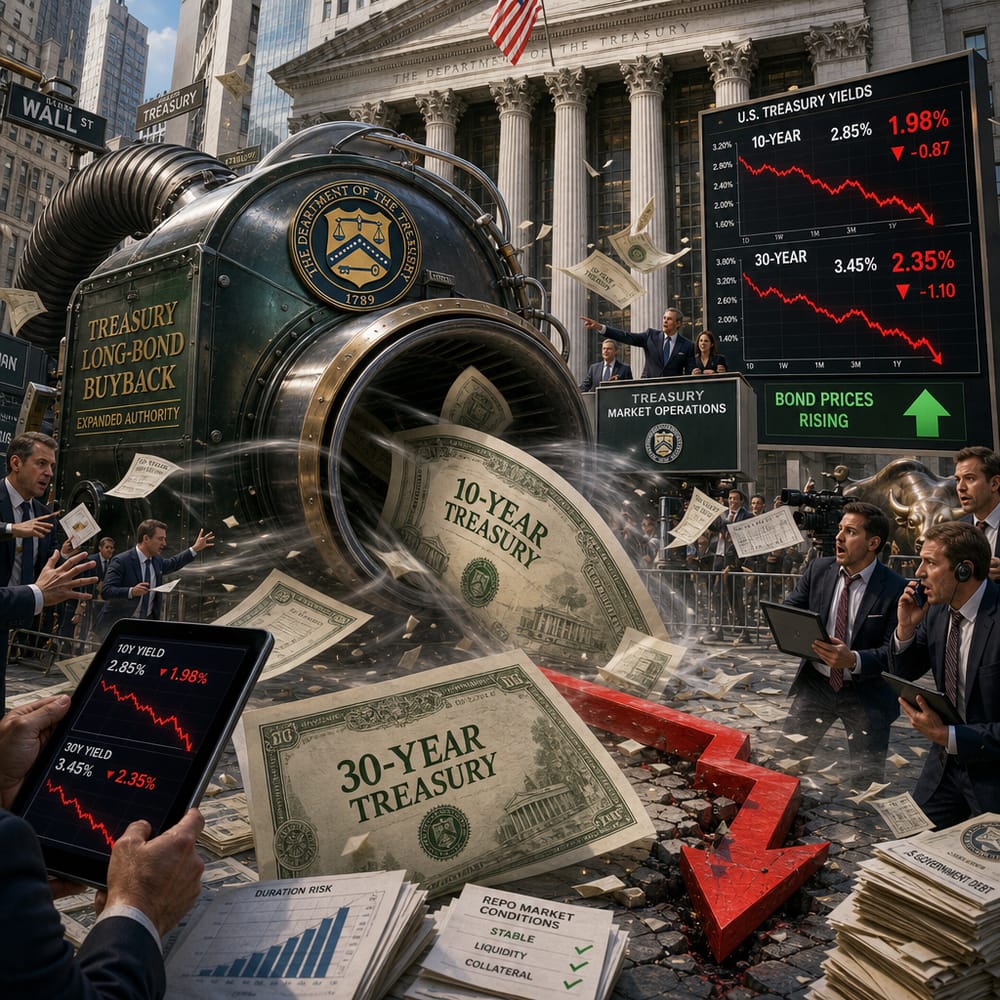
So, what's all the fuss about? The U.S. Treasury, under the baton of Secretary Scott Bessent, decided to play maestro by more than doubling its debt repurchases, focusing on longer-term bonds. This isn't just your usual Tuesday market ploy. By targeting the 10-year to 30-year range, the Treasury is essentially saying, "Hey, we're not messing around." And the market felt it. The benchmark 10-year note yield slipped 6 basis points to 4.647% and the 30-year bond yield fell 9 basis points to 5.196%. In bond speak, that's a big move.
So why the crescendo? The bond market has been feeling like it's on a rickety roller coaster, with yields hitting peaks not seen since your favorite 90s sitcom was still airing new episodes. Investors have been giving long-term bonds the cold shoulder since June, leading to concerns about liquidity. Treasury's aggressive buyback, doubling from $2 billion to "at least" $4 billion, is a bold move to inject confidence and liquidity into the market. It's like that friend who always orders extra fries—it ensures there's enough to go around.
But here's the million-dollar question: How does this affect the yield curve, that mystical graph that tells us a lot about market expectations? The yield curve, which plots interest rates of bonds with different maturities, is doing its own funky dance. Typically, long-term yields are higher than short-term ones—a nod to the risk of holding longer contracts. But when the Treasury swoops in and buys long-term bonds, it can flatten the curve, or even invert it—an economic omen that often hints at a recession.
What does all this mean for the Federal Reserve's moves? Well, lower yields can sometimes signal that markets are expecting less aggressive monetary policy from the Fed. If investors anticipate that the economy might slow down, they might expect the Fed to ease up on interest rate hikes. And when the price of money isn't climbing, businesses and consumers tend to borrow and spend more. It's essentially an economic dance that can influence everything from housing markets to stock investments.
For you, the retail investor, the implications are as broad as a Texas horizon. If you're holding bonds, especially long-term ones, pay attention. With yields dipping, your existing bonds look more attractive since they might offer better rates than newly issued ones. Meanwhile, if you're pondering mortgage rates or auto loans, the Treasury's move could eventually ease the upward pressure on these borrowing costs, though there's no guarantee it will happen overnight.
Of course, the Treasury's decision doesn't exist in a vacuum. It's part of a broader symphony of market forces, including global geopolitical tensions, inflation fears, and economic data releases that can tip the balance in unexpected ways. As the Fed's take on economic health and interest rates continues to evolve, investors should keep an ear to the ground—and maybe a stash of popcorn for the drama that can unfold in financial markets.
So, what should you do next? Keep a sharp eye on the yield curve and Fed signals. Whether you're a bond enthusiast or a stock market adventurer, these elements can guide your investment decisions like a trusty GPS. And remember, in this ever-evolving market, staying informed is your best ally. Consider this your cue to buckle up, because with the Treasury's latest move, the financial landscape is anything but predictable.
This article is for informational purposes only and is not investment advice. Always do your own research or consult a licensed financial professional before making investment decisions.
© Copyright 2024. All Rights Reserved.
© Copyright 2024. All Rights Reserved.