

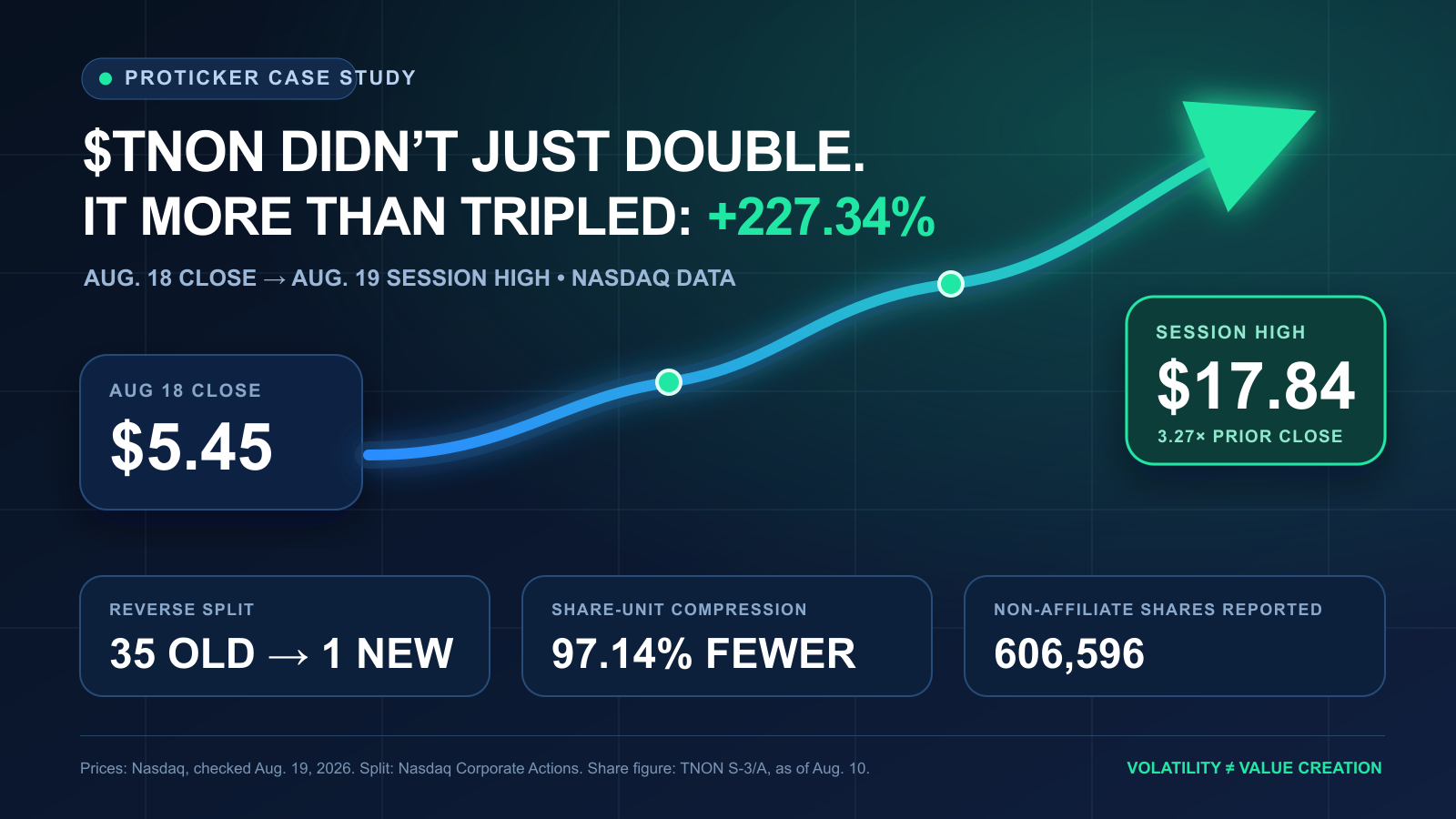
Eight days after Tenon Medical (NASDAQ: TNON) completed a 1-for-35 reverse split, its newly compressed share structure collided with extraordinary demand. The stock closed August 18 at $5.45, ignited after hours, and reached an official session high of $17.84 on August 19.
The move, minute by minute
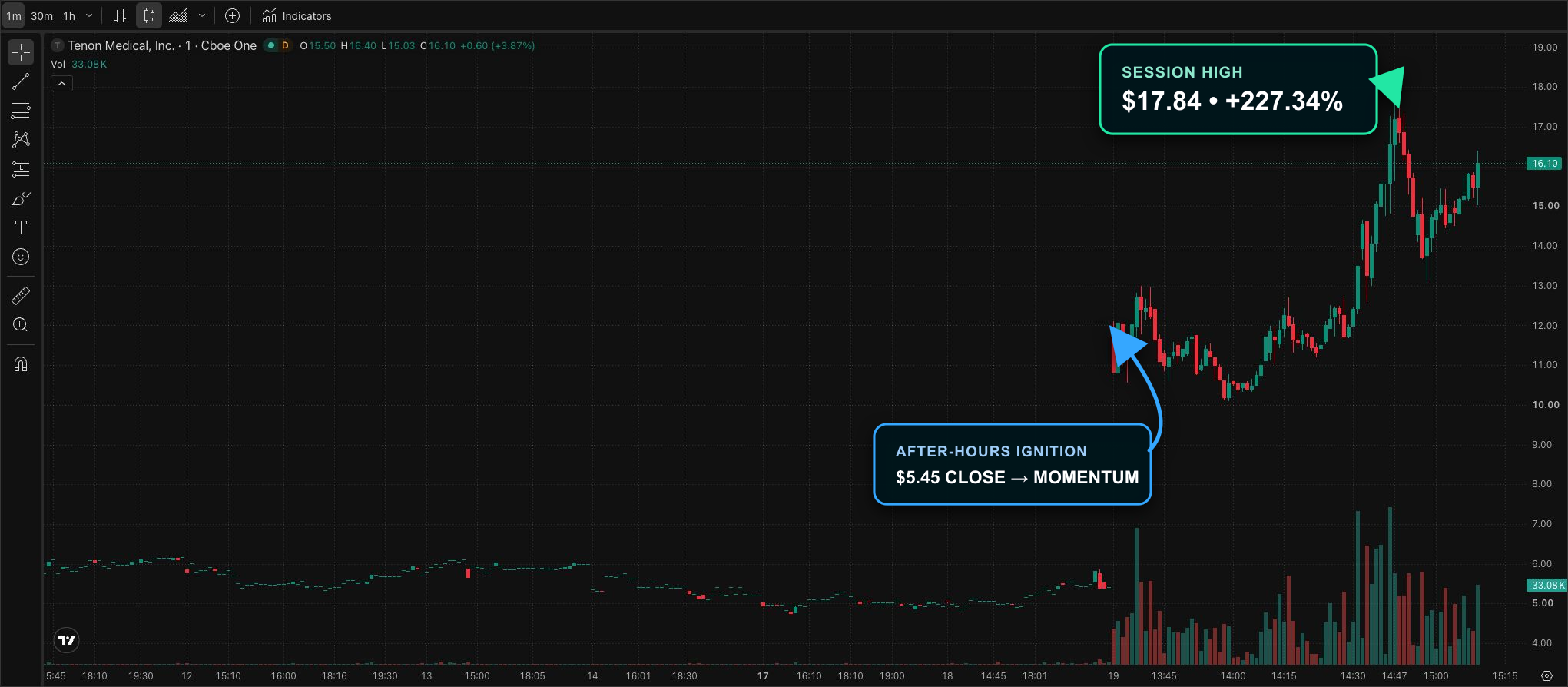
TNON's regular session ended on August 18 at $5.45. The acceleration began after the closing bell: the stock touched $10.10, an 85.32% jump from the close. Premarket demand carried it to $12.75, up 133.94%.
Then the opening session pushed through the first reported $13.06 peak. It did not stop there. Around the 10:47 a.m. ET minute, Nasdaq recorded an official high of $17.84—a $12.39 gain and a 227.34% peak advance from $5.45.
Why reverse splits can create explosive setups
A reverse split is simple arithmetic: fewer shares, proportionally higher price per share, and theoretically no instant change in ownership percentage or company value. TNON's 1-for-35 action compressed every 35 old shares into one new share—a 97.14% reduction in share units.
That compression matters when fresh demand arrives. With fewer shares available at each price level, a rush of market orders can consume the visible supply quickly. Sellers pull offers higher, momentum scanners detect the acceleration, short-term traders join, and the feedback loop can become violent.
This is the central lesson: a reverse split does not guarantee a rally, but it can create the kind of tightly wound structure in which an unexpected wave of demand produces an outsized price response. TNON is a textbook recent example of that mechanism.
TNON's post-split share structure
The company's filings make the compression tangible. TNON reported 667,047 shares outstanding as of August 13. A later registration statement reported 606,596 shares held by non-affiliates as of August 10. That non-affiliate figure is a filing-based proxy for the tradable-share structure—not a real-time float measurement—but it shows just how small the post-split base had become.
By 11:23 a.m. ET on August 19, Nasdaq showed roughly 34.86 million regular-session shares traded. Add about 11.13 million after-hours shares from August 18 and 15.51 million premarket shares, and the point-in-time combined turnover reached roughly 61.51 million shares—about 101× the 606,596 non-affiliate-share figure.
That does not mean 61.51 million unique shares existed: the same shares can change hands repeatedly. It means demand and churn were enormous relative to the disclosed share base—the exact environment in which low-float momentum can become extreme.
No fresh operating headline was required
As of the time of this analysis, TNON had not issued a same-day operating press release to explain the August 19 surge; its latest company press release was dated August 13. That makes the structure-and-demand explanation especially important. Price can move first when a compressed float meets aggressive order flow, even without a new product, trial, contract, or earnings headline that morning.
ProTicker added TNON to its watch list after the move was already underway. The important lesson is not to pretend the entire run was forecast in advance. It is to recognize why a post-split stock with a very small disclosed share base deserved immediate attention once volume and price expansion confirmed the setup.
The risk traders cannot ignore
The same thin structure that accelerates a squeeze can accelerate a reversal. TNON's effective shelf registration also covers a potential $4,397,821 at-the-market program within a broader $100 million shelf. No sale is automatic, but potential issuance creates real dilution risk.
- Reverse splits do not create economic value. They consolidate share units.
- Not every post-split stock rallies. Demand and order imbalance still have to arrive.
- Low-float momentum is two-sided. Price can fall as quickly as it rises.
- Filings matter. Authorized shares, shelves, warrants, convertibles, and ATM programs can change the supply picture.
The ProTicker takeaway
TNON turned a reverse-split compression event into one of the day's most dramatic momentum moves: $5.45 at the close, $10.10 after hours, $12.75 premarket, and $17.84 in the regular session.
The evidence supports a precise conclusion. Reverse-split microcaps can become explosive momentum setups when an unusually small post-split share structure meets extraordinary demand. The split is not the catalyst by itself—but it can load the spring. TNON showed what can happen when the trigger is pulled.
Sources and methodology
Price calculation: (($17.84 ÷ $5.45) − 1) × 100 = 227.34%. Price, high, and volume data were checked against Nasdaq as of 11:23 a.m. ET on August 19, 2026. Extended-hours values are Nasdaq-reported consolidated data.
Nasdaq TNON quote · Nasdaq historical data · Nasdaq after-hours data · Nasdaq premarket data
Nasdaq corporate action notice · TNON reverse-split proxy · TNON Form 10-Q · TNON Form S-3/A · SEC notice of effectiveness