

Think Like a Short Seller: Understanding the Fear Behind a Short Squeeze
Saturday, July 11, 2026
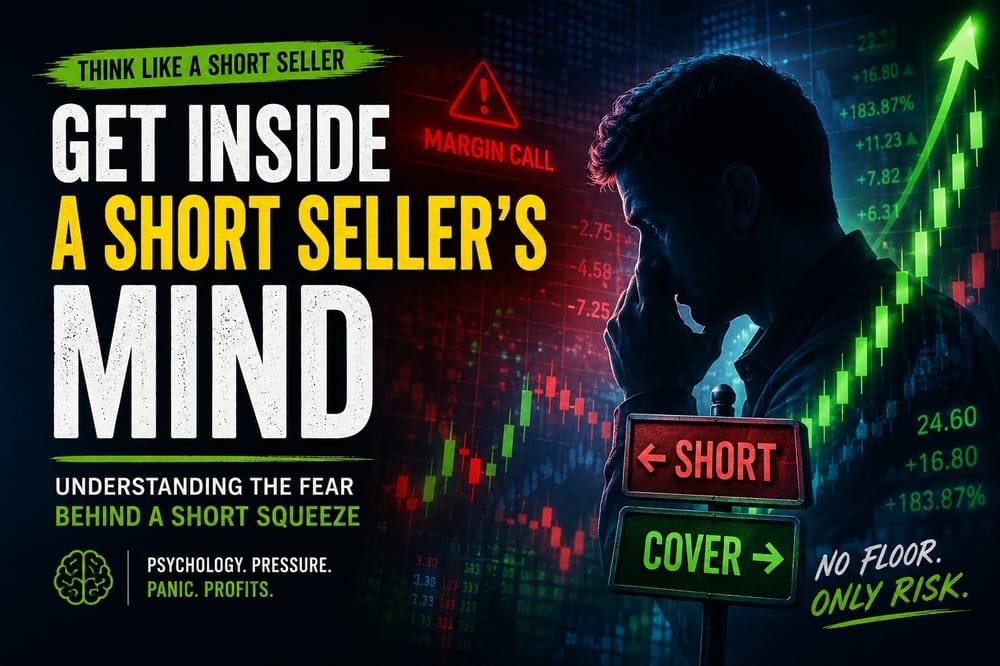
Think Like a Short Seller: Understanding the Fear Behind a Short Squeeze
Most traders study charts, volume, momentum, and news catalysts. But when a low-priced stock begins accelerating, one of the most valuable things you can study is the psychology of the traders betting against it.
To understand a short squeeze, you need to understand what the short sellers are feeling.
A long trader buys a stock hoping the price will rise. A short seller borrows shares, sells them, and hopes to repurchase them later at a lower price. On paper, both sides are simply trying to profit from a directional move.
In practice, their risk profiles are dramatically different.
That difference is what can turn an ordinary momentum move into an explosive squeeze.
Long Traders Have a Defined Floor
When someone buys a stock, the maximum theoretical loss is limited to the amount invested.
A trader who buys a stock at $2 can lose $2 per share if the company collapses and the stock falls to zero. It would be a painful loss, but the loss has a defined endpoint.
Short sellers do not have that protection.
A trader who shorts a stock at $2 loses 100% of the position’s original value if the stock rises to $4. If it climbs to $6, the loss reaches 200%. At $10, the loss becomes 400%.
There is no mathematical ceiling on how high a stock can rise, which means there is no fixed ceiling on a short seller’s potential loss.
That unlimited-risk structure creates fear, urgency, and sometimes forced buying.
Why Downside Moves and Upside Squeezes Behave Differently
Stocks can certainly collapse. Fraud, bankruptcy, dilution, failed clinical trials, delisting risk, and disastrous financial results can destroy shareholder value.
However, even heavily damaged stocks do not always fall directly to zero.
They may decline sharply and then stabilize. They may bounce, trade sideways, or slowly drift lower over several sessions. In many cases, long investors have time to evaluate the situation and decide whether to sell.
Short squeezes can unfold much faster.
A stock that breaks through an important resistance level may force short sellers to begin covering. Covering a short position requires buying shares. That buying activity pushes the price higher, which places even more pressure on the remaining short sellers.
The result can become a self-reinforcing cycle:
1. The stock begins rising.
2. Early short sellers enter, expecting the move to fail.
3. The stock continues higher instead of reversing.
4. Short sellers begin covering their positions.
5. Their buy orders add to the upward momentum.
6. Breakout traders and momentum buyers enter.
7. Additional short sellers are forced to cover at increasingly higher prices.
At that stage, the move may no longer be driven solely by the company’s underlying story. It is also being driven by positioning, fear, margin requirements, and the urgent need to exit.
The Most Dangerous Thought for a Short Seller
One of the most dangerous ideas in momentum trading is that a stock has already moved “too far.”
A stock rises from $2 to $4, and short sellers assume the move must be finished because the price has already doubled.
But the market does not care how far a stock has already traveled.
When the float is limited, volume is expanding, liquidity is thin, and traders are trapped on the wrong side, a stock can continue rising far beyond what appears reasonable.
A move from $2 to $4 may look extreme. But if the stock then rises from $4 to $8, the trader who shorted it at $2 is facing a 300% loss.
At that point, the decision is no longer purely analytical. It becomes emotional.
The short seller may be asking:
* How much more can I afford to lose?
* Will my broker increase the margin requirement?
* Can I locate additional shares?
* Will the stock halt again?
* What happens if it gaps higher after the next reopening?
* Should I cover now or wait for a pullback?
Every additional move higher increases the pressure.
BIRD: A Lesson in Trapped Positioning
BIRD demonstrated how quickly the balance between buyers and short sellers can change.
The stock gapped from approximately $2.49 to $6.82, a move that naturally attracted traders looking for a reversal. After such a large gap, many short sellers may have believed the stock was overextended and likely to fade.
Instead, the move continued.
As momentum buyers entered and short sellers attempted to cover, the stock eventually surged above $24 during the session.
The important lesson is not simply that BIRD produced a massive percentage move. The deeper lesson is that a stock can keep climbing when too many traders are positioned for the same reversal.
Every new short position can become a potential future buyer.
That does not mean every heavily shorted stock will squeeze. It means that when the technical structure, trading volume, available float, and market psychology align, the short interest can act like fuel.
What Creates a Strong Short-Squeeze Setup?
No single metric guarantees a squeeze. Traders should look for several conditions appearing together.
A Meaningful Catalyst
A major announcement can create legitimate demand and force the market to reassess the company. The catalyst could involve earnings, a regulatory development, a new contract, a strategic transaction, clinical data, or another material event.
The stronger and more unexpected the catalyst, the harder it may be for short sellers to confidently predict where the stock should stop.
Unusual Trading Volume
Volume confirms that the market is paying attention.
A stock trading several times its normal daily volume may attract momentum traders, algorithmic strategies, scanners, social-media attention, and additional short sellers.
Increasing volume can make a move more sustainable, but it can also increase volatility dramatically.
A Tight or Restricted Float
When relatively few shares are available for public trading, aggressive demand can move the price quickly.
If short sellers are competing with momentum buyers for a limited supply of shares, covering can become difficult and expensive.
Repeated Resistance Breaks
Short sellers often enter near prior highs, whole-dollar levels, or other visible resistance areas.
When those levels break instead of holding, stops may be triggered and new buyers may enter simultaneously.
A stock that repeatedly breaks resistance without delivering a meaningful pullback may be signaling that the sellers are losing control.
Failed Breakdowns
Some of the strongest squeeze candidates briefly appear ready to collapse and then recover.
A stock may break below support, attract additional short sellers, and then reclaim the level with volume. That failed breakdown can trap traders who entered late and expected immediate downside continuation.
When a bearish setup fails, the move in the opposite direction can be especially aggressive.
The Day-Three Surge Concept
Former runners often remain active for several sessions after the initial breakout.
The first day introduces the stock to the market. The second day tests whether the move can hold. By the third day, traders may be divided between those expecting another breakout and those expecting the momentum to disappear.
That disagreement can create an important setup.
A stock holding above key support after a major run may attract short sellers who believe the move is exhausted. If the stock then breaks above its consolidation range, those short sellers may be forced to cover while momentum traders return.
This is sometimes described as a Day-Three Surge.
Stocks with poor long-term charts, repeated reverse splits, or questionable fundamentals can still produce strong short-term trading opportunities. A weak company and a strong trading setup can exist at the same time.
That distinction is essential.
A trader does not need to believe that a company deserves a high long-term valuation to recognize that its stock may be positioned for a short-term squeeze.
Why Former Runners Matter
Stocks that have produced major moves in the past often remain on momentum traders’ radar.
When one of these stocks becomes active again, traders remember its history. That memory can affect behavior before the current move has fully developed.
Long traders may enter early because they remember the previous surge. Short sellers may also enter aggressively because they remember how the previous move eventually collapsed.
Both groups can increase volatility.
SUNE, for example, may have a disastrous long-term chart affected by reverse splits and repeated value destruction. That does not automatically eliminate it as a day-trading candidate.
If volume returns, the stock holds important support, and price action begins trapping short sellers, it could still develop into a tradeable momentum setup.
The long-term chart describes the company’s history. The intraday chart describes the current battle between supply and demand.
Those are not always the same story.
Learn to Identify Pain, Not Just Price
One of the best ways to evaluate a potential squeeze is to ask where traders are likely trapped.
Where did the shorts probably enter?
Where are their stops?
Which resistance level were they expecting to hold?
At what price would their losses become uncomfortable?
Where might brokers raise margin requirements or force positions to be reduced?
The chart becomes more meaningful when viewed as a map of trader positioning.
A breakout above a previous high is not merely a new price. It may represent the point at which a large group of short sellers realizes that its original thesis is failing.
That realization can produce urgent buying.
Do Not Chase Without a Plan
Short squeezes can create extraordinary moves, but they also carry extraordinary risk.
The same stock that rises several hundred percent can reverse violently. Trading halts, spreads, low liquidity, dilution risk, and sudden offerings can make exits difficult.
Recognizing squeeze potential does not mean buying at any price.
A disciplined trader should still identify:
* A specific entry area
* A clear invalidation level
* The amount of capital at risk
* Nearby resistance
* The possibility of trading halts
* The appropriate position size
* A plan for taking profits into strength
The goal is not to predict the exact top. The goal is to recognize when the balance of pressure may favor continued momentum while managing the risk of being wrong.
Final Thoughts
Short squeezes are powered by more than excitement. They are powered by structural risk and human emotion.
Long traders can lose only what they invest. Short sellers can face losses that continue expanding as the stock rises. When a stock has a catalyst, strong volume, a limited supply of shares, and multiple resistance breaks, that asymmetry can create intense pressure.
Understanding that pressure allows traders to see the market differently.
Instead of asking only whether a stock has already risen too much, ask whether the short sellers have been given a real opportunity to escape.
When the answer is no, the move may still have fuel left.
This article is for educational and informational purposes only. It does not constitute investment advice or a recommendation to buy, sell, or short any security. Low-priced and highly volatile stocks involve substantial risk, including the possible loss of your entire investment.
© Copyright 2024. All Rights Reserved.
© Copyright 2024. All Rights Reserved.