

Thin Breadth Underlying Chip-Led Mega-Cap Rally
Saturday, August 22, 2026
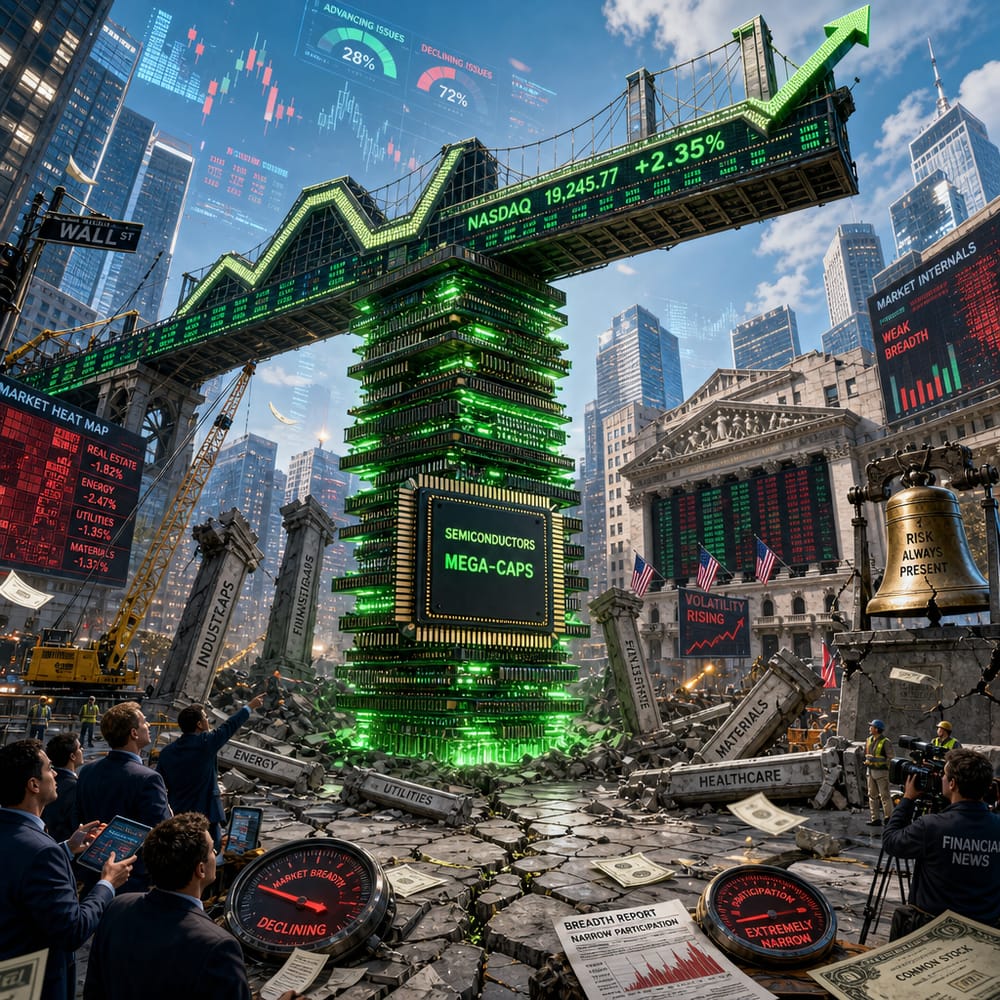
THIN BREADTH UNDERLYING CHIP-LED MEGA-CAP RALLY
You know those huge, glitzy fireworks displays that light up the night, captivating everyone until the grand finale seems to last an eternity? Well, that's kind of like what's happening in our beloved stock market right now, minus the inevitable smoke cloud that makes everyone cough.
If you’ve been peeking at the market charts lately, you’ve probably noticed that the Nasdaq and S&P 500 have been strutting their stuff, boasting year-to-date gains that make your 401(k) feel like it’s in Vegas. But don’t pop the champagne just yet. There's a twist. This rally is being powered by a handful of tech and semiconductor stocks, like an overzealous toddler hogging the spotlight in a school play. And that might be a problem.
THE RISKS OF A NARROW MARKET RALLY
So, what’s the big deal about a narrow rally where just a few mega-cap stocks carry the baton? Imagine a three-legged race with one hulking muscleman dragging two toddlers. Sure, they might win, but if the big guy trips, it’s game over. Market experts are sending up flares because this kind of concentration makes the whole shebang more vulnerable. If those star stocks—think Nvidia, Apple, and Microsoft—stumble, it could feel like a financial earthquake under Wall Street’s feet.
Consider it like a table with only a couple of sturdy legs: it’ll hold for a while, but spill a drink, and it might collapse. And while you might love the idea of a tech party, a diversified snack table is what makes a bash strong enough to survive the night.
Riding the wave of a narrow rally might lead you to wear rose-tinted glasses, but it leaves investors holding their breath, because the market’s health hinges on a balanced diet of sectors, not just a tech-heavy protein shake.
SECTORS DRIVING THE FRENZY
The tech and semiconductor sectors have been the poster children of this market surge. They're like the cool kids in high school getting all the attention—everyone wants a piece of them. Semiconductors, in particular, have been the golden geese, thanks to the AI revolution and the insatiable demand for everything from smartphones to robot vacuums. If your fridge isn’t already texting you grocery lists, it probably will soon.
But herein lies the rub. The market becomes lopsided, relying heavily on these sectors while others languish in mediocrity. When the tech stars decide to take a breather, the whole market might just find itself gasping for air.
IMPACT ON FUTURE MARKET STABILITY
So, what happens next? Can this rally keep its momentum, or is it like a house of cards waiting for a sneeze? If the market breadth remains as thin as a model on a catwalk, there’s a good chance that volatility could rear its ugly head. Investors might become as jittery as a cat near a sprinkler, leading to sudden retreats and panicked selling.
The market thrives on confidence, and when there's talk of systemic risk due to narrow breadth, that confidence gets shaky. Picture a herd of investors suddenly spooked—it might lead to a stampede for the exits, which no one wants to see.
Simply put, to maintain a healthy, robust market, we need more players on the field. The other sectors—energy, healthcare, consumer goods—need to step up and join the rally. Otherwise, this high-wire act could falter, leaving us with nothing but a bad case of vertigo.
THE BOTTOM LINE
While the market does its high-wire dance and the tech giants lead the charge, the rest of us are left watching, wondering if this is the beginning of a new era or just a precarious balancing act. Keep an eye on those sectors that are lagging behind—they might just be the ones to pull the market back to solid ground.
So, next time you check your stock app or glance at those mesmerizing charts, remember: a little diversification never hurt anyone. And while fireworks are fun, you'd rather not be the one cleaning up after the grand finale.
This article is for informational purposes only and is not investment advice. Always do your own research or consult a licensed financial professional before making investment decisions.
© Copyright 2024. All Rights Reserved.
© Copyright 2024. All Rights Reserved.