

Term Finance Governance Exploit Shakes Crypto Vaults
Saturday, August 29, 2026
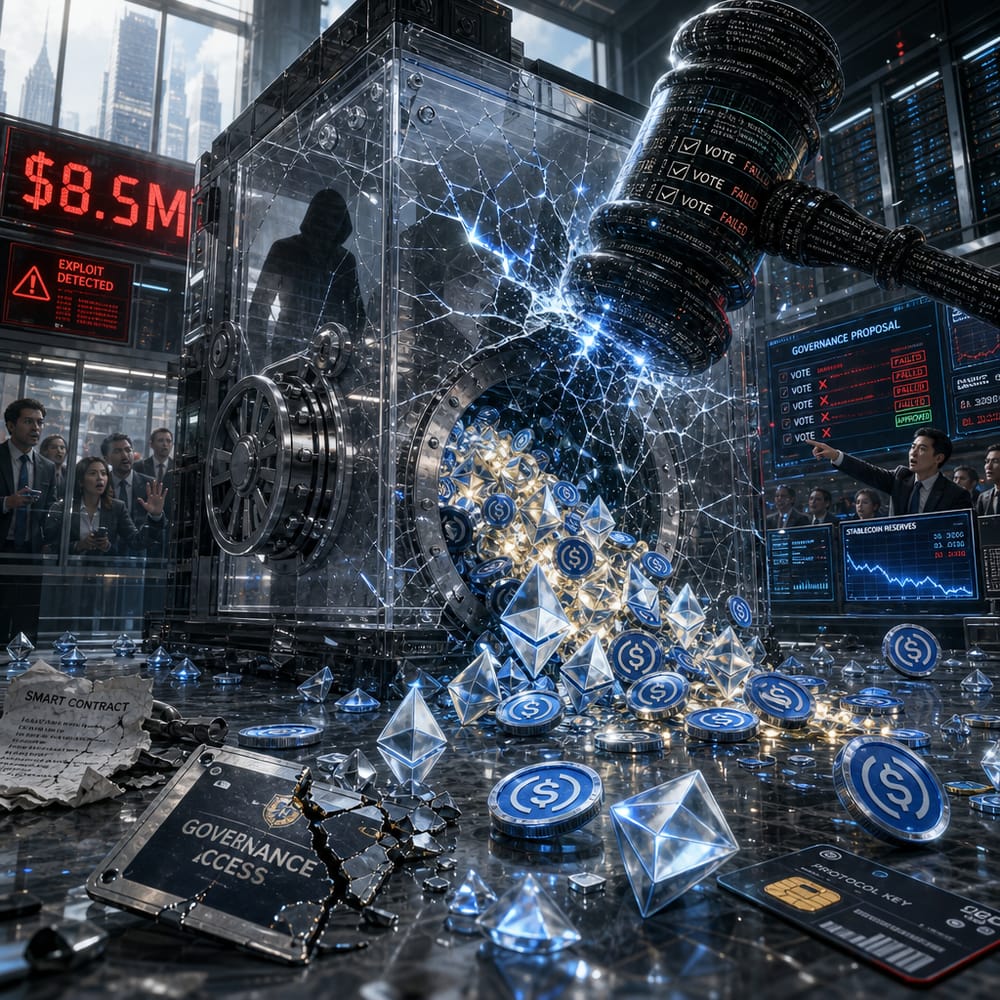
ETH and USDC Take the Hit: Inside Term Finance's $8.5 Million Crypto Caper
In the wild west of cryptocurrency, the sheriff is often asleep at the wheel. This time, the bandits hit Term Finance, making off with a cool $8.5 million in Ethereum (ETH) and USD Coin (USDC), exploiting a vulnerability in the platform's governance. If you're shaking your head thinking, "Not again," you're not alone. This latest breach serves as yet another reminder that the shiny world of decentralized finance (DeFi) can be as slippery as a greased pig in a rainstorm.
So, what went wrong? In a nutshell, it was a classic case of poor governance controls. A glitch in Term Finance’s smart contract—a self-executing contract with the terms of the agreement directly written into code—was exploited. Now, you might be wondering, isn't the whole point of smart contracts to be 'smarter' than the paper variety? Ideally, yes, but when they malfunction or are poorly designed, they can open the door to tech-savvy rogues.
Before you lose sleep over your own crypto stash, let's unpack the implications. For starters, this hack is a stark illustration of the deep-seated vulnerabilities in smart contracts. With the crypto market buzzing from the influx of exchange-traded fund (ETF) money, hacks like these are bound to make even the most adventurous investors think twice. After all, you wouldn’t buy a house with a leaky roof just because it’s in a hip neighborhood, would you?
Ethereum and USD Coin are the stars caught in this exploit's crossfire. Ethereum is the reigning champ of the smart contract arena, while USD Coin is everyone’s favorite stablecoin, pegged to the US dollar. Both assets are crucial cogs in the DeFi machine, and when their security is compromised, the tremors are felt across the blockchain landscape.
What’s being done to prevent future mishaps? Well, the big wigs at Term Finance are undoubtedly huddled in a war room as we speak, debating how to patch things up. The immediate step is likely a deep dive audit into their codes and governance protocols—a sort of digital spring cleaning. Often, these incidents lead to a flurry of improvements and an overhaul of security measures. Problem is, it’s like slapping a Band-Aid on a cut after it's become infected: it might help, but the damage is already done.
Investor confidence, however, is a trickier beast to tame. Once bitten, twice shy, as the saying goes. For the DeFi sector, every exploit chips away at the trust that takes years to build. Trust in crypto platforms often hinges on the security of smart contracts, and these breaches can cast a long shadow, scaring off potential investors who dread waking up to find their assets gone with the digital wind.
The solution? The crypto community has been making noises about 'bug bounties'—rewards for ethical hackers who sniff out vulnerabilities before the bad guys do. Some argue for more rigorous third-party audits and even real-time monitoring systems to catch anomalies as they happen. It's a tough crowd out there, and a tougher sell to investors already skeptical of the decentralized playground.
Meanwhile, the latest buzzword in crypto circles is 'resilience.' The ability for platforms to bounce back from setbacks will be crucial for their survival. As in any tech sector, those who adapt and innovate will live to trade another day. As DeFi continues to evolve, the hope is that it becomes less like the Wild West and more like a well-oiled machine, where investors can feel as secure as they do with their traditional financial institutions.
In conclusion, while the Term Finance incident is a black eye for crypto, it also serves as a cautionary tale. It’s a reminder that while DeFi offers tantalizing returns, it comes with its share of risks. The key is vigilance—whether you're an everyday investor, a platform developer, or a tech-savvy coder. The crypto market will continue to attract assets, intrigue, and, yes, even exploits. But with every breach comes a lesson learned, and hopefully, a stronger, smarter system.
This article is for informational purposes only and is not investment advice. Always do your own research or consult a licensed financial professional before making investment decisions.
© Copyright 2024. All Rights Reserved.
© Copyright 2024. All Rights Reserved.