

Teradyne (TER) Downgraded by Baird
Monday, August 24, 2026
BAIRD SENDS TERADYNE A REALITY CHECK
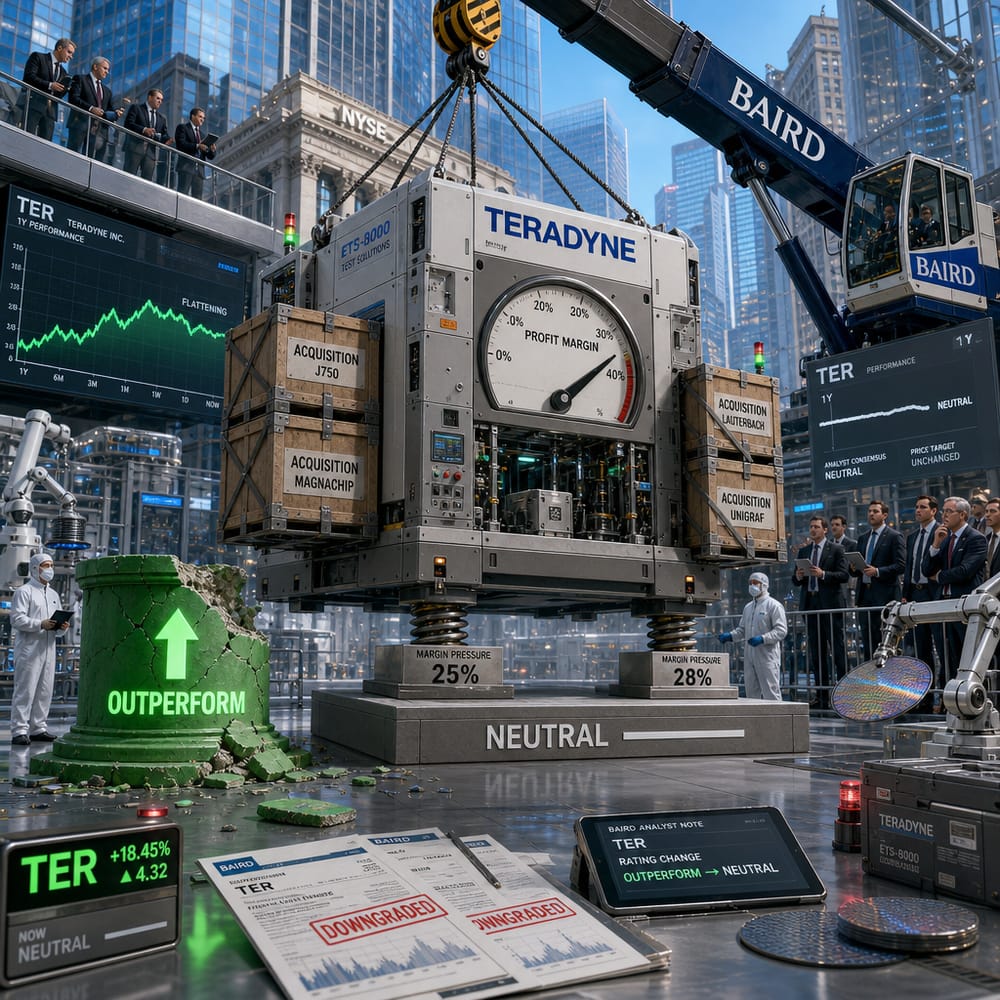
Competition, acquisitions, and margin compression aren’t the kind of things you want to invite over for a cup of coffee, but they're making themselves right at home in Teradyne's financial living room. Investors woke up to the news that Baird has decided to downgrade Teradyne’s stock rating from “Outperform” to a more tepid “Neutral,” and it’s got everyone double-checking their investment mix.
Perhaps Teradyne, known for its automated test equipment and industrial robotics, might have been too optimistic with its growth strategy. Baird's decision to downgrade came wrapped in a hefty list of concerns about acquisition-driven growth and those pesky compression margins. But what does all this mean for the tech juggernaut's future?
ACQUISITION: THE DOUBLE-EDGED SWORD
Teradyne’s recent growth spurt has been largely acquisition-driven. They’ve been snapping up companies like a kid in a candy store, including Universal Robots and Mobile Industrial Robots. These purchases certainly brought some new toys to the company’s lineup, especially in the rapidly evolving industrial automation sector, but did these acquisitions add any extra weight to Teradyne's financial ankles?
Acquisitions can be a double-edged sword. They open doors to new technologies and markets, but they also carry the baggage of integration costs, cultural mismatches, and the risk of overextension. Think of it like adopting a new pet: more love and joy, but also more responsibility. With acquisition-driven growth, if revenue from these shiny new parts doesn't start pulling its weight soon, investors might start looking at Teradyne with some skeptical side-eye.
MARGIN COMPRESSION: THE SNEAKY SQUEEZE
Let's talk about margin compression, the corporate equivalent of having your belt suddenly tighten a few notches after lunch. Margin compression refers to the decrease in the difference between what it costs a company to make a product and what it sells it for. In plain English: it means they’re making less money on each unit sold.
For Teradyne, this isn’t just a bookkeeping headache. Compressed margins can hurt profitability, and that’s a red flag for investors. If Teradyne can't keep its margins healthy, shareholders might find themselves reaching for the nearest exit.
WHAT’S THE FUTURE HOLD?
Despite these worries, it’s not all doom and gloom. The industrial automation sector is expected to grow significantly in the next decade. With industries on a quest to up their efficiency game through automation, Teradyne is well-positioned to be a major player. However, the competition is heating up faster than a mid-summer sidewalk, with rivals pushing hard to gain their own foothold in this lucrative space.
Baird's downgrade isn’t necessarily a death sentence. It’s more like a wake-up call, a reminder to Teradyne to focus on tightening its operations. To thrive in this industry, Teradyne will need to make sure their integrations from acquisitions are smoother than a jazz sax solo and ensure their margins are as appealing as a summer blockbuster.
BOTTOM LINE
Teradyne's journey is a classic tale of risk and reward. Their recent acquisitions have the potential to propel them to new heights, but they also bring challenges that can't be ignored. Margin compression is a thorn in their side, and Baird's downgrade is a stern warning to get their financial house in order.
For the everyday investor, this means keeping a close eye on how Teradyne navigates its path forward. There’s a lot of potential here, but also some bumps on the road that shouldn’t be underestimated. Whether Teradyne manages to turn these acquisitions into a runway rather than a stumbling block will determine whether this downgrade is just a blip on the radar or a more significant turning point. Investors, stay vigilant.
This article is for informational purposes only and is not investment advice. Always do your own research or consult a licensed financial professional before making investment decisions.
© Copyright 2024. All Rights Reserved.
© Copyright 2024. All Rights Reserved.