

Tech Workforce Pushback: Over 1,100 AI Workers Urge U.S. to Slow Tech Growth
Friday, August 14, 2026
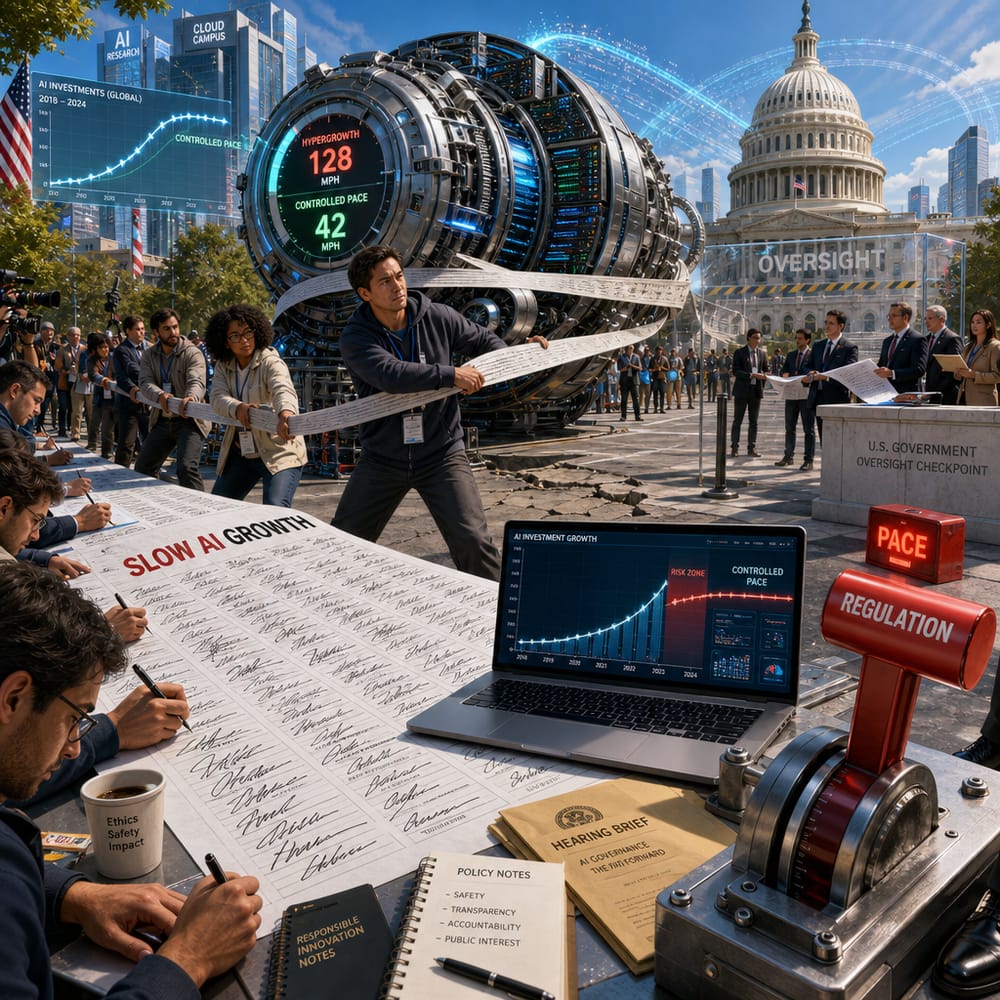
When over a thousand AI warriors sound the alarm about their own industry's growth, it’s time to pay attention. Picture this: more than 1,100 AI workers have joined forces, not to celebrate their tech prowess but to plead with Uncle Sam to hit the brakes on the rocket ship of tech growth. They’re not just whistling Dixie; they’ve gone official with a petition. It’s a plot twist worthy of a sci-fi blockbuster, with the twist that we're living it.
THE AI WORKER'S CONCERN
The AI boom has been nothing short of meteoric, but like any good movie, there’s drama in the details. The workers aren’t worried about job security or paycheck sizes. Nope, their beef is more existential. They're concerned about the unchecked speed of tech evolution, which could run roughshod over safety protocols, ethical considerations, and even our own privacy rights. Imagine opening Pandora’s box and having no clue how to close it. That’s the nightmare scenario they’re trying to avoid.
To understand their concerns, think of AI as a toddler with a jetpack. It’s got potential, but without the right guidance, it could crash into a wall or, worse, cause a lot of unintended harm. These industry insiders are essentially asking for a nanny to make sure the toddler learns to walk before it tries to fly.
GOVERNMENT REGULATION: THE POSSIBLE IMPACT
Now, the big question is, how could government regulation impact the AI industry? The short answer: it’s complicated. On one hand, regulations could act like a seatbelt, ensuring the industry's rapid acceleration doesn’t turn into a wild, uncontrollable skid. On the other hand, too many constraints could turn the industry’s sports car into a sluggish minivan.
The AI industry thrives on innovation and speed. Introducing extensive regulations could slow down some of the cutting-edge advancements and potentially make the U.S. less competitive on the global stage. No one wants to see their industry left in the digital dust while rivals in less regulated environments zoom ahead.
However, a strategically crafted regulation could alleviate societal concerns without stifling innovation. It could create a framework that ensures tech advancements align with public interests, making AI not just a tool for profit but a boon for society as a whole.
THE CONSEQUENCES FOR TECH INNOVATION
The road to regulation is fraught with potholes of unintended consequences. A hasty or poorly crafted policy could scare off investors quicker than you can say "bear market." The AI sector is notorious for needing heavy financial backing for its groundbreaking work, and uncertainty is kryptonite for investors.
Yet, some believe a well-defined regulatory environment could actually be a boon. It might be the ultimate innovation catalyst, forcing companies to think more creatively within defined boundaries. After all, necessity is the mother of invention, and pressure can create diamonds—or in this case, groundbreaking tech solutions.
However, there's a delicate balance to strike. Push too hard with regulation, and you risk pushing AI development underground, where oversight is minimal and accountability is a pipe dream. We could end up with a tech black market, where innovation thrives in the shadows, unbound by any ethical considerations.
THE BIGGER PICTURE
This isn’t just a story about AI or tech regulation. It’s a snapshot of a larger debate about how to handle the burgeoning power of technology in our lives. It’s about who gets to steer the ship as digital seas become more turbulent. The AI workers are sending a clear message: tech isn’t just about creating the flashiest new toy or app; it’s about ensuring these innovations serve humanity positively.
The tech industry’s giants, like OpenAI, are already feeling the tremors. With whispers of talent exodus and leadership shakeups, it’s clear the winds of change are blowing. How companies respond now could pave the way for the future of tech policy and market dynamics.
In the end, it's not just about slowing down tech growth but about hitting the gas on responsible innovation. It’s about ensuring that the future of AI doesn’t just compute—it cares. And that, dear reader, could be the real innovation we all need.
This article is for informational purposes only and is not investment advice. Always do your own research or consult a licensed financial professional before making investment decisions.
© Copyright 2024. All Rights Reserved.
© Copyright 2024. All Rights Reserved.