

Tech Bloodbath Deepens: AI Stocks Drive Broad Indices to Fresh Lows
Monday, November 23, 2026
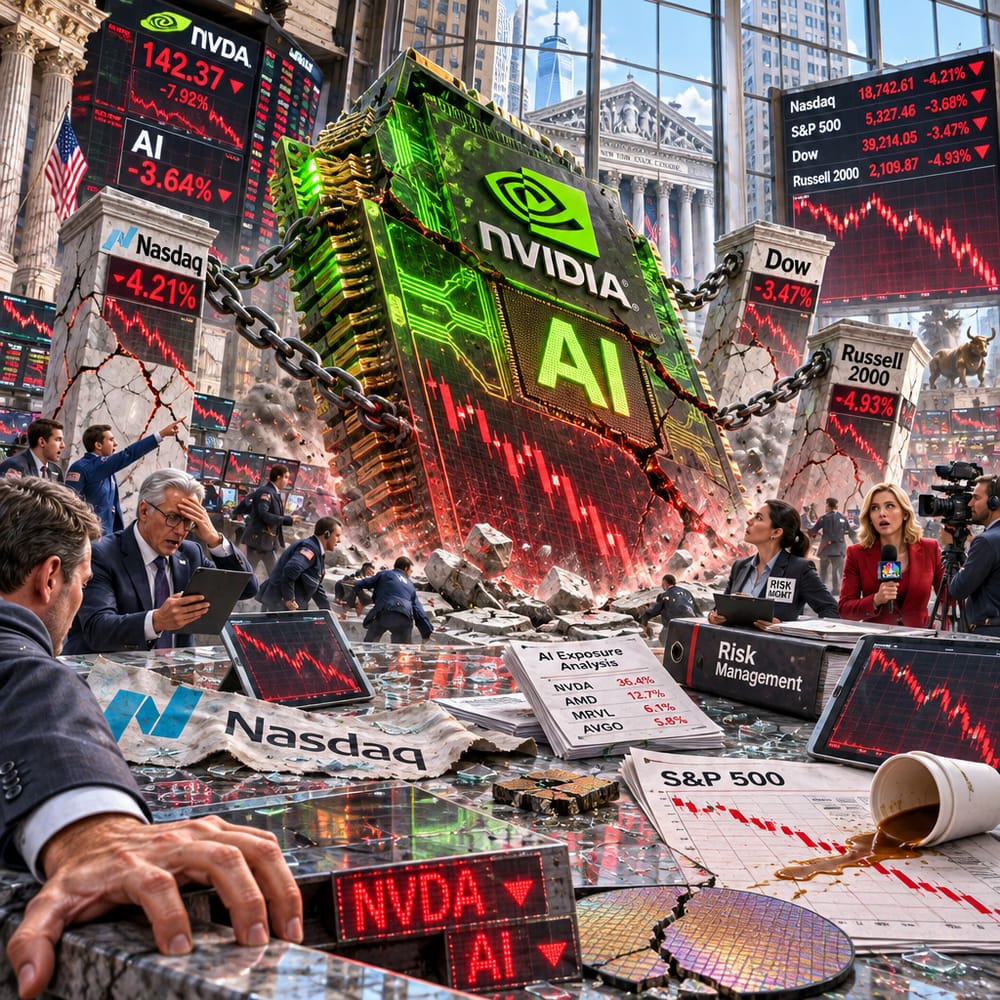
TECH BLOODBATH DEEPENS: AI STOCKS DRIVE BROAD INDICES TO FRESH LOWS
If Wall Street was a party, this week would be the hangover no one saw coming. Just as investors were starting to get comfortable, a tech sell-off—led by the former golden child of AI, Nvidia—reminded everyone why you shouldn't count your chickens before they hatch, or in this case, before your portfolios are AI-proof.
As recent as last week, the S&P 500, Nasdaq, and Dow were cruising in correction territory, not a place markets like to hang out. It’s like realizing you’ve been partying in the wrong neighborhood the whole time. The tech-heavy Nasdaq, in particular, has been taking hits like an overused punching bag, turning negative for the year.
So what in the world is going on? AI stocks, once the darlings of Wall Street, are now behaving like a moody teenager. Nvidia, the poster child for AI evolution, is casting a long shadow over investors' optimism. When Nvidia sneezes, other AI stocks seem to catch a cold, dragging down the broader indices. It’s like the domino effect, only those dominoes are made of silicon.
Last week’s carnage on Wall Street was not just a hiccup; it was a gut punch. The Nasdaq and Dow experienced their worst week in more than six years. You might say it's a bit dramatic, but in the world of investing, drama is the main attraction. Investors are now questioning if the AI hype was just a mirage—an oasis in a desert of volatility.
This tech meltdown isn't confining itself to the U.S. borders, either. It’s a global affair. In Asia, markets braced for an "AI wipeout," with Australia’s and Hong Kong’s indices feeling the chill as well. There’s an international game of follow-the-leader, and it seems everyone is following Nvidia—right off a cliff.
But let’s zoom out a bit. Why is this AI sell-off such a big deal? For one, these stocks had been leading the charge, infusing the market with a dose of hope for a future dominated by artificial intelligence. They were the cool kids everyone wanted to hang out with, and now they're barely making eye contact.
So, how are the major indices reacting to all of this? Picture a rollercoaster ride, but without the fun or the safety harness. The S&P 500 and the Dow are stumbling along, trying to find their footing after the bruising. Meanwhile, the Nasdaq is in its room, listening to sad songs and thinking about what could have been.
Investor sentiment at this point is like a cat on a hot tin roof—nervous, skittish, and ready to leap at the slightest sound. Confidence has taken a hit, and with major indices echoing the tech sector's downturn, it’s not surprising investors are feeling a bit seasick. If this negative sentiment sticks around, we might be looking at a broader market instability—like a bad mood that sets the tone for a week.
But hold on to your hats, because Wall Street futures are hinting at a potential rebound. The Dow futures jumped by 449 points while S&P 500 and Nasdaq-100 futures also picked up. It’s not exactly a feast, but more like a light snack after a week of fasting.
This unpredictable market is a stark reminder that investing is not for the faint-hearted. It’s like navigating a maze with a blindfold on—sometimes you just hit a wall. For the everyday investor, keeping emotions in check and staying informed is more crucial than ever. Diversification remains the golden rule, like a life raft in stormy seas.
In the short term, it's going to be a bumpy ride. But market veterans will tell you, it’s all part of the game. The trick is to stay in your seat and not jump ship at the first sign of trouble. After all, it’s often the daring who profit from volatility.
So, while AI stocks are stumbling now, the future is still unwritten. And as any savvy investor knows, every storm eventually passes. Just make sure your portfolio has an umbrella.
This article is for informational purposes only and is not investment advice. Always do your own research or consult a licensed financial professional before making investment decisions.
© Copyright 2024. All Rights Reserved.
© Copyright 2024. All Rights Reserved.