

Synopsys' Sell-the-News Reaction Despite Raised Guidance
Thursday, August 27, 2026
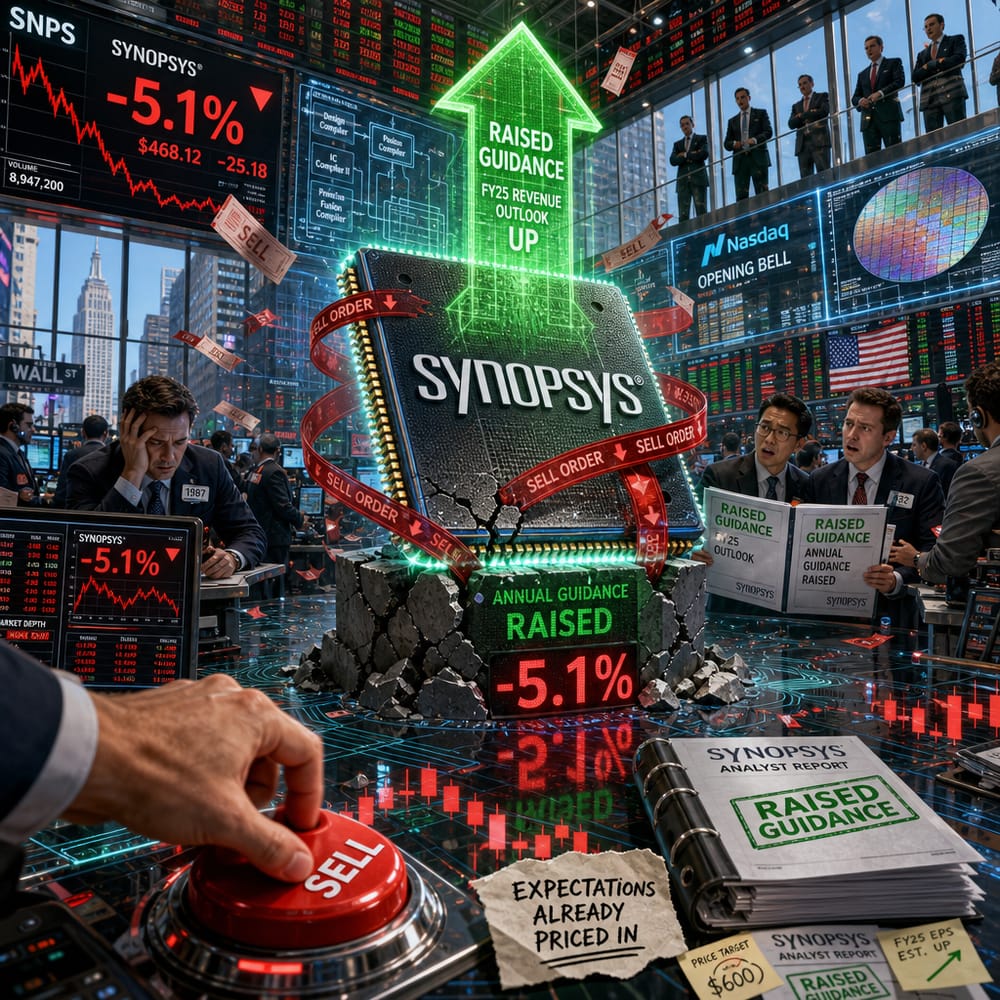
THE CASE OF SYNOPSYS: WHEN GOOD NEWS ISN'T GOOD ENOUGH
So, you've just got your Fitbit steps in, scrolled past some avocado toast recipes, and now you’re wondering why Synopsys, a big player in electronic design automation (EDA), is having a rough day on Wall Street. They just upped their annual guidance, but instead of popping champagne, investors are reaching for the tissues. What gives?
Synopsys, the wizard behind the curtain for chip design software, delivered some seemingly sunny news. They told us they're expecting to outdo their previous forecasts. In corporate speak, that's basically like saying, "We're crushing it, folks!" Yet, the market reacted like they'd just announced a new line of beige office supplies—yawn. Their stock tumbled 5.1% faster than you can say "sell-the-news."
Now, you might be scratching your head. Why would a company that’s optimistic about its future suddenly see its stock take a dive? Welcome to the "expectation vs. reality" plot twist that makes the stock market a soap opera with fewer commercial breaks.
LET'S TALK ABOUT EXPECTATIONS
In the world of investing, especially in tech sectors like EDA, expectations are not just high—they're in orbit. If a company hints at brighter days but doesn't absolutely blow the roof off, investors can become as twitchy as a cat at a dog show. This is especially true in a tech space that thrives on innovation and rapid growth.
Think of it as a first date that’s going great, but then you find out your charming dinner companion doesn’t like pizza. Suddenly, you’re reevaluating the entire evening. For investors, Synopsys' good news just wasn't great enough.
SELL-THE-NEWS: THE FINANCIAL POWER MOVE
The market’s "sell-the-news" response isn't new. It's like when your favorite band announces a reunion tour, and tickets sell out faster than you can hit refresh. Investors had already priced in the optimism, and when the actual news hit, it was old hat. So they did what savvy investors do: they cashed in their chips.
Analysts, always ready to add fuel to a fire, often set sky-high expectations for companies like Synopsys. And when those expectations aren't met or exceeded, even a positive report can feel underwhelming. It's the financial equivalent of expecting a Ferrari and getting a very nice—but very much not a Ferrari—sedan.
THE BIGGER PICTURE FOR EDA
So what does this mean for the EDA sector? Synopsys' stumble is a reminder that even in niches driven by innovation, investors demand perpetual fireworks. This can be a tall order in EDA, where advancements are often incremental, hiding behind flashy AI breakthroughs or semiconductor headlines. It’s a bit like trying to shine under the shadow of a giant Redwood—challenging, to say the least.
This sell-off should also serve as a gentle nudge to stay wary of sector-wide expectations. If Synopsys—with its stronghold on the chip design toolkit—is facing scrutiny for not dazzling enough, other companies in the space better be ready to dazzle or risk the same fate when they step into the earnings spotlight.
WHAT'S NEXT?
As Synopsys executives likely nurse their Wall Street bruises, they’re faced with the task of not just meeting but redefining investor expectations. It will be essential for them to not only continue their path of innovation but to perhaps showcase it with the razzmatazz of a Broadway showstopper.
In the end, for you, the retail investor, the Synopsys saga is a classic lesson in market dynamics: positive news isn't always enough. When expectations are set sky-high, even a little turbulence can feel like a full-on nosedive. So keep your eyes peeled, your wits sharp, and remember, in the ever-dramatic theater of the stock market, timing and expectations are everything.
Now get back out there, scroll with purpose, and never underestimate the power of a good avocado toast recipe. It might not move markets, but it sure can move moods!
This article is for informational purposes only and is not investment advice. Always do your own research or consult a licensed financial professional before making investment decisions.
© Copyright 2024. All Rights Reserved.
© Copyright 2024. All Rights Reserved.