

Surging Long-Term Yields & “5% World” Reality: Mortgage Rates Now Near 8%
Tuesday, September 29, 2026
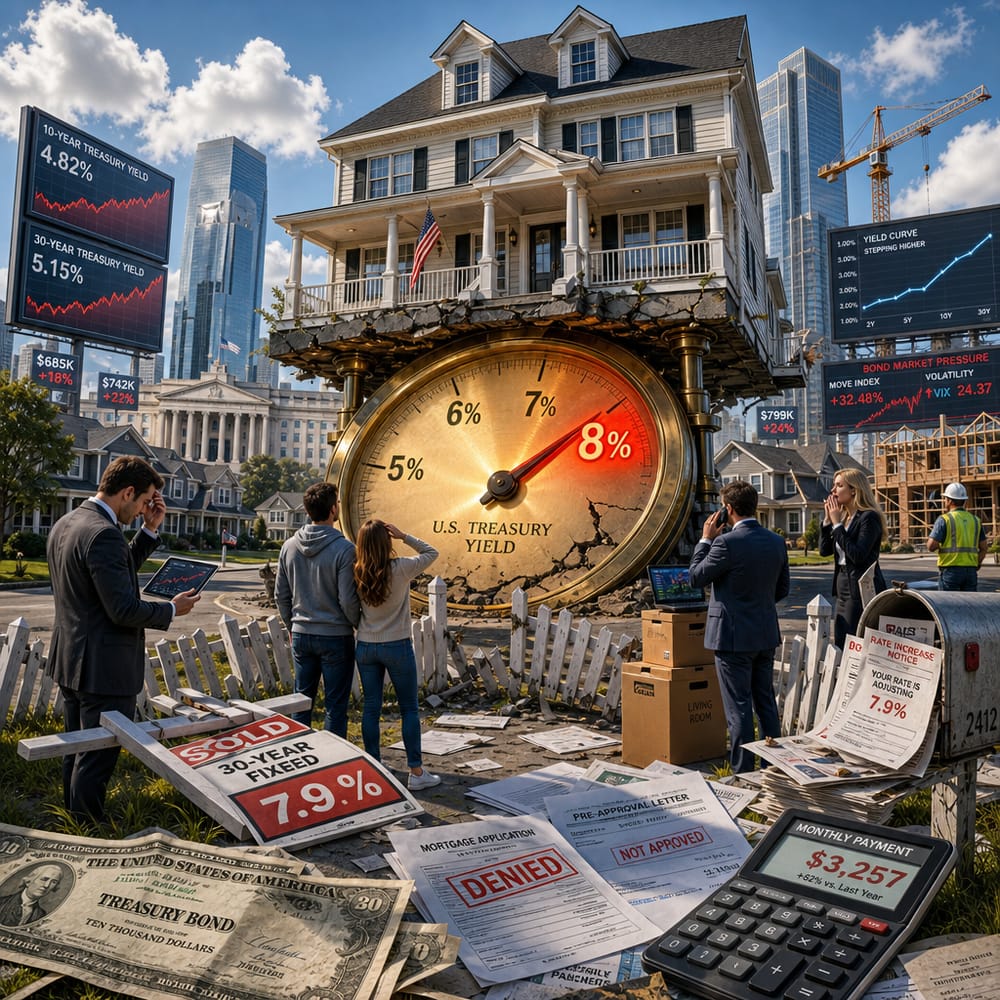
DOWN THE RABBIT HOLE: AMERICA'S NEW "5% WORLD" AND WHAT IT MEANS FOR YOU
Welcome to the new reality, folks, where long-term interest rates have decided to try on a 5% outfit, and they're wearing it like they own the place. The financial world's current trendsetter—the 30-year fixed-rate mortgage—has been strutting dangerously close to the 8% mark. It's as if mortgage rates have been binging on avocado toast and craft lattes, and now they’ve got expensive taste.
You might be asking, how did we end up in this "5% world"? It's not just an inflated sense of self-worth; there are actually solid reasons behind it. The recent surge in long-term U.S. Treasury yields isn't merely a reflection of inflation whispering sweet nothings in the ears of bond investors. No, it's more about the market's collective hunch that our economy is set to flex its muscles. In other words, investors are banking on stronger growth, and they’re willing to bet the farm on it—quite literally, if farms were for sale.
DRIVERS OF RISING YIELDS
So, what's driving these long-term yields skyward? Well, the answer is a cocktail of robust economic factors. We're talking about the Federal Reserve's cozy relationship with higher interest rates, the resilience of consumer spending, and a labor market that seems to have two left feet—it just won't stop dancing. It's a recipe for growth that has investors chomping at the bit, driving real yields (those are the yields you get after accounting for inflation) straight to the moon.
This bond market volatility has been more intense than a high school relationship, but unlike teenagers, these yields seem to be here for the long haul. Some experts believe that current rates indicate stronger future growth rather than just inflationary fears. It's like the economy is ordering a protein shake at the gym's smoothie bar—it's bulking up for the next big push.
IMPACT ON THE HOUSING MARKET AND MORTGAGE BORROWERS
Now, let's talk about what this means for you, the modest mortgage borrower, and the housing market. When mortgage rates hover near 8%, it’s not just the air getting thin. The "dream house" many have been eyeing might start looking more like a fixer-upper. High mortgage rates mean higher monthly payments, which means some folks might have to settle for the charming little bungalow instead of the sprawling McMansion.
For the housing market, the implications are as clear as mud. Higher borrowing costs could cool off house prices, potentially making it a buyer's market—if you can stomach the monthly payments, that is. Sellers might have to reconsider their strategy, possibly throwing in a sweetener like a new roof or a backyard pool to entice buyers.
THE BROADER ECONOMIC IMPLICATIONS
Zooming out to the broader economic picture, what does this 5% world spell for the U.S. economy? For one, we're likely to see a shift in consumer spending as borrowing costs rise. The days of refinancing your mortgage to fund that Instagram-worthy kitchen makeover might be nearing an end. Instead, welcome back to the era of savings accounts and penny-pinching—where every dollar counts.
As borrowing costs climb, we could see a slowdown in sectors that thrive on easy credit, like housing and consumer goods. This could, in turn, temper economic growth, although not enough to curb that bullish sentiment on Wall Street. Yes, it's a bit of a financial tightrope, but as long as the economy keeps its balance, we might just see a smoother landing than expected.
The Federal Reserve, ever the quiet conductor of this economic symphony, will also have to play it cool. If long-term yields keep climbing, they may find themselves in a delicate balancing act—raising rates too fast could stifle growth, while moving too slow might let inflation turn from a campfire to a wildfire.
THE TAKEAWAY
In this brave new 5% world, the only certainty is that nothing is certain. While long-term rates are doing their best to redefine "normal," the game is still on for investors, buyers, and policymakers. For mortgage borrowers and the housing market, it’s time to recalibrate those expectations and strategize accordingly.
So, keep your eyes peeled, wallets ready, and your sense of humor intact. Because whether you're buying a house or just watching from the sidelines, this economic landscape promises to be anything but boring. Welcome to the 5% world. Stay tuned, stay savvy, and remember: in finance, as in life, the only constant is change.
This article is for informational purposes only and is not investment advice. Always do your own research or consult a licensed financial professional before making investment decisions.
© Copyright 2024. All Rights Reserved.
© Copyright 2024. All Rights Reserved.