

Surge in AI-Related Global Debt Issuance
Monday, August 10, 2026
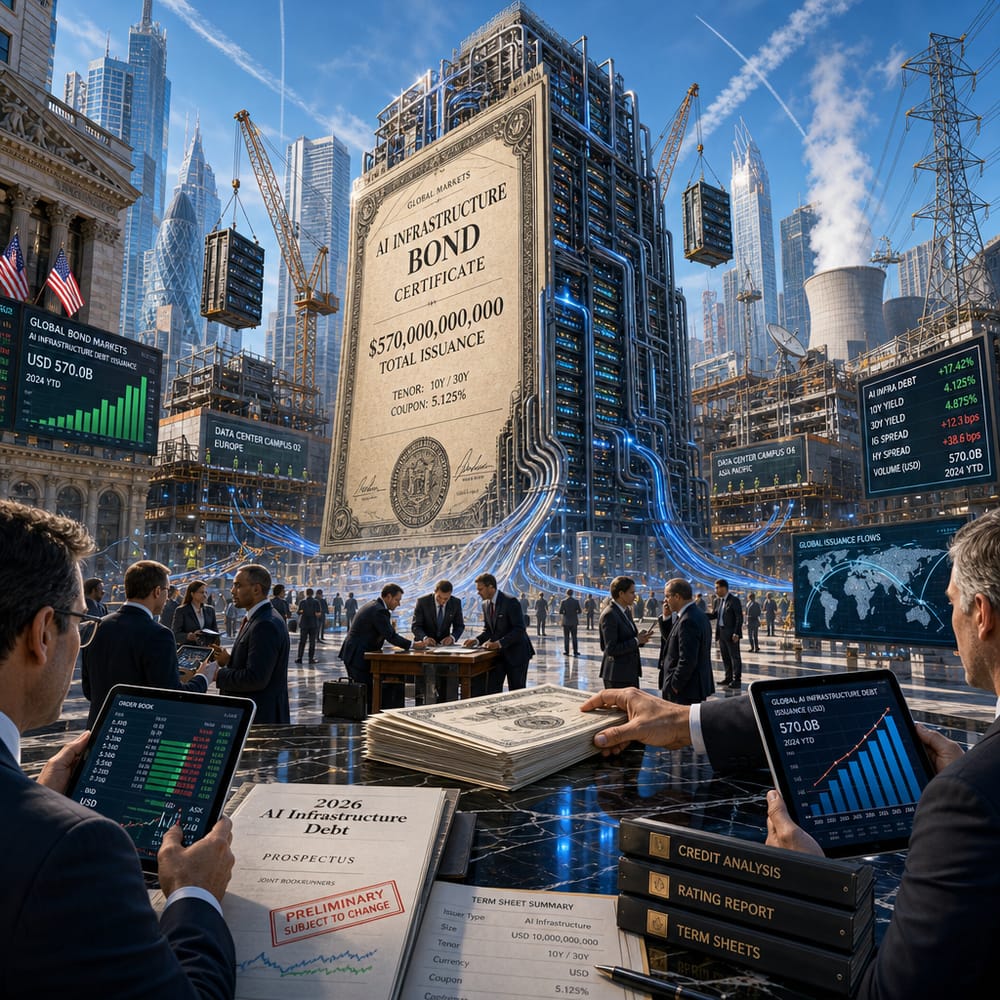
SURGE IN AI-RELATED GLOBAL DEBT ISSUANCE: IS SILICON VALLEY GETTING TOO DEEP INTO DEBT?
Picture this: the tech world is opening its credit card statement and seeing a jaw-dropping $570 billion charge by 2026, according to Morgan Stanley. That’s not for a massive office pool party; it's artificial intelligence (AI) doing a money dance. We're talking about a surge in AI-related global debt issuance, and it's enough to make even the most die-hard tech enthusiasts raise an eyebrow. The big boys in the tech playground—Alphabet, Amazon, Microsoft, and Meta—are getting in on the action, and it's time we unpack what that means for investors and the economy at large.
THE RISKY BUSINESS OF DEBT ISSUANCE
Before you pop the champagne to celebrate tech's latest financial venture, let’s talk risks. Increasing debt is like adding weights to your yacht while cruising into uncharted waters—it can either make you go faster or sink you if a storm hits. In the tech sector, this storm could be market volatility, economic downturns, or both.
Debt issuance isn't inherently evil, of course. But with great power comes great responsibility, and with great debt comes, well, great interest payments. Suppose these AI-fueled projects don't pan out as expected. In that case, these tech giants could face pressure from all sides—investors growling about returns, creditors calling for payments, and a market eager to short anything even remotely shaky.
HYPERSCALERS AND THEIR GRAND PLANS
Hyperscalers, our favorite digital overlords, are not merely piling up debt to buy fancy gadgets. They're planning to pour this money into beefing up their infrastructure to support the AI revolution. Imagine data centers the size of small countries, sprawling with enough servers to power your wildest sci-fi fantasies. That's where a chunk of that $570 billion is heading.
This capital isn't just about maintaining their current market dominance—it's about future-proofing against rivals and staying ahead of the innovation curve. Hyperscalers are prepping to process more data, make sense of complex algorithms, and ultimately, bring AI to our fingertips in ways we can't even imagine yet.
WHAT DOES THIS MEAN FOR TECH INVESTORS?
If you're sitting on a tech-heavy portfolio, this news is both exciting and nerve-wracking. On one hand, investing massively in AI could lead to groundbreaking advancements and juicy returns. The potential for transformative innovation is enormous—think personalized AI assistants, smarter cybersecurity measures, and AI-driven healthcare solutions. On the other hand, if these colossal investments don't yield expected results, we could see some tech behemoths floundering under their debt.
Investors need to keep their eyes peeled. Not all tech stocks will ride the AI wave successfully. Companies that can leverage this debt to generate growth and innovate effectively will be the real winners. Meanwhile, those that mismanage their capital or fail to adapt to AI's fast-evolving landscape might end up as cautionary tales.
A GLIMPSE INTO THE FUTURE
So, what’s next? Will tech titans conquer the AI domain, or will they consider debt a necessary evil that eventually haunts them? The truth likely lies somewhere in between. AI's impact on tech and beyond is undeniable, and with great risk comes the potential for great reward.
As retail investors, our best play is to stay informed and agile. Bet on companies with strong management, clear vision, and adaptability. While the AI party is just getting started, let's ensure we're not the ones cleaning up the mess afterward.
In a world buzzing with AI potential, remember that not every shiny object is gold. Stay smart, stay savvy, and keep questioning. After all, it's your money on the line—make sure it's working as hard as you are.
This article is for informational purposes only and is not investment advice. Always do your own research or consult a licensed financial professional before making investment decisions.
© Copyright 2024. All Rights Reserved.
© Copyright 2024. All Rights Reserved.