

Summit Therapeutics (SMMT) Slumps After Material Event Filing
Wednesday, November 18, 2026
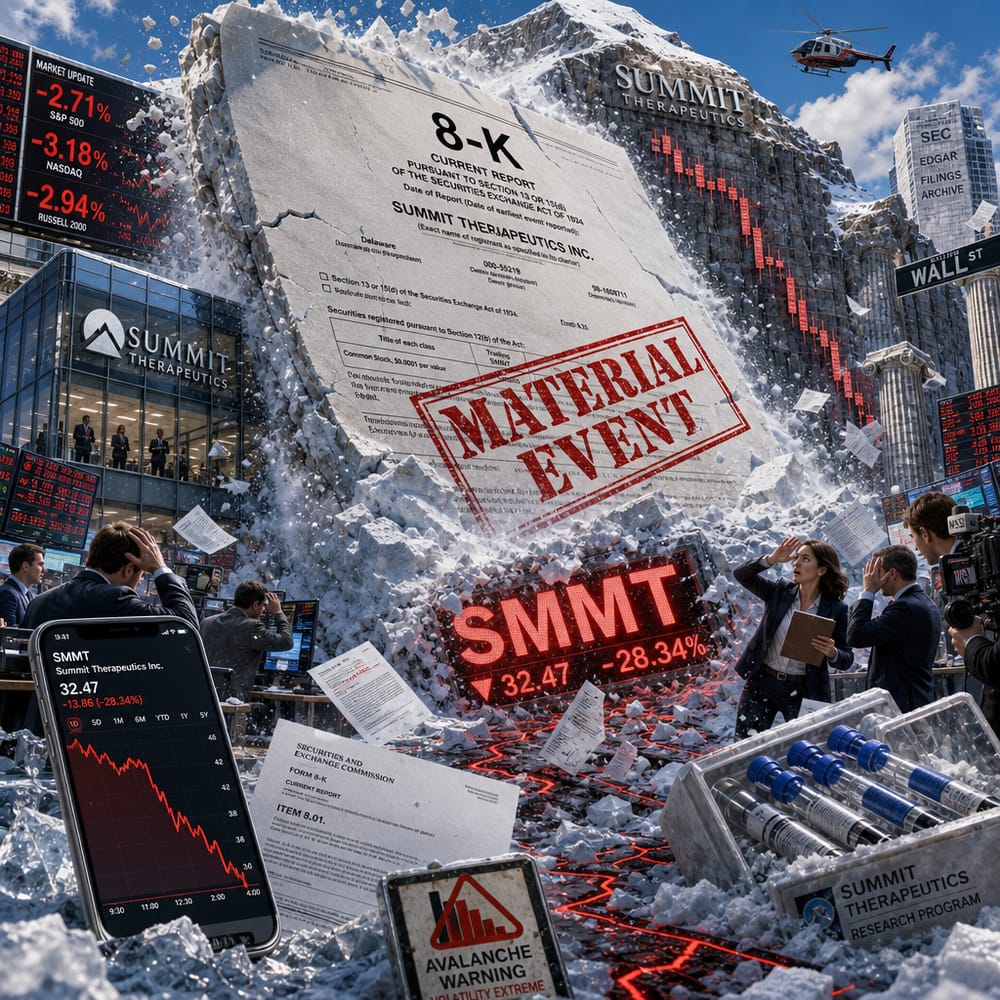
SUMMIT THERAPEUTICS STUMBLES: WHAT WENT WRONG?
Accidents happen—and it seems like Summit Therapeutics just tripped over a financial banana peel. If you haven't been clutching your pearls over biotech lately, here's what you missed: Summit Therapeutics (SMMT) took a nosedive after filing an 8-K, a document that can say everything or nothing at all, but in this case, it said "yikes." The market didn't respond like a gentle coach coaxing an athlete to stand back up; instead, it slapped Summit down by a hefty 25%. So what’s in this little piece of paper that’s got investors all shook up? Let's dive in.
WHAT'S IN THE FILING?
The 8-K filing—think of it as a company's diary entry for the SEC and investors—revealed Summit's plans for restructuring. The document was as thrilling as tax law, but its implications were far from boring. It outlined that Summit will be trimming the fat, a.k.a. cutting jobs and slashing costs. In the company’s words, it's aiming for "operational efficiency." Translated to everyday speak: "We're in a tight spot, and it's time to downsize."
The filing also hinted at a strategic pivot. Summit has been pouring resources into the development of its prized drug candidate, ivonescimab. But it seems like the faucet of cash is running a bit dry. This shift in strategy may include prioritizing partnerships or finding new revenue streams, a move akin to diversifying your side hustles when the main gig just isn’t paying the bills.
THE STOCK MARKET FREAKOUT
The market reaction was immediate and, let's be real, dramatic. Summit's stock price felt the wrath of investors quicker than you can say "biotech bubble." The 25% tumble is the kind of downturn that makes even hardened traders wince. For investors, this isn't just a dip; it's a double black diamond slope of uncertainty.
But why such a strong reaction? Here's the kicker: Small-cap biotech stocks like Summit are essentially roller coasters. They’re high-risk, high-reward. Investors in this sector are chasing potential blockbuster drugs, but when bad news hits, they bail faster than a cat from a cucumber.
WHAT ARE ANALYSTS SAYING?
Analysts haven't exactly rolled out the red carpet for Summit's latest moves. Some are concerned about the company’s cash runway, a polite way of asking, "Do they have enough fuel to keep this plane in the air?" There's also skepticism about whether Summit's restructuring will pay off in the long run.
Piper Sandler analyst Edward A. Tenthoff, though, seems to be the lone optimist in a sea of worry. He argues that Summit's focus on ivonescimab could eventually bear fruit. However, he caveats this with the acknowledgment that the path ahead is fraught with obstacles—and more importantly, that time is of the essence.
WHY THIS MATTERS
So why should you, the scrappy retail investor scrolling through your phone, care? Summit's stumble is a cautionary tale—a reminder of the volatility inherent in small-cap biotech stocks. These companies are like young startups: full of potential but also rife with risk. Investing here is not for the faint-hearted or the impatient.
If you're considering diving into this sector, know this: Your investment could go zero to sixty or crash and burn—all in the blink of an 8-K filing.
THE BOTTOM LINE
In the high-stakes world of biotech, Summit Therapeutics just reminded us why it’s a wild ride. For those holding Summit’s stock, the recent filing and the subsequent market reaction demand a reassessment of risk tolerance and investment strategy. For potential investors, it's a wake-up call to read the fine print and brace for turbulence.
So, dear investor, if you're still keen on biotech, fasten your seatbelts. Keep one eye on the prize and the other on the exits, because as Summit has shown us, the line between breakthrough and breakdown can be a thin one.
This article is for informational purposes only and is not investment advice. Always do your own research or consult a licensed financial professional before making investment decisions.
© Copyright 2024. All Rights Reserved.
© Copyright 2024. All Rights Reserved.