

Strong October Job Gains Revive Fed Tightening Odds
Sunday, November 08, 2026
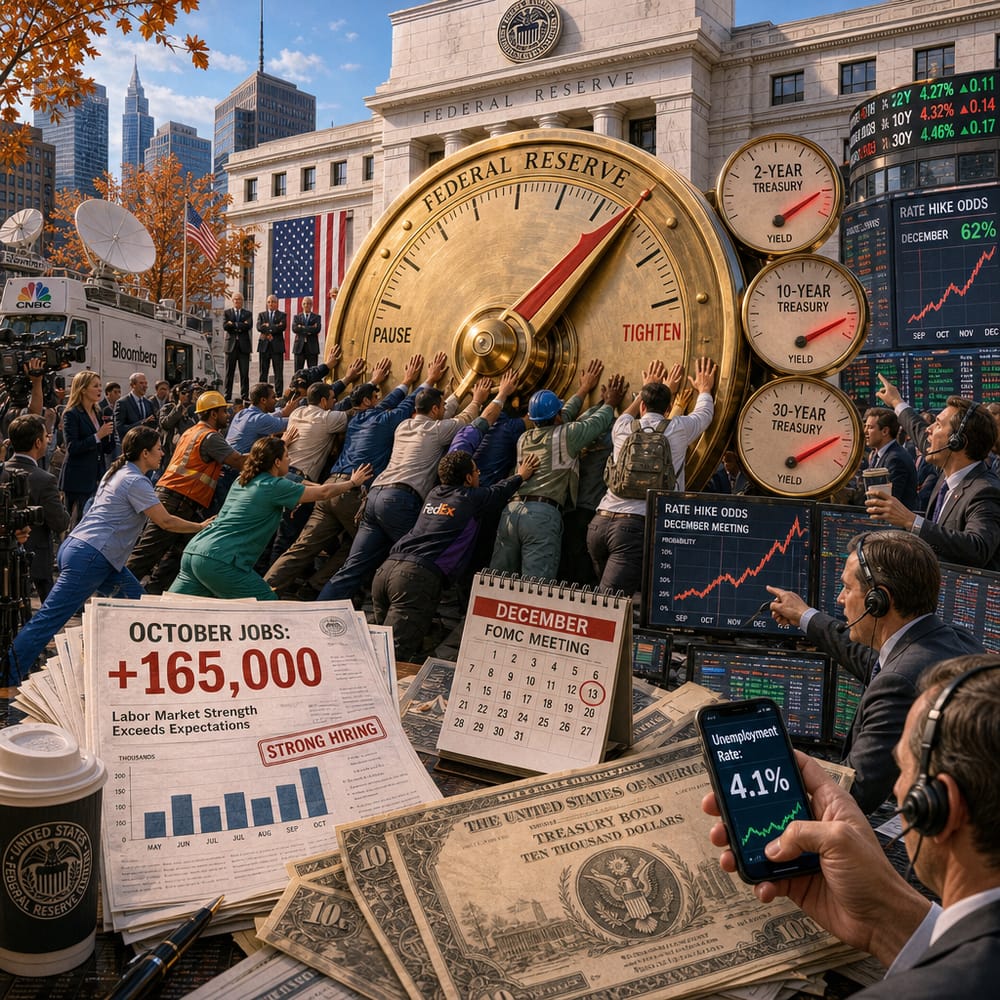
STRONG OCTOBER JOB GAINS REVIVE FED TIGHTENING ODDS
Hold onto your hats, folks, because the U.S. job market just pulled a Houdini act. October rolled in with a whopping 165,000 new jobs, leaving economists who predicted a much smaller number rubbing their eyes in disbelief. And if that wasn't enough to have you double-tapping headlines, the unemployment rate dipped to a neat 4.1%. This is more than just a statistical blip—it's the kind of job growth that makes the Federal Reserve's heart skip a beat at the thought of potential interest rate hikes.
So, what sectors are playing Santa Claus early this year, doling out those job goodies? In the spotlight, we've got healthcare and social assistance, which seem to be on a hiring spree. Think of this as a nod to our aging population and an ever-expanding healthcare system. Professional and business services also had a hand in this job bonanza, which means the folks in suits and ties are bustling with activity. And yes, leisure and hospitality are joining the party, finally catching up as we continue to navigate our way back from pandemic-inflicted woes.
Now, let’s talk about how these numbers might stir things up at the Fed's December meeting. If you're picturing a bunch of economists in suits pacing around a boardroom, you're not far off. See, the Fed's been playing it cool for a while now, hesitant to crank up interest rates unless they see a rock-solid economy. But with job gains like these, they might just have to face the music. The robust job market suggests an economy that's not just surviving but thriving, even as inflation continues to fan its flames.
Inflation—there's that pesky word again. It's the thorn in the side of every central banker, and these job gains are essentially pouring oil on the fire. More jobs mean more people with cash to burn, which generally leads to increased consumer spending. Great for the economy, right? Well, yes and no. As spending rises, so does the demand for goods and services, which can drive prices up—exactly what inflation is all about. Hence, the Fed’s potential rate hikes are not just a knee-jerk reaction but a strategic move to keep inflation from spinning out of control.
For retail investors, this data sends a ripple through the financial markets. Yields on government bonds, like the 10-year and 30-year Treasury, are particularly sensitive to changes in interest rates. A potential rate hike often induces investors to demand higher yields, seeing as they could get better returns elsewhere. Recently, the 2-year Treasury yield, which is often seen as a harbinger of Fed actions, has been making waves, climbing like a squirrel in a nut grove, as expectations of a December rate hike grow.
But here's the twist: While rate hikes typically cause jitters, they also signal confidence that the economy can handle a little tough love. For investors, it’s a double-edged sword—sure, borrowing costs might go up, but it also reflects an economy with its head above water.
So, what’s the takeaway for you, the savvy retail investor scrolling through this on your smartphone? Well, give some thought to how interest rate changes might tilt the scales in your stock and bond portfolios. If the Fed does pull the rate-hike trigger, sectors like utilities and real estate might feel the squeeze, given their sensitivity to borrowing costs. On the flip side, financials like banks and insurance companies could get a boost, as higher interest rates often translate into better margins.
In the end, the October job numbers are a reminder that the economy is a living, breathing beast—one capable of surprises. As we inch closer to the Fed’s December meeting, keep an eye on how these dynamics play out. Because if there’s one thing we’ve learned from this twisty year, it’s that the only constant is change. And as any investor worth their salt knows, staying informed and adaptable is half the battle won.
This article is for informational purposes only and is not investment advice. Always do your own research or consult a licensed financial professional before making investment decisions.
© Copyright 2024. All Rights Reserved.
© Copyright 2024. All Rights Reserved.