

Sticky PCE Inflation and Fed Dilemma
Wednesday, August 26, 2026
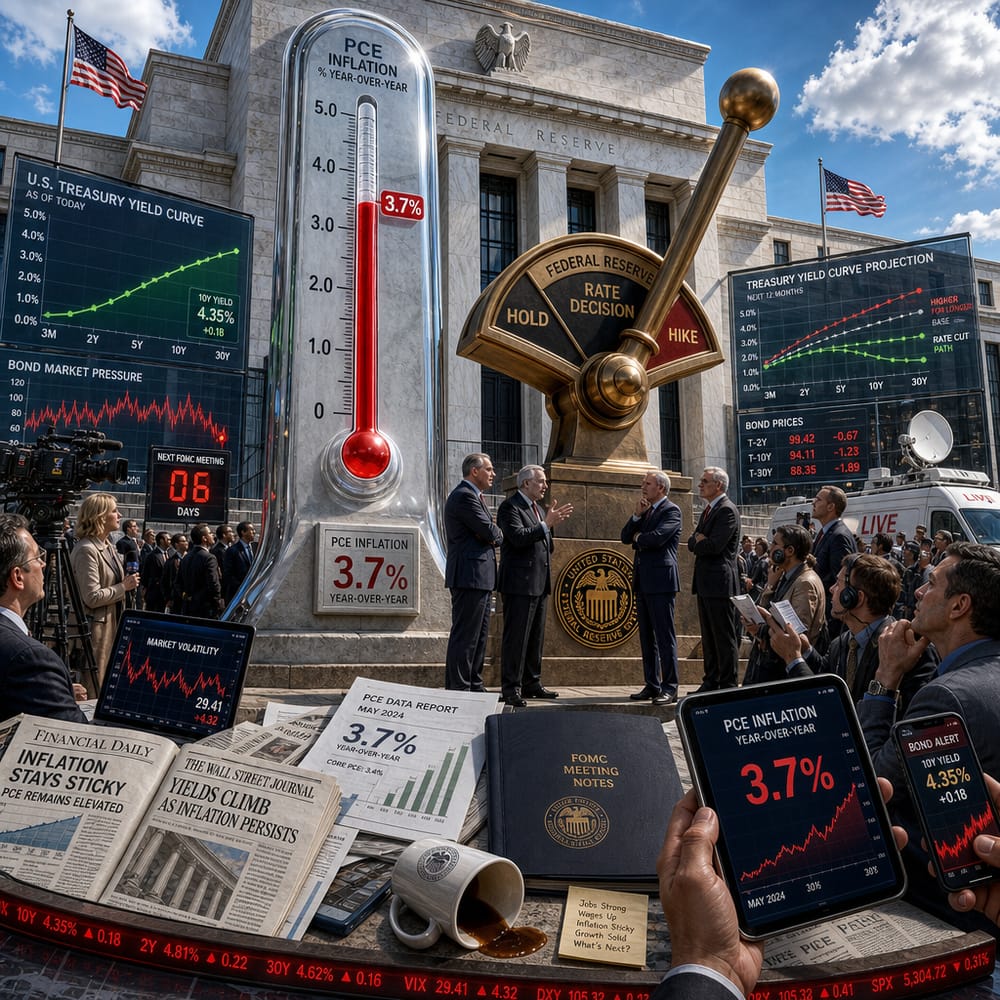
THE FED'S STICKY SITUATION WITH STICKY INFLATION
Imagine you're driving your car down Inflation Highway, and the brakes just aren't gripping the way you'd like. That's exactly what the Federal Reserve is dealing with right now, as the Personal Consumption Expenditures (PCE) inflation rate stubbornly sticks at 3.7% year-over-year. This isn't just a minor pothole; it's more like a traffic jam that could change the route the Fed takes on interest rates. Buckle up, folks, because the implications touch everything from your mortgage rate to the price of bread on your kitchen table.
The PCE inflation report, a piece of data the Fed watches like a hawk, came in a bit hotter than expected. And while the core PCE—think of it as the diet version of PCE, sans food and energy—was more in line with expectations, that headline number is reminiscent of a siren wailing in the distance. Market gurus are already whispering about a potential rate hike, and if you're wondering if that's just financial scuttlebutt, think again. The stakes are real and tangible.
IMPACT ON THE ECONOMY
So, what happens if the Fed decides to play hardball with another rate hike? Think of it like the Fed turning the dial on your thermostat. Suddenly, loans become less cozy. Mortgages, car loans, credit card rates—they all could get frostier. For businesses, especially those heavily reliant on borrowing, this could mean tightening belts or shelving expansion plans. Higher interest rates can slow down the economy, damping investment and spending. But for the Fed, it's a necessary evil to keep inflation from spiraling out of control like an unchecked wildfire.
But hold on, before you start panicking about a dystopian future of perpetual rate hikes and shrinking savings, remember that the Fed walks a tightrope. If they crank interest rates too high, it could choke the economy into recession territory. It's a delicate dance of taming inflation without breaking the economy's back.
CONSUMER BEHAVIOR IN THE FACE OF INFLATION
Now, let's talk about you—yes, you the consumer. With inflation being the uninvited guest that's overstayed its welcome, how does this affect your wallet? Persistent inflation can act like a stealthy pickpocket, unnoticed at first but slowly chipping away at purchasing power. Consumers may start to tighten their purse strings, opting for generic brands over name labels or delaying that new car purchase. Savings become more appealing as the specter of higher prices looms large.
That said, consumers are a crafty bunch, and many will look to navigate these challenges with adaptive behaviors. Think more home-cooked meals and fewer nights out at restaurants. For retailers, this shift in consumer behavior might demand a pivot, offering more discounts or promotional deals to lure budget-conscious shoppers. It's a ripple effect that stretches across the economic pond.
TREASURY YIELDS AND MARKET REACTION
Speaking of ripples, let's not forget U.S. Treasury yields. A potential Fed rate hike can send these yields into a tizzy, causing them to climb higher. This isn't just a matter for economics professors to ponder; it has real consequences for anyone involved in the market. Higher treasury yields can make bonds appear more attractive compared to stocks, possibly nudging investors to re-evaluate their portfolios. The stock market, meanwhile, might react like a teenager being told to clean their room—erratic and unpredictable.
In the grand scheme of things, the Federal Reserve's decisions over the coming months will be like watching a high-stakes poker game. Every move is analyzed, every decision dissected. The Fed might decide to hold steady, gamble on another rate hike, or even surprise with an alternative strategy to tackle inflation. Whatever the choice, it’s bound to keep economists, investors, and everyday consumers on edge.
In this economic thriller, there are no clear-cut villains or heroes, just a complex narrative where every stakeholder plays a part. So, as we navigate this road of economic uncertainty, keep your eyes on the dashboard, and maybe ease off the pedal a bit. The path ahead is far from clear, but with a little patience and a lot of strategy, we might just make it through this inflationary maze.
This article is for informational purposes only and is not investment advice. Always do your own research or consult a licensed financial professional before making investment decisions.
© Copyright 2024. All Rights Reserved.
© Copyright 2024. All Rights Reserved.