

Squeeze on Data Center Water Resources Sparks Bipartisan Pushback in New Mexico
Saturday, August 29, 2026
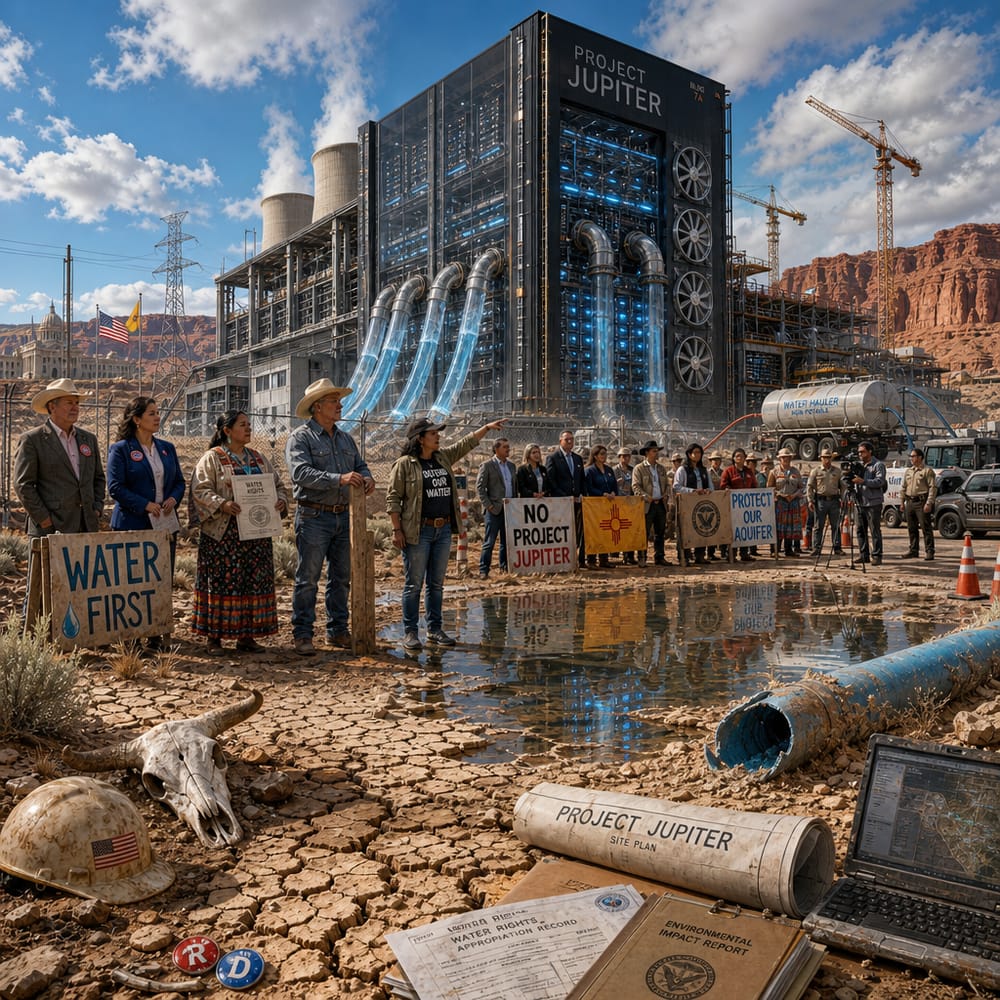
POLITICIANS AND DATA CENTERS: WATER WOES IN THE DESERT
There’s a new bipartisan battleground in New Mexico, and it’s not the usual suspects of taxes or healthcare. No, the latest political punch-up is over something that sounds more fitting for a sci-fi drama: data centers. Welcome to Project Jupiter, a massive endeavor that’s managed to do what few have achieved—unite politicians from both sides of the aisle in fierce opposition. Their beef? Water. A lot of it.
In the land where Breaking Bad unfolded its saga of moral decay in the desert, Project Jupiter is stirring up its own kind of dust storm. The massive data center project, while promising technological advancement and job creation, is also seen as a potential guzzler of one of the Southwest’s most precious resources: water.
ENVIRONMENTAL CONCERNS OVER DATA CENTERS
Data centers are the backbone of our digital lives. They store everything from TikTok dance videos to essential business data. But behind those flashing lights and humming servers lies an inconvenient truth. These facilities require a staggering amount of water to keep their systems cool. And in a place like New Mexico, where water scarcity is as much a part of life as red chilies, that’s a ticking time bomb.
The region’s arid environment and unpredictable rainfall make it particularly vulnerable. Critics of Project Jupiter, including environmental groups and local politicians, argue that placing a water-hungry facility in such a dry region is akin to hosting a polar bear plunge in a desert—it's not just impractical, it’s dangerous.
THE POLITICAL WATERFIGHT
It's not every day that you see politicians reaching across the aisle with gusto, but when it comes to water shortages, common sense sometimes prevails over party lines. That’s exactly what’s happening in New Mexico as Democrats and Republicans alike rally against Project Jupiter. They argue that the facility’s projected water use poses an unacceptable risk to local communities and ecosystems that are already feeling the pinch of a drying climate.
This unusual alliance has brought environmental concerns into sharper focus, highlighting the challenges of balancing technological progress with sustainability. New Mexico's political mavericks are sending a clear message: water comes first.
THE FUTURE OF DATA CENTERS IN DRY REGIONS
Here’s the million-dollar question: Could the backlash against Project Jupiter set a precedent for future data center projects in areas where water is a precious commodity? If politicians and activists in New Mexico have their way, the answer could be a resounding yes.
As data centers expand to meet our ever-growing digital appetite, the tension between technological demand and environmental sustainability will only intensify. This contentious dialogue might push companies to innovate technologically, finding ways to minimize water usage or explore alternative cooling methods.
That could mean anything from using recycled water to developing cutting-edge cooling technologies that don’t rely on large water quantities. Because, let’s face it, running a data center in the middle of the desert without a robust plan to address water consumption is like bringing a toaster to a bath—potentially catastrophic.
THE LARGER IMPLICATIONS
The Project Jupiter debacle sheds light on a broader issue: the environmental footprint of our digital infrastructure. As our thirst for data grows, so does the need for facilities that can support it. But with great power comes great responsibility, and data center operators might soon be feeling the heat—not just from their servers but from public pressure to go green.
Environmental scrutiny like this could reshape how and where data centers are built in the future. It might encourage companies to reconsider their site selection strategies, prioritize renewable energy sources, and invest heavily in sustainable technologies.
So, where does this leave Project Jupiter? The battle is far from over. But whatever the outcome, New Mexico’s showdown over data center water use is a timely reminder that innovation and sustainability must walk hand-in-hand. The stakes are high, not just for New Mexico, but for any place where progress runs headfirst into the limits of natural resources.
In the end, Project Jupiter might just be the canary in the coal mine, signaling the need for a smarter, more sustainable approach to data-driven digital growth. Because when it comes to resources as vital as water, every drop counts.
This article is for informational purposes only and is not investment advice. Always do your own research or consult a licensed financial professional before making investment decisions.
© Copyright 2024. All Rights Reserved.
© Copyright 2024. All Rights Reserved.