

SpaceX’s Nasdaq Fast Pass: When “Passive” Investing Stops Being Passive
Sunday, June 28, 2026
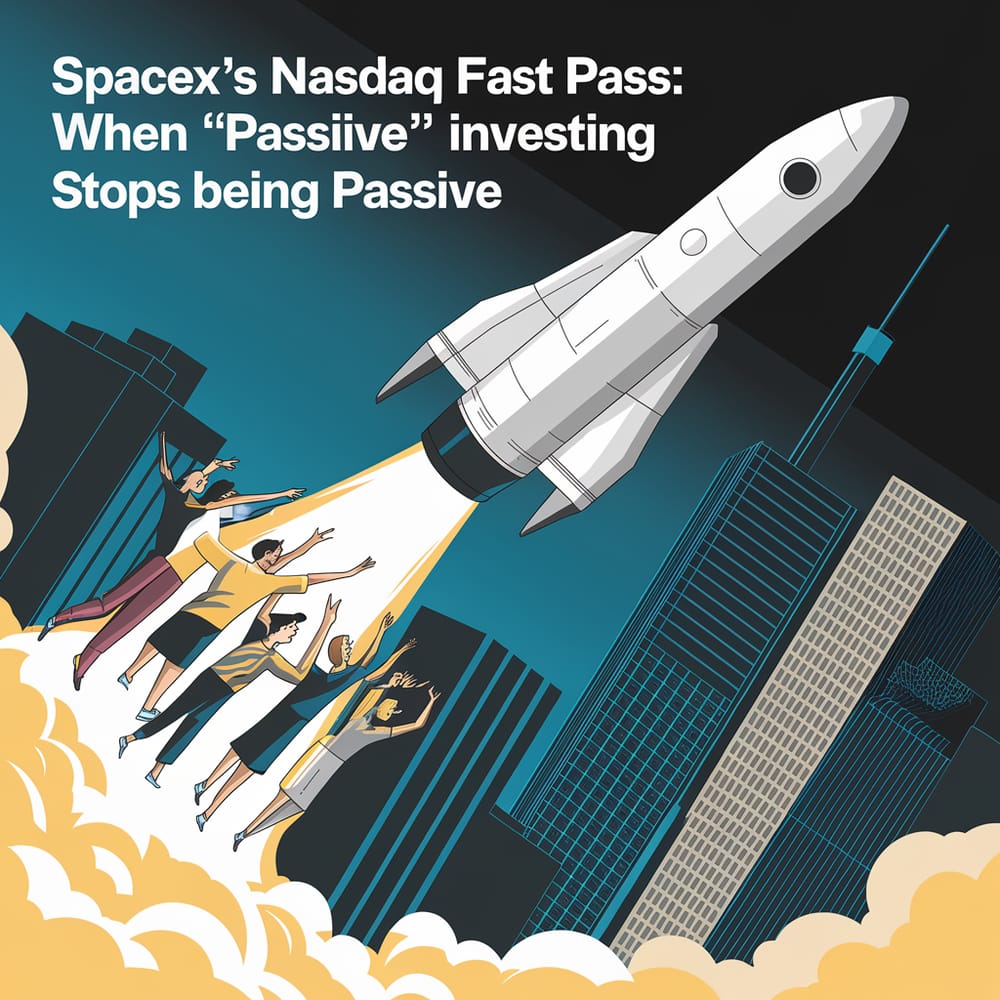
SpaceX has spent years making rockets reusable. Now it may have done something just as disruptive on Wall Street: it turned index rules into market fuel.
Less than a month after its record public debut, SpaceX is set to join the Nasdaq-100, one of the most closely watched stock indexes in the world. The market note you shared highlighted the speed of the move: index-tracking funds can begin buying after the close on July 6, with SpaceX officially joining before trading opens on July 7 — made possible by a Nasdaq rule change that lets some mega-sized IPOs qualify after just 15 trading days. Reuters also confirmed that SpaceX will be added to the Nasdaq-100 on July 7.
That may sound like a routine index update. It is not.
This is a story about how modern markets really work — where stock prices are not moved only by earnings, innovation, or investor conviction, but also by the mechanical buying power of ETFs, mutual funds, and index rules.
First, the scale is almost hard to process
SpaceX priced its IPO at $135 per share, raising a record $75 billion and valuing the company at about $1.77 trillion at the offering price. That instantly placed Elon Musk’s rocket, satellite, and AI company among the most valuable public companies in the world.
But the IPO was only the first launch.
The second launch is into the portfolios of millions of investors who may never choose SpaceX directly. Once a company enters the Nasdaq-100, funds that track the index need to own it. That includes major vehicles like Invesco’s QQQ and QQQM, which investors use to get broad exposure to large Nasdaq-listed growth companies. Reuters reported that J.P. Morgan estimates SpaceX’s Nasdaq-100 inclusion could draw about $4.3 billion in passive inflows.
In simple terms: a giant wave of buyers may be required to show up, not because they love the stock, but because the benchmark changed.
The twist: SpaceX is huge, but its tradable float is small
Here is where the story gets interesting.
A company can be worth trillions on paper, but only a small portion of its shares may actually be available for public trading. The article you shared noted that more than $800 billion tracks the Nasdaq-100, while only roughly 5% of SpaceX shares were made available to the public at listing. Reuters later reported that SpaceX had a market capitalization around $2 trillion, but only about $100 billion of shares listed for trading, with the rest held by Musk, insiders, and employees.
That creates a powerful supply-demand setup.
Imagine a stadium with 70,000 people trying to get through one small door. The stadium is massive, but the doorway controls the flow. SpaceX may be a mega-cap company, but its available trading supply is much smaller than its headline valuation suggests.
That helps explain the early volatility. Reuters reported that SpaceX surged 67% from its $135 IPO price to an intraday high of $225.64, then cooled back to $153.23 by June 27.
In other words, this is not just a rocket story. It is a liquidity story.
Nasdaq opened the fast lane
Nasdaq’s fast-entry rule was designed for a market where companies stay private much longer and arrive on public exchanges already enormous. Under the new framework, Nasdaq can evaluate a newly listed company on its seventh trading day and fast-track it into the Nasdaq-100 after the 15th trading day if it ranks among the top 40 by market capitalization and meets the other requirements. Nasdaq also removed a previous rule requiring companies to float at least 10% of their shares, though low-float companies receive lower index weighting.
That rule change matters far beyond SpaceX.
OpenAI, Anthropic, and other large private technology companies may eventually face similar decisions. If the next generation of trillion-dollar companies enters public markets with limited floats, index providers will have to decide whether to include them quickly or wait for more trading history.
Nasdaq chose speed.
S&P chose caution
The S&P 500 is taking a different approach.
S&P Dow Jones Indices decided not to fast-track “MegaCap” IPOs into the S&P 500, S&P MidCap 400, or S&P SmallCap 600. AP reported that S&P kept its existing requirements, including profitability standards and a rule that IPO companies must trade on an eligible exchange for at least 12 months before they can be considered.
That difference is important.
A Nasdaq-100 fund may soon give investors SpaceX exposure. An S&P 500 fund will not — at least not yet.
So when investors say they “own the market,” the next question should be: which market? Index rules decide what gets included, what gets excluded, and when billions of dollars move.
The lesson for investors
SpaceX may be one of the most exciting companies in the world. It operates at the intersection of space launches, satellite internet, artificial intelligence, and long-term infrastructure. But excitement and index inclusion are not the same thing as valuation discipline.
Index buying can support demand. A thin float can magnify price moves. A famous founder can attract attention. But none of those factors replaces earnings, cash flow, governance, and execution.
That is the key lesson for investors: passive buying can move a stock, but it cannot guarantee that the stock is fairly priced.
Reuters reported that SpaceX lost $4.9 billion last year, even as investors continue to bet on its future dominance in satellite internet, AI, and commercial space launches. That does not mean the company is doomed. It means the market is being asked to price a very ambitious story before the public-company track record has fully developed.
Why this matters beyond SpaceX
SpaceX’s Nasdaq-100 entry may be remembered as more than a big moment for one company. It may be remembered as a turning point in how public markets absorb mega-sized private companies.
For years, investors have complained that the best growth stories stay private too long. By the time ordinary investors can buy shares, much of the early value creation has already happened behind closed doors. Nasdaq’s rule change is one attempt to make major new public companies visible inside indexes faster.
But faster inclusion also brings trade-offs. It can send billions of dollars into companies with limited trading history, limited float, and valuations that may still be difficult to test.
That is why SpaceX’s index debut is so fascinating. It shows both sides of the new market reality: more access, but also more complexity.
The Protector takeaway
SpaceX did not just join an index. It exposed the machinery behind the market.
Millions of investors may soon own SpaceX indirectly through ETFs and mutual funds, whether they personally researched the company or not. The original article summed up that point clearly: for passive investors, Nasdaq-100 inclusion means SpaceX exposure could land in portfolios automatically, and the mechanics of how that exposure is built may matter as much as the headline itself.
That is the real story.
In today’s market, “passive” investing is not passive in its impact. Index rules can create demand. Low float can amplify volatility. And a single methodology change can turn a newly public company into a must-own position for funds around the world.
SpaceX may still need to prove that its valuation is justified. But one thing is already clear: Wall Street’s next frontier is not only in space. It is in the rules that decide where the money flows.
This article is for educational purposes only and should not be considered financial advice.
© Copyright 2024. All Rights Reserved.
© Copyright 2024. All Rights Reserved.